In milestone decision, UN creates institution for Syria’s missing and disappeared

Families and relatives of Syrian detainees and missing people demand information on their loved ones, in the town of Azaz in Aleppo province. (AFP)
Short Url
Updated 30 June 2023
Follow

In milestone decision, UN creates institution for Syria’s missing and disappeared

  • 83 states voted in favor of adopting the resolution to establish an institution to clarify the fate of the missing, 11 against, and 62 abstained
  • More than 150,000 Syrians have gone missing or been forcibly disappeared during 12 years of civil war in the country

NEW YORK CITY: In a milestone decision as part of the international response to the war in Syria, the UN General Assembly on Thursday voted to establish an independent institution to investigate and clarify the fate of more than 150,000 Syrians who have gone missing or been forcibly disappeared at the hands of the Syrian regime, opposition forces, or terrorist groups since the conflict began 12 years ago.
Introducing the draft resolution, Luxembourg’s permanent representative to the UN, Olivier Maes, paid tribute to the “strength and courage” of Syrian families who have “been desperately seeking to find out what happened to their loved ones and where they are every day.”
He added: “Families, especially women, face administrative and legal difficulties, financial uncertainties and deep trauma as they continue to search for their missing loved ones.”
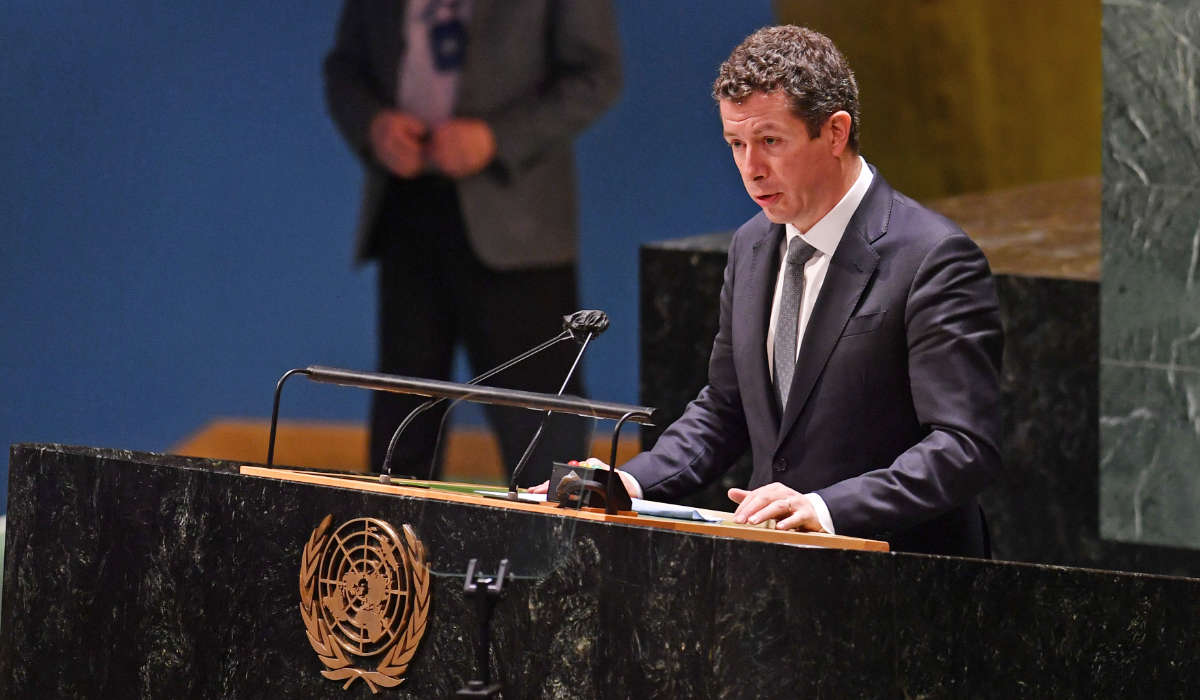


Olivier Maes, Luxembourg’s Ambassador and Permanent Representative to the United Nations. (AFP)

A large number of international, nongovernmental, humanitarian, and family-focused organizations — including the International Committee of the Red Cross, the International Commission on Missing Persons, and the Independent International Commission of Inquiry on the Syrian Arab Republic — investigate and follow up on missing-persons cases in Syria.
However, a lack of coordination leaves families in limbo as they seek information about the whereabouts of loved ones, and victims and survivors unsure of where to share any details they might have.
Families have been pushing for the establishment of a dedicated, independent, international agency, commensurate with the scale and complexity of the crisis, to investigate the fate of loved ones.
Guided by their views and advice, the UN secretary-general published a report last year that concluded such an international institution, equipped with a robust mandate to investigate and clarify the fate of the missing and provide support for their families, would be the cornerstone of a comprehensive solution to the crisis.
The resultant resolution was sponsored by more than 50 countries including Albania, Australia, Denmark, the Dominican Republic, Estonia, Finland, France, Georgia, Germany, Greece, Iceland, Ireland, Israel, Italy, Latvia, Liberia, Liechtenstein, Lithuania, Luxembourg, Malta, Slovenia and Spain.
Maes said the new institution “will reinforce complementarity and avoid duplication, (serve) as a single point of entry for collecting and comparing data, (and) ensure coordination and communication with all relevant actors and ongoing initiatives.”
He stressed that the resolution “does not point the finger at anyone” and added: “It has only one goal and that is a humanitarian goal: Improve the situation of Syrian families who do not know what has happened to their brother, to their son, father, husband or other relative, alleviate the suffering of these victims by providing them with the support that they need and the responses to which they’re entitled under international humanitarian law.”
A representative of the EU expressed hope that “this new humanitarian institution can help heal some of the wounds of 12 years of conflict. And in so doing, that it will play an important role in contributing to efforts toward reconciliation and sustainable peace.”
US ambassador Jeffrey De Laurentis, reiterated that the resolution is humanitarian in nature and added: “It is focused on all missing Syrians, regardless of ethnicity, religion or political affiliation.
“Many Syrians have asked us to remember who this institution seeks to defend — the humans missing and detained with a full life yet to live. They are not statistics, they are spouses, children, siblings, parents, friends, colleagues.
“As their harrowing testimonies show, we must deliver long-overdue answers to the victims and their families who deserve our support.”
De Laurentis noted that Damascus had refused to engage with efforts to create the institution.
Russia’s deputy permanent representative to the UN, Maria Zabolotskaya, said that the General Assembly, “in violation of the UN Charter, is today being invited to create an instrument of pressure on Syria under a cynical humanitarian pretext, which has nothing to do with the true objectives of this enterprise.”
She added that far from being independent or impartial, the mechanism “can only obediently fulfill the orders of its sponsors” and insisted that “in order to truly solve the problem of missing persons, developing substantive cooperation with Damascus is necessary, as is providing it with effective assistance and lifting illegal and unilateral sanctions that negatively affect these efforts, as well as humanitarian recovery on the whole.”
She also called for an end to “foreign occupation of the country” and the repatriation of “foreign citizens present there.”
Bassam Sabbagh, Syria’s permanent representative to the UN, said the resolution is “politicized and targets the Syrian Arab Republic.”
He added: “This draft clearly reflects flagrant interference in our internal affairs and provides new evidence of the hostile approach being pursued by certain Western states against Syria. At the heart of this group is the United States.”


Syrian army continues advance against Kurdish-held towns despite US calls against it

Updated 4 sec ago
Follow

Syrian army continues advance against Kurdish-held towns despite US calls against it

  • Kurdish forces say Syrian army breached withdrawal deal
  • US envoy meets with Kurdish leaders in Irbil

DEIR HAFER, Syria: The Syrian army continued its push into Kurdish-held territory on Saturday, despite US calls to halt its advance in towns in the area in Syria’s north.

State media said the army took over the northern city of Tabqa and its adjacent dam, as well as the major Freedom dam, formerly known as the Baath, west of the Syrian city of Raqqaa.

Syrian Kurdish authorities had not acknowledged their loss of control over those strategic points, and it was unclear if fighting was still ongoing.

For days, Syrian troops had amassed around a cluster of villages that lie just west of the winding Euphrates and had called on the Kurdish-led Syrian Democratic Forces stationed there to redeploy their forces on the opposite bank of the river. They have been clashing over strategic posts and oilfields along the Euphrates River.

SDF fighters withdrew from the area early on Saturday as a gesture of goodwill — but then accused Syrian troops of violating the agreement by continuing to push further east ‌into towns and oilfields not ‌included in the deal.

Brad Cooper, who heads the US military’s Central Command, said in ‌a ⁠written statement ​posted on ‌X that Syrian troops should “cease any offensive actions in areas” between the city of Aleppo and the town of Tabqa, approximately 160 kilometers further east.

Arab residents rejoice at troops’ arrival

The initial withdrawal deal included the main town of Deir Hafer and some surrounding villages whose residents are predominantly Arab. The SDF withdrew on Saturday and Syrian troops moved in relatively smoothly, with residents celebrating their arrival.

“It happened with the least amount of losses. There’s been enough blood in this country, Syria. We have sacrificed and lost enough — people are tired of it,” Hussein Al-Khalaf, a resident of Deir Hafer, told Reuters.

The Syrian Petroleum Company said that the nearby oilfields of Rasafa and Sufyan had been captured by Syrian troops and could now be brought ⁠back online.

SDF forces had withdrawn east, some on foot, toward the flashpoint town of Tabqa — downstream but still on the western side of the river and near a hydroelectric dam, a ‌crucial source of power.

But when Syria’s army announced it aimed to capture Tabqa next, the ‍SDF said that was not part of the original deal ‍and that it would fight to keep the town, as well as another oilfield in its vicinity.

Syria’s army said four of its ‍troops had been killed in attacks by Kurdish militants, and the SDF said some of its own fighters had been killed, but did not give a number.

US-led coalition planes flew over the flashpoint towns, releasing warning flares, according to a Syrian security source.

The US has had to recalibrate its Syria policy to balance years of backing for the SDF — which fought against the Daesh — against Washington’s new support for Syrian President Ahmed Al-Sharaa, whose rebel forces ousted dictator ​Bashar Assad in late 2024.

Main oilfields are still under Kurdish control

To try to end the fighting, US envoy Tom Barrack traveled to Irbil in northern Iraq on Saturday to meet with both Abdi and Iraqi Kurdish leader Masoud ⁠Barzani, according to two Kurdish sources. There was no immediate comment from Barrack’s spokesperson.

The latest violence has deepened the faultline between the government led by Sharaa, who has vowed to reunify the fractured country after 14 years of war, and local Kurdish authorities wary of his Islamist-led administration.

The two sides engaged in months of talks last year to integrate Kurdish-run military and civilian bodies into Syrian state institutions by the end of 2025, repeatedly saying that they wanted to resolve disputes diplomatically. But after the deadline passed with little progress, clashes broke out earlier this month in the northern city of Aleppo and ended with a withdrawal of Kurdish fighters. Syrian troops then amassed around towns in the north and east to pressure Kurdish authorities into making concessions in the deadlocked talks with Damascus.

Kurdish authorities still hold Arab-majority areas in the country’s east that are home to some of Syria’s largest oil and gas fields. Arab tribal leaders in SDF-held territory have told Reuters they are ready to take up arms against the Kurdish force if Syria’s army issues orders to do so. Kurdish fears have been deepened by bouts of sectarian violence last year, when nearly 1,500 Alawites were killed ‌by government-aligned forces in western Syria and hundreds of Druze were killed in southern Syria, some in execution-style killings.