Traumatized Syrians face major mental health issues with little care available

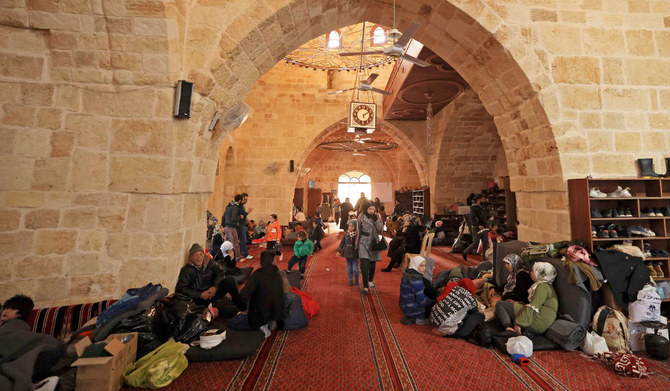
Displaced Syrians take refuge at the Sultan Ibrahim Mosque in the regime-controlled town of Jableh, northwest of the capital Damascus, on February 12, 2023 following a deadly earthquake in Turkey and Syria. (AFP)
Short Url
Updated 29 June 2023
Follow

Traumatized Syrians face major mental health issues with little care available

  • Years of war, and the earthquakes in February, have taken a deep psychological toll on people, delegates at a conference in Washington heard
  • Charitable organization MedGlobal said there has been ‘a severe psychological impact’ on civilians, resulting in depression, anxiety and PTSD

WASHINGTON: After more than a decade of civil war, the devastating earthquakes in Syria this year inflicted further trauma on an already vulnerable population, experts said during a conference in the US on Wednesday.
Many Syrians are not only suffering the physical effects of the crises in their country but also severe mental repercussions, including post-traumatic stress disorder, that are taking a deep psychological toll on Syrian society as a whole and those in the northwest in particular.
The knock-on effects of this mental health crisis, which affects not only victims of the conflict and the natural disaster but also those who provide them with healthcare, include substance abuse of drugs such as the amphetamine Captagon, narcotics and pain medications.
These effects are observed across many segments of Syrian society, according to medical and social experts who shared their experiences and findings during Wednesday’s event, which was organized by the Middle East Institute in Washington and attended by Arab News.
As the civil war approached the end of its 12th year, two earthquakes, of magnitude 7.8 and 7.5, caused devastating damage to parts of northern Syria and southern Turkiye on Feb. 6.
According to report by MedGlobal, a charitable, non-governmental organization that provides emergency humanitarian aid and healthcare, the “Syrian conflict has had a severe psychological impact on its civilians, resulting in high levels of mental health problems such as depression, anxiety and post-traumatic stress disorder.”
It added that many Syrians have experienced traumatic events such as bombings, shootings and forced displacement, which have contributed to mental health issues. The lack of access to adequate mental healthcare and support has exacerbated the psychological effects of the war on the population.
The conference heard that almost half of the Syrian population, and especially those worst-affected by the earthquakes, is suffering from some degree of mental disorders, and many have developed severe condition and show the full symptoms of PTSD.
Dr. Nora Abdullah, a psychiatry resident at Yale New Haven Hospital in Connecticut and a MedGlobal volunteer, said there is an acute mental health crisis in the parts of northwestern Syria that are outside the control of the Syrian regime, with only two psychiatrists to serve a population of about 3.5 million people.
She described the scale of the crisis as “staggering” and said a “telehealth” approach, using technology to provide treatment and support services to patients and to medical staff working under highly stressful conditions, who often fall victim to mental health issues themselves, is helping to compensate for this lack of mental health professionals in parts of Syria.
Dr. Dania Albaba, a psychiatry resident at Baylor College of Medicine in Houston, Texas, and a volunteer and report author for MedGlobal, said “psychological first aid” is being used in the field in Syria to help people recognize the warning signs of mental trauma and disorders, and teach them what they can do to address them.
“We know emergency mental health aid is very valuable and is needed in the immediate aftermath of an earthquake, or any crisis,” she added.
Alex Mahoney, acting director for the Middle East, North Africa and Europe at the US Agency for International Development’s Bureau for Humanitarian Assistance, said that in addition to supporting the provision of emergency mental health treatment, the agency is also helping to provide psycho-social support services for the Syrian people, including material aid and training for displaced refugees.
He acknowledged that the region remains “a dangerous environment,” especially for organizations with direct links to the US, and so USAID works with the UN and is careful not to reveal the identities of those who help it distribute aid to communities.
He also spoke about “telehealth” and said it is one of the services his agency provides, through the work of specialist partners.
Natasha Hall, a senior fellow with the Middle East Program at the Center for Strategic and International Studies in Washington, said the situation in northwestern Syria is dire, especially since the earthquakes. Between 60 and 85 percent of people are unemployed and about 9,000 who did have jobs have lost them because of funding cuts by international donors, she added.
International aid and funding for refugees in the country is drying up yet the situation Syrians find themselves in has not improved in years, said Hall.
“This population is completely dependent on humanitarian aid,” she added.


Lebanon approves financial gap draft law despite opposition from Hezbollah and Lebanese Forces

Lebanon's Prime Minister Nawaf Salam speaking during a press conference after a cabinet session in Beirut on December 26, 2025.
Updated 21 min 28 sec ago
Follow

Lebanon approves financial gap draft law despite opposition from Hezbollah and Lebanese Forces

  • Legislation aims to address the fate of billions of dollars in deposits that have been inaccessible to Lebanese citizens during the country’s financial meltdown

BEIRUT: Lebanon’s Cabinet on Friday approved a controversial draft law to regulate financial recovery and return frozen bank deposits to citizens. The move is seen as a key step in long-delayed economic reforms demanded by the International Monetary Fund.

The decision, which passed with 13 ministers voting in favor and nine against, came after marathon discussions over the so-called “financial gap” or deposit recovery bill, stalled for years since the banking crisis erupted in 2019. The ministers of culture and foreign affairs were absent from the session.

The legislation aims to address the fate of billions of dollars in deposits that have been inaccessible to Lebanese citizens during the country’s financial meltdown.

The vote was opposed by three ministers from the Lebanese Forces Party, three ministers from Hezbollah and the Amal Movement, as well as the minister of youth and sports, Nora Bayrakdarian, the minister of communications, Charles Al-Hajj, and the minister of justice, Adel Nassar.

Finance Minister Yassin Jaber broke ranks with his Hezbollah and Amal allies, voting in favor of the bill. He described his decision as being in line with “Lebanon’s supreme financial interest and its obligations to the IMF and the international community.”

The draft law triggered fierce backlash from depositors who reject any suggestion they shoulder responsibility for the financial collapse. It has also drawn strong criticism from the Association of Banks and parliamentary blocs, fueling fears the law will face intense political wrangling in Parliament ahead of elections scheduled in six months.

Prime Minister Nawaf Salam confirmed the Cabinet had approved the bill and referred it to Parliament for debate and amendments before final ratification. Addressing public concerns, he emphasized that the law includes provisions for forensic auditing and accountability.

“Depositors with accounts under $100,000 will be repaid in full with interest and without any deductions,” Salam said. “Large depositors will also receive their first $100,000 in full, and the remainder will be issued as negotiable bonds backed by the assets of the Central Bank, valued at around $50 billion.”

He said further that bondholders will receive an initial 2 percent payout after the first tranche of repayments is completed.

The law also includes a clause requiring criminal accountability. “Anyone who smuggled funds abroad or benefited from unjustified profits will be fined 30 percent,” Salam said.

He emphasized that Lebanon’s gold reserves will remain untouched. “A clear provision reaffirms the 1986 law barring the sale or mortgaging of gold without parliamentary approval,” he said, dismissing speculation about using the reserves to cover financial losses.

Salam admitted that the law was not perfect but called it “a fair step toward restoring rights.”

“The banking sector’s credibility has been severely damaged. This law aims to revive it by valuing assets, recapitalizing banks, and ending Lebanon’s dangerous reliance on a cash economy,” he said. “Each day of delay further erodes people’s rights.”

While the Association of Banks did not release an immediate response after the vote, it previously argued during discussions that the law would destroy remaining deposits. Bank representatives said lenders would struggle to secure more than $20 billion to cover the initial repayment tier and accused the state of absolving itself of responsibility while effectively granting amnesty for decades of financial mismanagement and corruption.

The law’s fate now rests with Parliament, where political competition ahead of the 2025 elections could complicate or delay its passage.

Lebanon’s banking sector has been at the heart of the country’s economic collapse, with informal capital controls locking depositors out of their savings and trust in state institutions plunging. International donors, including the IMF, have made reforms to the sector a key condition for any financial assistance.