

Netanyahu ‘drops part of judicial overhaul’

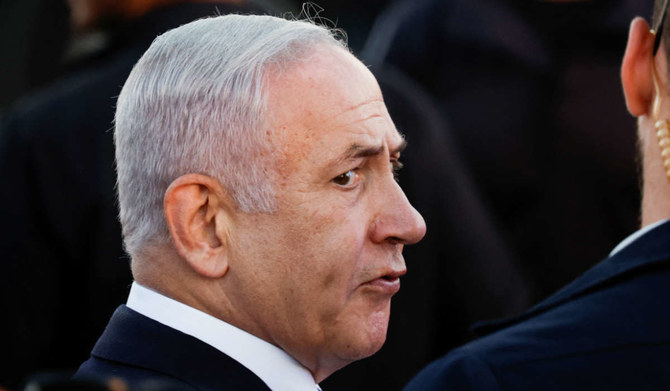
Israeli Prime Minister Benjamin Netanyahu looks on during a graduation ceremony for Israeli Air Force pilots at Hatzerim Airbase, in southern Israel, June 29, 2023. (REUTERS)
Short Url
Updated 30 June 2023
Follow

Netanyahu ‘drops part of judicial overhaul’

  • “The way of choosing judges is not going to be the current structure but it’s not going to be the original structure,” Netanyahu said

JERUSALEM: Prime Minister Benjamin Netanyahu said he has dropped a central element of a bitterly contested plan to roll back Supreme Court powers that has roiled Israel for months, though he was still pursuing changes to the way judges are selected.
In a filmed interview posted on the Wall Street Journal website on Thursday, Netanyahu said he was no longer seeking to grant parliament the authority to overturn Supreme Court rulings.
“I threw that out,” Netanyahu said of the highly disputed “override clause.”
He said that another part of his nationalist-religious government’s plan that would give the ruling coalition decisive sway in appointing judges will be changed but not scrapped.

FASTFACT

Benjamin Netanyahu’s remarks upset his far-right minister Itamar Ben-Gvir, who accused the Israeli prime minister of caving to protesters.

“The way of choosing judges is not going to be the current structure but it’s not going to be the original structure,” Netanyahu said.
Netanyahu’s remarks upset his far-right police minister Itamar Ben-Gvir, who accused the premier of caving to protesters.
“We were elected to bring governance and change, the reform is a cornerstone of this promise,” Ben-Gvir tweeted.
Netanyahu’s government unveiled its plan to overhaul Israel’s justice system in January soon after it came to power, saying the Supreme Court had been increasingly encroaching into political areas where it had no authority.
The plan triggered mass protests, with critics saying it was a threat to democracy.
Washington urged Netanyahu to seek broad agreements over reforms instead of rapidly driving unilateral changes it said would compromise Israel’s democratic health.
After weeks of demonstrations and with financial markets increasingly nervous over the proposed changes and the ensuing political upheaval, Netanyahu paused the plan in late March for compromise talks with the opposition.
But after those talks were suspended this month, Netanyahu said he would press on with judicial changes.
His coalition began work this week on a new bill that would reduce Supreme Court power to rule against the government by limiting “reasonableness” as a standard of judicial review.
Opposition leaders offered no immediate reaction to the latest comments by Netanyahu, who is on trial on corruption charges he denies. His office did not offer additional details.


Soleimani warned Al-Assad about ‘spy’ Luna Al-Shibl: Al-Majalla

Updated 59 min 27 sec ago
Follow

Soleimani warned Al-Assad about ‘spy’ Luna Al-Shibl: Al-Majalla

LONDON: The late Iranian General Qassem Soleimani confronted Syria’s National Security Bureau chief Ali Mamlouk in late 2019 after seeing Luna Al-Shibl leaving his office. Al-Majalla magazine claims its reporters reviewed a document containing the full Arabic transcript of their exchange.

Soleimani reportedly asked, “Who is this?” and Mamlouk replied, “She is Louna Al-Shibl, the president’s adviser.”

The Quds Force commander pressed further: “I know, I know… but who is she really? Where did she work?”

According to Al-Majalla, a sister publication of Arab News, he said her former salary was “ten thousand dollars,” compared with her current salary of “five hundred thousand Syrian pounds,” before asking: “Does it make sense for someone to leave ten thousand dollars for five hundred thousand pounds? She is a spy.”

Both Soleimani and Maher Al-Assad, commander of the Syrian army’s powerful Fourth Division, had warned the ousted president’s inner circle about Al-Shibl, Al-Majalla reported.

‘Suspicious’ car crash

On July 2, 2024, Al-Shibl was involved in what officials described as a traffic accident on the Damascus-Dimas highway. She was hospitalized and died four days later.

But Al-Majalla reported that photos of her armored BMW showed only minor damage, raising immediate questions among those close to the case.

Eyewitnesses told the magazine that the crash was intentional. One said, “a car approached and rammed her vehicle,” and before her bodyguard could exit, “a man attacked her and struck her on the back of the head,” causing paralysis that led to her death.

She was first taken to Al-Saboura clinic, then transferred to Al-Shami Hospital. Several senior regime-linked figures, including businessman Mohammed Hamsho and an aide to Maher Al-Assad, were present when her condition deteriorated. One witness told Al-Majalla that when her bodyguard tried to explain what had happened, “he was arrested immediately in front of the others.”

The presidency later issued a brief statement announcing her death. Her funeral was attended only by a handful of officials. Then president Al-Assad did not attend.