

Lebanon economic crisis worsened by vested interests, IMF says

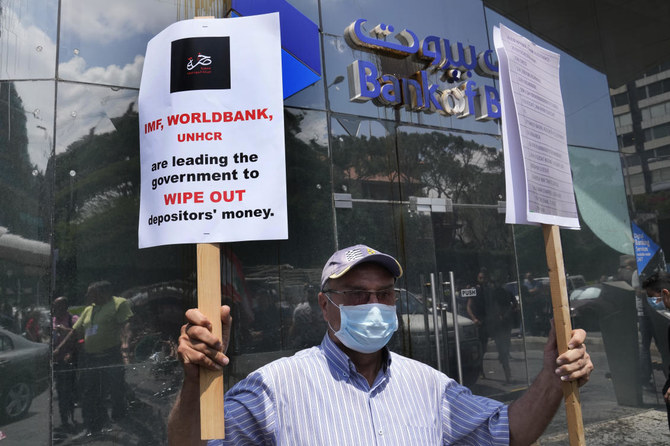
A protester holds placards outside Bank of Beirut during a protest demanding the release of depositors' trapped savings, in Beirut, Lebanon. (File/AP)
Short Url
Updated 29 June 2023
Follow

Lebanon economic crisis worsened by vested interests, IMF says

  • Lebanon signed an agreement with the IMF in April 2022 but has not met the conditions to secure a full $3 billion financing program
  • The IMF said that without reforms, public debt could reach 547 percent of GDP by 2027


BEIRUT: Lebanon’s financial crisis has been aggravated by vested interests resisting crucial reforms, the International Monetary Fund (IMF) said on Thursday, warning that no action could lead the country “down an unpredictable road.”
The nearly four-year economic meltdown has cost the local currency roughly 98 percent of its value, seen GDP contract by 40 percent, pushed inflation into triple-digits and drained two-thirds of the central bank’s foreign currency reserves, the IMF said.
The figures came as part of its Article IV report, a comprehensive assessment of Lebanon’s finances.
The IMF said the crisis had been compounded “by a failure to take much needed policy action, hampered by a lasting political crisis and resistance from vested interests to reforms.”
Lebanon signed an agreement with the IMF in April 2022 but has not met the conditions to secure a full $3 billion financing program, seen as crucial to a recovery from one of the worst economic collapses in modern history.
The IMF said the steps Lebanon had tried so far, including the 2022 budget and a banking secrecy law fell short of the advice given by IMF staff or the expectations discussed.

BACKGROUND

The IMF report said current public debt above 280 percent of GDP was already ‘unsustainable,’ and without reforms it could reach 547 percent by 2027.

The IMF said the steps Lebanon had tried so far, including the 2022 budget and a banking secrecy law, fell short of the advice given by IMF staff, or their expectations.

Mission chief Ernesto Rigo told reporters that Lebanon’s leaders may face a “temptation” to avoid difficult political decisions and may hope the economy stabilizes without reforms, but that it would come at a “very high cost.”
“The situation is very dire,” he said.
The report said delayed reforms had led to a decrease in the foreign currency deposits that could eventually be recovered when the banking sector is restructured, with depositors effectively having lost $10 billion compared to 2020.
Lebanese politicians often say depositors’ rights must be preserved in any plan to address losses of some $70 billion in the financial system.
The IMF said that without reforms, public debt could reach 547 percent of GDP by 2027. It said current debt levels, above 280 percent of GDP, were already “unsustainable.”
“The continuation of the status quo presents the largest risk to Lebanon’s economic and social stability, taking the country down an unpredictable road,” the report said, adding the central bank needed new policies on conflicts of interest, more autonomy from government and more accountability.


Death toll in Iran protests over 3,000, rights group says

Updated 17 January 2026
Follow

Death toll in Iran protests over 3,000, rights group says

  • The protests erupted on December 28 over economic hardship and swelled into widespread demonstrations calling for the end of clerical rule
  • President Donald Trump, who had threatened ‘very strong action’ if Iran executed protesters, said Tehran’s leaders had called off mass hangings

DUBAI: More than 3,000 people have died in Iran’s nationwide protests, rights activists said on Saturday, while a “very slight rise” in Internet activity was reported in the country after an eight-day blackout.

The US-based HRANA ​group said it had verified 3,090 deaths, including 2,885 protesters, after residents said the crackdown appeared to have broadly quelled protests for now and state media reported more arrests.

The capital Tehran has been comparatively quiet for four days, said several residents reached by Reuters. Drones were flying over the city, but there were no signs of major protests on Thursday or Friday, said the residents, who asked not to be identified ‌for their safety.

A ‌resident of a northern city on the ‌Caspian ⁠Sea ​said ‌the streets there also appeared calm.

The protests erupted on December 28 over economic hardship and swelled into widespread demonstrations calling for the end of clerical rule in the Islamic Republic, culminating in mass violence late last week. According to opposition groups and an Iranian official, more than 2,000 people were killed in the worst domestic unrest since Iran’s 1979 Islamic Revolution.

“Metrics show a very ⁠slight rise in Internet connectivity in #Iran this morning” after 200 hours of shutdown, the ‌Internet monitoring group NetBlocks posted on X. Connectivity ‍remained around 2 percent of ordinary levels, ‍it said.

A few Iranians overseas said on social media that ‍they had been able to message users living inside Iran early on Saturday.

US President Donald Trump, who had threatened “very strong action” if Iran executed protesters, said Tehran’s leaders had called off mass hangings.

“I greatly respect the fact that all scheduled ​hangings, which were to take place yesterday (Over 800 of them), have been canceled by the leadership of Iran. Thank you!” he ⁠posted on social media.

Iran had not announced plans for such executions or said it had canceled them.

Indian students and pilgrims returning from Iran said they were largely confined to their accommodations while in the country, unable to communicate with their families back home.

“We only heard stories of violent protests, and one man jumped in front of our car holding a burning baton, shouting something in the local language, with anger visible in his eyes,” said Z Syeda, a third-year medical student at a university in Tehran.

India’s External Affairs Ministry said on Friday that commercial flights were available and that ‌New Delhi would take steps to secure the safety and welfare of Indian nationals.