In Pakistan's Gujrat, families of Greece shipwreck victims face grim Eid, lifetime of mourning

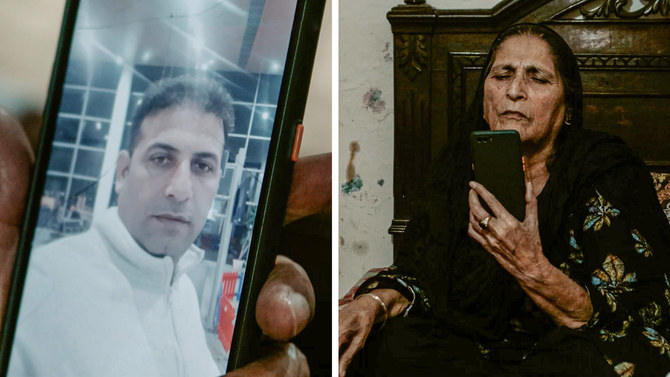
The collage of photos shows Maryam, the mother of Muhammad Tahir, who was among at least 350 Pakistanis on board a boat that capsized and sank in open seas off Greece in June 2023. (AN photo)
Short Url
Updated 29 June 2023
Follow

In Pakistan's Gujrat, families of Greece shipwreck victims face grim Eid, lifetime of mourning

  • At least 350 Pakistanis were onboard overloaded boat that sank in open seas off Greece earlier this month
  • Around 90 men from the Pakistani city of Gujrat were onboard, each having paid $7,000 to human smugglers

GUJRAT: The last time Muhammad Tayyab heard his father’s voice, it was in a voice note sent on June 9 in which Muhammad Tahir said:

“Assalaam-Alaikum, my son, we have boarded the ship, just keep praying.”

Tahir, 42, was among at least 350 Pakistanis onboard an overloaded boat that capsized and sank in open seas off Greece earlier this month, along the world's most deadly migration route from Libya to Italy. There were 750 illegal migrants in total on the vessel, with only 104 survivors and 78 people who drowned brought to shore by Greek authorities. Nothing has been found since.

“[We] have no Eid, what is Eid without a father," Tayyab told Arab News outside his small house in the Pakistani city of Gujrat, believed to be a notorious hub for human traffickers. "We pray to Allah for a miracle."

Pakistanis have increasingly been making perilous sea journeys in recent months amid skyrocketing inflation, joblessness and other economic hardships. From Gujrat district alone, at least 90 people, including Tahir and his brother Qaisar, left home on April 15, flying from Islamabad airport to Karachi to Dubai, Egypt, and finally Libya, where they boarded the doomed vessel in June. Each of the men from Gujrat had paid around $7,000 to traffickers and now all 90 are missing and presumed dead, highlighting the perils faced by people who seek to enter Europe illegally.

“It was his mission to take his children there for their better future,” Tayyab said about why his father choose the illegal migration route.

“But I'll advise people, don't go through this route. It's a very dangerous route and mothers don't get their beloved ones back through this route. It is a dangerous route and agents there intentionally do all this.”

According to local estimates, at least one member from each family in Gujrat district lives and works in Europe and sends back remittances, inspiring confidence among others in the area that they too could use traffickers to seek a better life abroad.

In fact, Tahir had himself successfully traveled to Germany via a boat around 15 years ago and afterwards, helped three of his brothers migrate to the country as well. Two of them, Faisal and Sheraz, are now legal residents of Italy while Tahir was deported to Pakistan from Germany in April 2023 as he still did not have valid documents

Immediately upon returning, he wasted no time in planning to go back.

“They [Tahir and Qaisar] asked us to pray for them, that we are leaving now and your prayers will help us reach our destination,” Tahir’s mother, who only identified herself by her first name, Maryam, told Arab News, surrounded by her grandsons and daughters, an entire family in mourning.

Sixty-eight-year-old Mohammad Deen was also grieving, but said he was still waiting for news from his stepson, Muhammad Faizan Ali, 22, whose elder daughter had sold agricultural land to pay Rs2.35 million (over $7,000) to a local smuggler so Ali could travel to Italy.

“He was adamant to go abroad, he would say, send me, I want to go to Italy, that I have to take care of my home's resources,” Deen said. “He said nothing else but insisted that we send him as quickly as possible.”

Sitting on a worn-out sofa in his drawing room, Deen said the community would not be celebrating Eid this year.

“What is our Eid, Eid is happiness and what is our happiness,” he asked. “It has been twelve, thirteen days. Whenever we remember him, we grieve and shed tears.”

Tahir Manda, an ex-municipal mayor of Gujrat, said every house in the city was in mourning:

“We cannot even feel it, … we cannot even narrate it. They [the grieved families] have lost their sleep, don’t know where their children are,” he said.

“Agent mafia, what is it to them, they have already fled after fleecing them but what will happen to the families whose loved ones are missing or dead?”


Pakistan’s deputy PM says country will not send forces to Gaza to disarm Hamas

Updated 9 sec ago
Follow

Pakistan’s deputy PM says country will not send forces to Gaza to disarm Hamas

  • Ishaq Dar says Pakistan open to peacekeeping but Gaza’s internal security is Palestinian responsibility
  • Pakistan’s top religious clerics from different schools have warned against sending forces to Palestine

ISLAMABAD: Deputy Prime Minister Ishaq Dar said on Saturday Pakistan was willing to contribute to an international peacekeeping force in Gaza, though it would not deploy troops to disarm or de-weaponize Hamas.

The statement follows media reports saying Washington views Pakistan as a potentially significant contributor given its battle-hardened military and wants it to be part of International Stabilization Force (ISF), which is part of United States President Donald Trump’s 20-point framework for a Gaza peace plan.

The plan announced by Trump at the White House on September 29 was formally adopted at the Sharm El-Sheikh Peace Summit in October. Co-chaired by Trump and Egyptian President Abdel Fattah El-Sisi, the summit brought together leaders from 27 countries to sign the “Trump Declaration for Enduring Peace and Prosperity.”

Deployment of troops from Muslim-majority countries during a transitional stabilization phase is a key part of the plan before the war-ravaged Palestinian territory moves toward reconstruction and a longer-term political settlement.

“If they say that we should go and start fighting, disarm Hamas, de-weaponize them, and go and destroy the tunnels that Hamas has built until now, that is not our job,” Dar, who is also the country’s foreign minister, told reporters during a year-end briefing in Islamabad.

He emphasized there was clarity between Pakistan’s civil and military leadership over the matter.

“We have a very complete understanding on this matter that we cannot do that kind of work,” he added.

The deputy prime minister said Pakistan had been using the term “peacekeeping” and had never used the phrase “peace enforcement” while discussing the force.

“I have been very clear: Pakistan will be happy to join if the mandate is not peace enforcement and disarming and de-weaponizing Hamas.”

The government’s stance comes amid growing domestic pressure over the issue.

On Monday, a group of Pakistan’s top religious leaders, chaired by prominent scholar Mufti Taqi Usmani, warned the government against yielding to what they described as international pressure to send forces to Gaza.

In a joint statement from Karachi, the clerics — representing Deobandi, Barelvi, Ahl-e-Hadees and Shia schools of thought — said that Washington wanted Muslim countries to send their forces to Gaza to disarm Hamas.

“Several Muslim governments have already refused this, and pressure is being increased on Pakistan,” it added.

Addressing such concerns, Dar said Pakistan would not land its forces in Palestine to “fight Muslims.”

Israel has repeatedly called for the disarmament of Hamas as a precondition for any long-term settlement, and the United Nations Security Council has also endorsed the ISF framework in November.

However, Dar maintained during the media briefing the internal security of Gaza was the Palestinian responsibility.

“The Palestinian Authority, their government, it is their job, it is the job of their law enforcement agency,” he said

The deputy prime minister also highlighted Pakistan’s involvement in the “Arab Islamic Group of Eight,” including Saudi Arabia, Jordan, Egypt, the United Arab Emirates, Qatar, Turkiye and Indonesia, which has been coordinating on the crisis.

He said the efforts of these countries had brought some peace to Palestine and reduced bloodshed.

“Our declared policy is that there should be an independent two-state solution,” he continued while calling for pre-1967 borders.