

Fewer buyers for Eid camels as Pakistanis count the rupees 

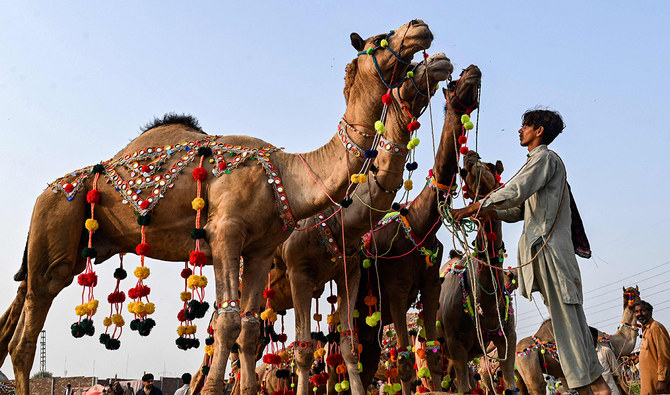
In this picture taken on June 25, 2023, a farmer holds sacrificial camels, as he waits for customers at a livestock market ahead of the Muslim festival of Eid al-Adha in Lahore. (AFP)
Short Url
Updated 28 June 2023
Follow

Fewer buyers for Eid camels as Pakistanis count the rupees 

  • Many middle-class Pakistanis will not be able to perform sacrifice amid record inflation
  • Some wealthier buyers prefer a camel sacrifice because 11 families can share its meat

ISLAMABAD: Teenager Amanullah Khan teeters on his tiptoes, daubing towering camels with festive henna patterns to entice Eid Al-Adha customers at a market near the Pakistan capital. 

Hundreds of farmers have camped at livestock markets between Islamabad and its twin city Rawalpindi for two weeks, hoping to sell animals ahead of the annual holy festival starting Thursday in Pakistan. 

But with rampant inflation — reaching a record 38 percent in May — markets are attracting smaller crowds. 

Khan’s cousin Zakaria brought 18 camels to market after good profits last year but has sold only one so far. 

“People’s purchasing power is over. Customers are not coming to the market, and those who come prefer to return empty-handed due to the high prices of the animals,” Zakaria, 21, told AFP. 

During the festival, Muslims around the world will slaughter an animal — a goat, sheep, bull or camel — keeping a third for themselves before giving a third to friends and relatives, and a third to charity. 

The ritual commemorates the readiness of Ibrahim — Abraham in the Christian and Jewish faiths — to sacrifice his son to show obedience to Allah. 

The centuries-old festival is guided by tradition, but this year many middle-class Pakistanis will not be able to perform a sacrifice. 

“Our income is the same but the prices are sky-high. From where would we get that much money?” buyer Ali Akbar, a 46-year-old builder, asked. 

Another customer, Zerak Ali, had come to enquire about the price of a camel, which can cost up to one million rupees ($3,500). 

“It is worth 700,000 for you,” Zakaria barters. But 56-year-old shopkeeper Ali leaves, leading his two grandsons toward the enclosure housing cheaper bulls. 

Camel sacrifice is not common in Pakistan, but some wealthier buyers prefer the animal because 11 families can share its meat, according to Islamic rules. 

More than 250 camels have been brought to the Islamabad market, along with thousands of bulls, cows, goats and sheep. 

Bulls cost up to 500,000 rupees, while the price of goats ranges from 50,000 to 150,000. 

Eating into Zakaria’s profits are market taxes, rising fodder and truck rental prices, as well as staff wages. 

“I will lose millions of rupees this year,” he glumly predicts. 

Bakht Zaman, a farmer from Mardan district in Pakistan’s northwest, brought 10 camels to market and has so far sold only one for 500,000 rupees. 

“The value of the Pakistani rupee has fallen,” says buyer Haq Nawaz. “Who will buy such expensive animals?” 


World Bank approves $400 million to expand water, sanitation services in Pakistan’s Punjab

Updated 4 sec ago
Follow

World Bank approves $400 million to expand water, sanitation services in Pakistan’s Punjab

  • Project aims to improve access for 4.5 million people and curb waterborne diseases
  • Program to prioritize women’s participation and climate-resilient urban infrastructure

ISLAMABAD: The World Bank this week approved $400 million for a new project to expand access to safe water, sanitation and hygiene services for around 4.5 million people in Pakistan’s most populous Punjab province, aiming to curb waterborne diseases and reduce long-term public health costs.

The project, known as the Punjab Inclusive Cities Program (PICP), is the second phase of the World Bank-supported Pakistan Urban Water, Sanitation and Hygiene Services Multiphase Programmatic Approach. It will focus on rehabilitating water supply networks, sewerage systems and wastewater treatment plants, while expanding stormwater drainage infrastructure across 16 secondary cities in Punjab.

Punjab faces persistent challenges in providing safe drinking water and adequate sanitation, with many urban households relying on contaminated sources. Weak infrastructure and limited hygiene services contribute to high rates of waterborne diseases such as diarrhea, typhoid and hepatitis, which disproportionately affect children and low-income communities.

“Reducing child stunting is essential for Pakistan’s future. Through the Punjab Inclusive Cities Program, we are investing in safe water, sanitation, and hygiene services to break the cycle of malnutrition and disease that holds back so many children from reaching their full potential,” the World Bank quoted its Country Director for Pakistan, Bolormaa Amgaabazar, as saying in a statement.

“In collaboration with the Punjab Government, the program represents a significant step forward in improving urban infrastructure and strengthening local institutions, thereby laying the foundation for healthier communities and a more prosperous Pakistan.”

Child stunting, a form of chronic malnutrition that leaves children too short for their age, is often linked to repeated infections, poor sanitation and unsafe drinking water, and remains a major public health concern in Pakistan.

Beyond water and sanitation, the project will also support solid waste management systems to improve sanitary waste disposal, extending services to an additional two million people in Punjab’s urban areas. The program will strengthen the capacity of local governments, including efforts to improve revenue generation and long-term service sustainability.

“The program complements infrastructure investments with capacity building and revenue generation, helping to ensure that service delivery is well sustained,” the statement quoted Amena Raja, Senior Urban Specialist at the World Bank, as saying.

“It will also help Punjab’s cities better withstand floods and droughts, ensuring urban development is both environmentally responsible and resilient to climate change.”

The program includes a gender-focused component, prioritizing the hiring of women in decision-making roles, establishing gender-compliant service desks and supporting skills development. It also aims to mobilize private capital to support water and sanitation services in Punjab’s secondary cities.

Pakistan has been a member of the World Bank since 1950 and has received more than $48 billion in assistance since. The Bank’s current portfolio in the country comprises 54 projects with total commitments of $15.7 billion, while its private-sector arm, the International Finance Corporation, has invested about $13 billion since 1956.

Earlier this year, Pakistan and the World Bank signed a first-of-its-kind agreement for a plan to focus $20 billion in lending to the cash-strapped nation over the coming decade on development issues like the impact of climate change as well as boosting private-sector growth.