In southwestern Pakistan, business of knife sharpening shines ahead of Eid Al-Adha holiday

Sufi Khalid Mehmood sharpens a knife on a stone grinding machine in Quetta Pakistan on June 26, 2023. (AN Photo)
Short Url
Updated 28 June 2023
Follow

In southwestern Pakistan, business of knife sharpening shines ahead of Eid Al-Adha holiday

  • Knife sharpening, sale of new knives takes center stage at Tak Tak Gali, Quetta’s largest steel and metal market
  • Customers complain of unusually high prices this year as Pakistan’s annual inflation rate rose to 37.97 percent in May

QUETTA: Sufi Khalid Mehmood sat on a crowded street in the southwestern Pakistani city of Quetta, sparks flying around his fingers as he sharpened a large knife against a giant grinding stone.

The scene is from Tak Tak Gali, the largest steel and metal market in Quetta, where steel masons place wheel grinding machines and display glistening knives of all shapes and sizes outside their shops to attract customers visiting the bazaar ahead of the Eid Al-Adha holiday.

Many Muslims celebrate the four-day feast by ritually slaughtering livestock and distributing the meat among family, friends and the poor, creating a large market not just for animals and butchers but also for knives and knife sharpeners.

“A lot of people are bringing old tools [for sharpening] because butchers ask for Rs6,000 [$21] for slaughtering a small goat on the first day [of Eid]. Hence, people say it is a Sunnah to slaughter sacrificial animals with their own hands and it is rewarding as well,” Mehmood, who has been in the business for the last 35 years, told Arab News. 
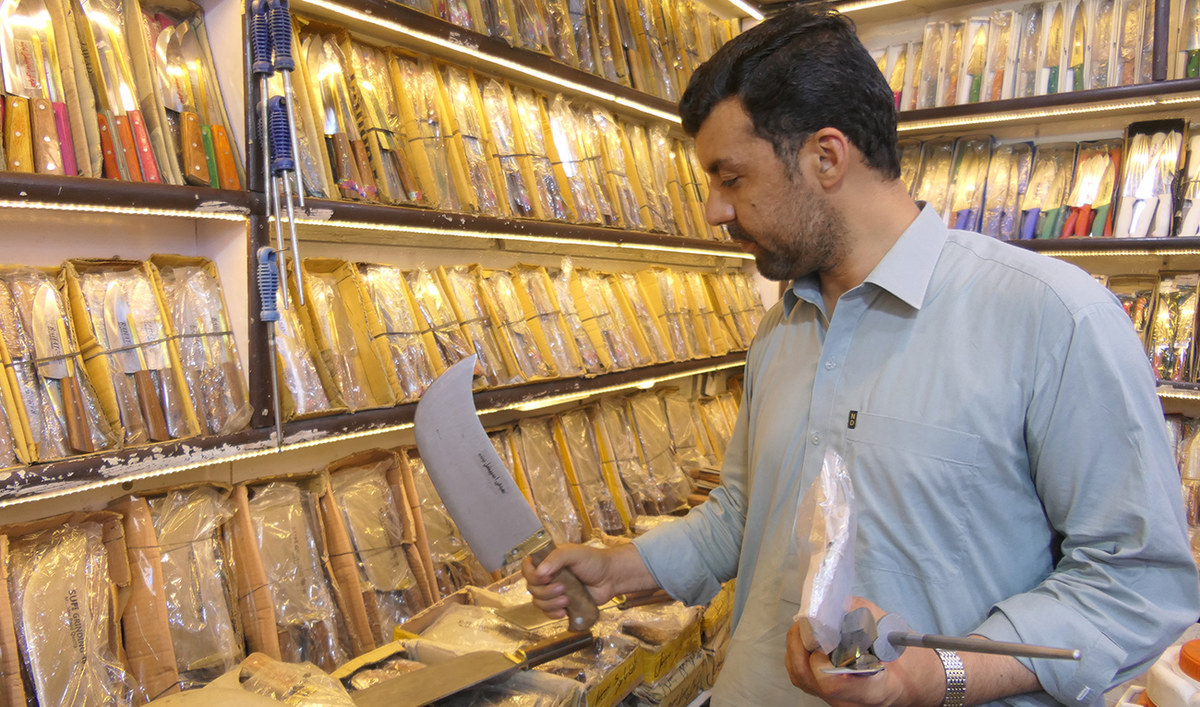


A man holds a cleaver with sharp edges inside a shop in Quetta Pakistan on June 26, 2023. (AN Photo)

Since the Eid Al-Adha moon was sighted last week and the first day of Eid announced for Thursday, the experienced mason and hundreds of others like him in Tak Taki Gali have been working 18-hour work days.

“For the last five days, we have been sharpening 200 sets of knives daily,” Mehmood said, adding that customers came to the market from far off districts like Khuzdar, Chaman, Kalat and Mastung since knife sharpening services were not available in those areas. 

“We are so overburdened with the work of [sharpening] used knives that we have been closing the shop at 2:30am, 3am, 4am daily.” 

Muhammad Hamza , a 29-year-old customer, said he had come to get his knife sharpened as it was advised in Islam that tools “must be so sharp that the animal is slaughtered in a second and doesn’t feel any pain, any misery.”

Javed Haider, 62, who had brought his knives for sharpening at Tak Tak Gali, also said he did not like to rely on butchers but carried out the sacrificial ritual with his own hands with the help of other male family members. He said several different types of knives were required in the process. 

“One which is smaller in size which the butcher uses to remove the hide [of the animal]. Then, another knife is used for slaughtering. Then, there’s a cleaver for breaking the bones and another knife is used for chopping [the animal] into pieces of meat. Hence, every knife has its own role.”
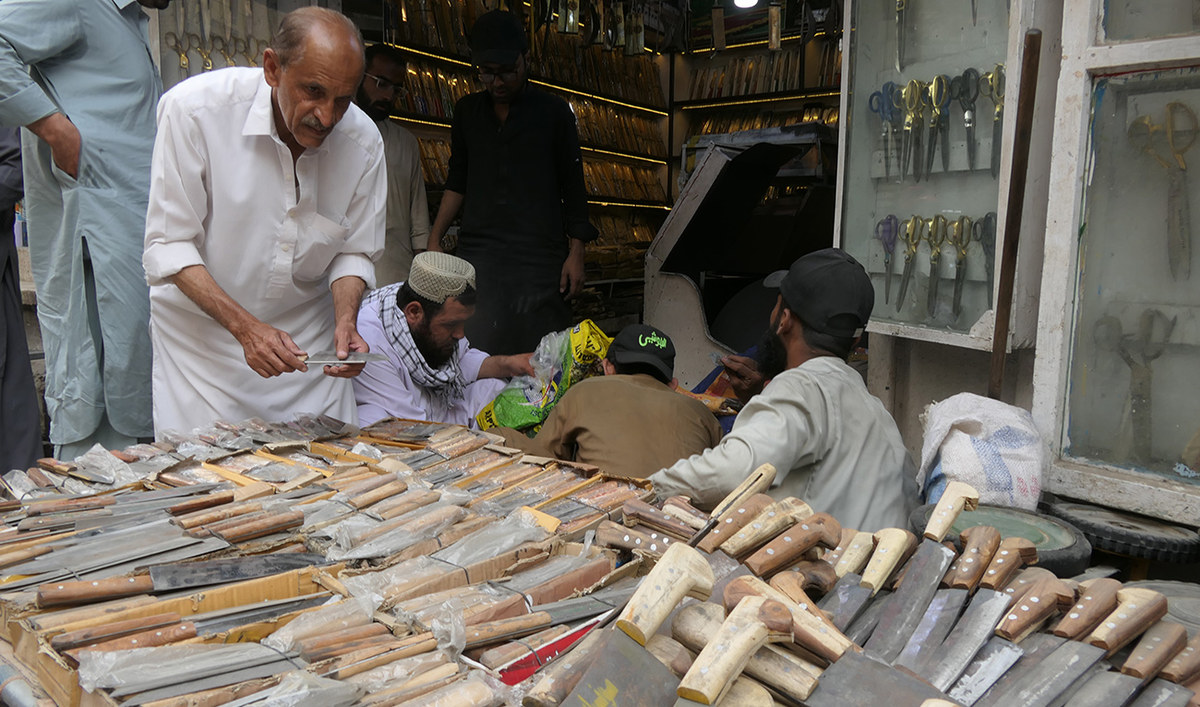


Javed Haider, a local resident looks for a sharpened knife for the annual Muslim festival Eid ul Adha in Quetta Pakistan on June 26, 2023. (AN Photo)

But while there is demand of new knives and for sharpening old ones, customers also complained of unusually high prices this year, as the country faces soaring inflation, which rose to 37.97 percent in May, a national record.

“The price of new knives has increased up to 15 percent because in the previous year, a new set of knives was Rs3,500 ($12.25) but for this year, the price has grown up to Rs4.500 ($15.76),” Hamza, the young customer, said, saying the rate for sharpening had also gone up.

Mehmood the mason defended the price hikes, saying inflation was not only affecting customers but businesses also.

“Keeping in view inflation, we have increased by only 20 rupees the price for sharpening used knives,” he said.

“But for new knife sets, we are compelled to enhance the prices because we purchase them at increased prices ourselves.”


Imran Khan’s party, government trade claims over ex-PM’s health and jail access

Updated 28 January 2026
Follow

Imran Khan’s party, government trade claims over ex-PM’s health and jail access

  • Khan’s party cites eye ailment media reports, demands family access, medical details
  • Government says health of all prisoners a priority, accuses PTI of politicizing issue

ISLAMABAD: Pakistan’s opposition party led by jailed former prime minister Imran Khan on Wednesday raised fresh concerns over his health and jail access, saying his family had been kept uninformed about a reported medical condition, while the government rejected the allegations and accused the party of politicizing a routine prison matter.

The dispute comes amid heightened scrutiny of Khan’s incarceration, which has become a central fault line in Pakistan’s polarized politics. Khan, a popular leader who was prime minister from 2018-22, has been in prison since August 2023 following a series of convictions he and his party say are politically motivated. His detention has repeatedly triggered legal challenges, protests and claims of mistreatment, all of which the government denies.

On Tuesday, Khan’s Pakistan Tehreek-e-Insaf (PTI) party said on social media platform X it had "credible" reports that he had been diagnosed with central retinal vein occlusion in his right eye, which it described as “a dangerous blockage in the retinal vein.” Quoting medical experts who had examined him in prison, the party warned the condition could lead to permanent damage to his eyesight if not treated properly.

Pakistan’s leading English-language daily Dawn reported on Wednesday that Khan had been taken from Rawalpindi’s Adiala Jail to the Pakistan Institute of Medical Sciences (PIMS), a major public hospital in Islamabad, late Saturday night and returned to prison on Sunday.PTI leaders said neither Khan’s family nor the party had been informed of the alleged hospital visit or his medical condition.

“We were not even informed whether he was taken outside the jail or not, what was his illness and what was done and who examined him,” PTI Chairman Barrister Gohar Ali Khan told Arab News after a press conference in Islamabad.

“That is really a serious matter for all of us.”

He demanded that authorities immediately facilitate a family meeting with Khan and provide full details of his treatment.

PTI Secretary General Salman Akram Raja said Khan’s family had been denied access to him for nearly two months.

“So Mr. Imran Khan is being kept in isolation for long periods of time,” he alleged.

Concerns over Khan’s health are not new. In November last year, his sisters publicly raised alarm over rumors that he had died in custody, claims the government dismissed at the time. Khan’s sisters last met him in December.

Responding to the latest claims, Pakistan’s Minister of State for Law and Justice Aqeel Malik neither confirmed nor denied that Khan had been taken to PIMS, but said the health of all prisoners was a government priority.

“The majority of health facilities are available at the jail hospital while some others may not be available,” Malik told Arab News.

“In such cases, prisoners can be treated outside the jail and this is a routine matter.”

He said Khan was entitled to all facilities under prison rules and, as a “superior-class” inmate, was examined daily by medical staff.

Addressing PTI’s demand that Khan’s family should have been informed of any hospital visit, Malik said prison authorities were responsible for medical decisions.

“The family does not need to be informed unless it is a life-threatening situation,” he said, adding that Khan was “generally in good health for his age.”

Malik accused PTI of using Khan’s health as a political tool, alleging the party routinely violated Islamabad High Court orders by speaking to the media after jail meetings and creating security concerns outside prison premises.

“Why do they not comply with court orders? Why do they always speak to the media outside the jail and create law and order situations?” he asked.

Khan, who was ousted from the PM's office through a parliamentary vote in April 2022, has since accused Pakistan’s powerful military of colluding with his political rivals to remove him from power and keep him imprisoned. The military denies the allegations and says it does not interfere in politics.

Khan’s health and access dispute comes against a backdrop of multiple high-profile convictions. 

In December 2025, a special court in Rawalpindi sentenced Khan and his wife Bushra Bibi to 17 years’ imprisonment each in the Toshakhana-2 corruption case, involving alleged fraud over state gifts received from foreign dignitaries, with fines also imposed on both.  

Earlier in January 2025, an accountability court convicted Khan and Bibi in the £190 million Al-Qadir Trust land corruption case, sentencing him to 14 years and her to seven years after finding that the trust was used to acquire land and funds in exchange for alleged favors.  

Khan and his allies deny wrongdoing in all cases, saying they are politically motivated, and legal appeals are ongoing.