Nikki Haley says Trump did ‘too little’ about China threats, warns of global conflict if Ukraine falls

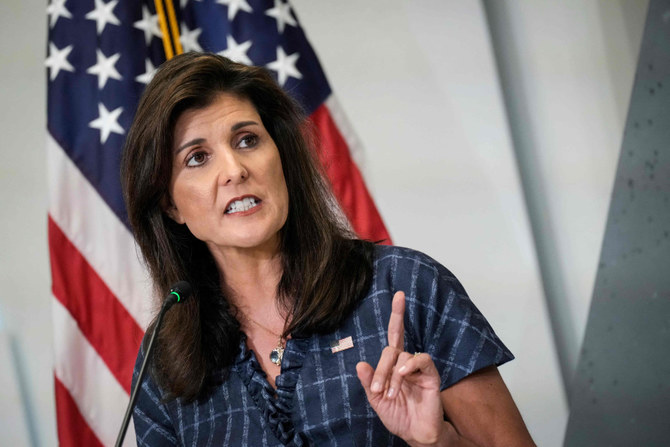
Republican presidential candidate Nikki Haley speaks at the American Enterprise Institute on June 27, 2023, in Washington. (Getty Images/AFP)
Short Url
Updated 28 June 2023
Follow

Nikki Haley says Trump did ‘too little’ about China threats, warns of global conflict if Ukraine falls

  • Says Trump failed to rally US allies “against the Chinese threat” and was friendly with China's President Xi Jinping
  • Slams President Joe Biden for being “far too slow and weak in helping Ukraine”

COLUMBIA, South Carolina: Nikki Haley, the former US envoy to the United Nations, on Tuesday criticized former President Donald Trump for being too friendly to China during his time in office, while also warning that weak support for Ukraine would “only encourage” China to invade Taiwan.

Haley, a Republican presidential candidate running against Trump, said in a speech at the American Enterprise Institute that Trump was “almost singularly focused” on the US-China trade relationship but ultimately did “too little about the rest of the Chinese threat.”
Specifically, Haley noted that Trump failed to rally US allies “against the Chinese threat” and that he had congratulated Chinese President Xi Jinping on the 70th anniversary of Communist Party rule in China.
“That sends a wrong message to the world,” Haley said. “Chinese communism must be condemned, never congratulated.”
Haley’s comments, promoted by her presidential campaign as “a major foreign policy speech,” came a week and a half after US Secretary of State Antony Blinken held talks with Xi in Beijing. Blinken said they had agreed to “stabilize” badly deteriorated US-China ties, but there was little indication that either country was prepared to bend from positions on issues including trade, Taiwan, human rights conditions in China and Hong Kong, Chinese military assertiveness in the South China Sea, and Russia’s war in Ukraine.
Haley did note that Trump imposed tariffs and other trade restrictions on the superpower, saying he “deserves credit for upending this bipartisan consensus.” But she added, “Being clear-eyed is just not enough.”
As Trump remains the clear front-runner for the 2024 Republican presidential nomination, his rivals are increasingly lashing out at him. On Tuesday in New Hampshire, Florida Gov. Ron DeSantis said that, unlike Trump, he was “actually going to build the wall,” a reference to Trump’s 2016 signature issue that he fell short of meeting during his first term.

Haley, who served for two years as Trump’s ambassador to the United Nations, said President Joe Biden has been “much worse” when it comes to dealing with threats she said China poses to America’s economic, domestic and military security. She also said that China’s military buildup and aggression toward Taiwan shows that the nation is “preparing its people for war,” a conflict she said would draw in the US and other global partners if left unchecked.
“We must act now to keep the peace and prevent war,” she said. “And we need a leader that will rally our people to meet this threat on every single front. ... Communist China is an enemy. It is the most dangerous foreign threat we’ve faced since the Second World War.”
In a question-and-answer session with reporters, Haley was asked about comments earlier Tuesday from Miami Mayor Francis Suarez, a fellow Republican presidential candidate, who said, “What’s a Uygher?” in response to a question from radio show host Hugh Hewitt about the predominantly Muslim group that China has been accused of oppressing.
Haley, who didn’t mention Suarez in her response, called the allegations of sexual abuse and religious discrimination against the Uyghurs a potential “genocide,” adding, “The fact that the whole world is ignoring it, is shameful.”
For his part, Suarez later tweeted that he is “well aware of the suffering of the Uyghurs in China” but just “didn’t recognize the pronunciation.”
In her speech, Haley also called Biden “far too slow and weak in helping Ukraine,” warning that a failure to send enough military equipment to help stem Russia’s invasion there could “only encourage China to invade Taiwan as soon as possible,” leading to further international conflict.
“The events of this past weekend show how weak and shaky the Russian leadership is,” Haley said, referencing the short-lived weekend revolt by mercenary soldiers who briefly took over a Russian military headquarters. “Make no mistake: China is watching the war with Ukraine with great interest.”
Some of Haley’s Republican rivals, including Trump and DeSantis, have faced criticism over their own comments toward Ukraine. Both Trump and DeSantis have said that defending Ukraine is not a national security priority for the US DeSantis also had to walk back his characterization of Russia’s war in Ukraine as a “territorial dispute.”
Last month, Biden approved a new package of military aid for Ukraine that totals up to $300 million and includes additional munitions for drones and an array of other weapons. In all, the US has committed more than $37.6 billion in weapons and other equipment to Ukraine since Russia attacked on Feb. 24, 2022.


US allows oil majors to broadly operate in Venezuela, new energy investments

Updated 14 February 2026
Follow

US allows oil majors to broadly operate in Venezuela, new energy investments

  • Treasury Department issues general license allowing Chevron, BP, Eni, Shell and Repsol to operate oil and gas operations in Venezuela
  • Move is the most significant relaxation of sanctions on Venezuela since US forces captured and removed President Nicolas Maduro

WASHINGTON: The US ​eased sanctions on Venezuela’s energy sector on Friday, issuing two general licenses that allow global energy companies to operate oil and gas projects in the OPEC member and for other companies to negotiate contracts to bring in fresh investments. The move was the most significant relaxation of sanctions on Venezuela since US forces captured and removed President Nicolas Maduro last month.
The Treasury Department’s Office of Foreign Assets Control issued a general license allowing Chevron, BP, Eni, Shell and Repsol to operate oil and gas operations in Venezuela. Those companies still have offices in the country and stakes in projects, and are among the main partners of state-run ‌company PDVSA.
The authorization ‌for the oil majors’ operations requires payments for royalties and Venezuelan ​taxes ‌to ⁠go through ​the US-controlled ⁠Foreign Government Deposit Fund.
The other license allows companies around the world to enter contracts with PDVSA for new investments in Venezuelan oil and gas. The contracts are contingent on separate permits from OFAC.
The authorization does not allow transactions with companies in Russia, Iran, or China or entities owned or controlled by joint ventures with people in those countries.
The licenses “invite American and other aligned companies to play a constructive role in supporting economic recovery and responsible investment, ” the US State Department said in a release. Additional authorizations may be issued “as necessary,” it said.
A spokesperson for Chevron, ⁠the only US oil firm currently operating in Venezuela, said the company welcomed ‌the new licenses.
“The new General Licenses, coupled with recent changes ‌in Venezuela’s Hydrocarbons Law, are important steps toward enabling the further development ​of Venezuela’s resources for its people and for advancing ‌regional energy security,” the spokesperson said in a statement.
Eni said it is assessing the opportunities in ‌Venezuela that the authorization opens up.

Oil law reform

The US licenses follow a sweeping reform of Venezuela’s main oil law approved last month, which grants autonomy for foreign oil and gas producers to operate, export and cash sale proceeds under existing joint ventures with PDVSA or through a new production-sharing contract model.
The US has had sanctions on Venezuela since ‌2019 when President Donald Trump imposed them during his first administration. Trump is now seeking $100 billion in investments by energy companies in Venezuela’s oil and gas sector. ⁠US Energy Secretary Chris Wright ⁠said on Thursday, during his second day of a trip to Venezuela, that oil sales from the country since Maduro’s capture have hit $1 billion and would hit another $5 billion in months.
Wright said the US will control the proceeds from the sales until Venezuela stands up a “representative government.” Since last month, the Treasury issued several other general licenses to facilitate oil exports, storage, imports and sales from Venezuela. It also authorized the provision of US goods, technology, software or services for the exploration, development or production of oil and gas in Venezuela.
The Venezuelan government expropriated assets of Exxon Mobil and ConocoPhillips in 2007 under then-President Hugo Chavez. The Trump administration is trying to get those companies to invest in Venezuela as well. At a meeting at the White House with Trump last month, Exxon Mobil CEO Darren Woods said Venezuela was “uninvestable” at ​the moment.
Wright said on Thursday that Exxon, ​which no longer has an office in Venezuela, is in talks with the government there and gathering data about the oil sector. Exxon did not immediately comment.