

Hajj attracts more than 1.8m pilgrims, says minister

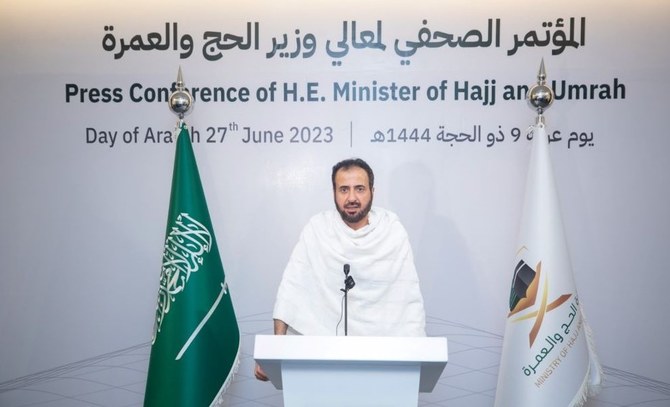
Minister of Hajj and Umrah Dr. Tawfiq Al-Rabiah. (Supplied)
Short Url
Updated 27 June 2023
Follow

Hajj attracts more than 1.8m pilgrims, says minister

  • Dr. Tawfiq Al-Rabiah said that the transportation of pilgrims from Mina had been a success and all had arrived at Arafat by 10 a.m
  • Dr. Tawfiq Al-Rabiah: This advancement in technology can, for sure, help us to provide better services, and also enriches the experience of pilgrims

ARAFAT: The Kingdom’s Ministry of Hajj and Umrah has revealed that this year’s Hajj attracted 1,845,045 worshippers from 150 countries.

The Minister of Hajj and Umrah Dr. Tawfiq Al-Rabiah, speaking at a press conference on Tuesday at the ministry’s camp at Arafat, said that the transportation of pilgrims from Mina had been a success and all had arrived at Arafat by 10 a.m.

He expressed his gratitude to the Kingdom’s leadership for helping to provide the best possible services to visitors, and the efforts of more than 40 government entities and other private sector companies.

He added: “These efforts have facilitated the pilgrims’ movement in peace, tranquility and good health.”

Al-Rabiah said the ministry had started its preparation for Hajj at the conclusion of last year’s event.

He added: “We have set up a task management center and its main job is to coordinate with all the participating agencies. That is why the pilgrims’ transportation process went smoothly and easily.

“We have also expanded the use of smart cards that help pilgrims to know which services are provided to them. It also assists them in reaching their camps and finding locations.”

Al-Rabiah said that technology was proving to be an invaluable tool for pilgrims during Hajj.

He added: “This advancement in technology can, for sure, help us to provide better services, and also enriches the experience of pilgrims.”


Board of Grievances unveils judicial intelligence hackathon to foster innovation

Updated 28 December 2025
Follow

Board of Grievances unveils judicial intelligence hackathon to foster innovation

  • Registration opens on Sunday, Dec. 28, 2025, and continues through Jan. 20, 2026

RIYADH: Saudi Arabia’s Board of Grievances has opened registration for the Judicial Intelligence Hackathon, the institution’s first competition seeking sustainable solutions that harness cutting-edge technology to improve the efficiency of judicial procedures, the Saudi Press Agency reported.

Registration opens on Sunday, Dec. 28, 2025, and continues through Jan. 20, 2026, as part of efforts to cultivate talent and promote innovation in digital transformation and artificial intelligence in the judicial sector.

The board is calling on industry experts, experienced professionals, and university students to form teams of three to five members. Each team must be led by a Saudi citizen or academic staff member at least 18 years old.

Participants register via a dedicated portal on the board’s digital platform and must submit a preliminary proposal demonstrating practical and legal viability, incorporating advanced technology with appropriate quality standards, and showing innovation relevant to the board's operations with transformative impact and long-term sustainability.

Competition unfolds in two distinct tracks. The first addresses AI applications and creative solutions for administrative justice, tackling challenges such as minimizing procedural errors and offenses during virtual court proceedings and streamlining lawsuit filing classifications.

The second track emphasizes digital innovation enhancing user journeys, focusing on simplifying document submission processes when initiating lawsuits and developing accessibility solutions enabling seniors and people with disabilities to navigate board services more effectively.

Finalists are scheduled to be announced on Jan. 23, 2026, followed by virtual project discussion and presentation sessions on Jan. 28. 

According to the SPA, this methodology for sourcing innovative concepts underscores the dedication of the board’s leadership to advance performance across judicial chambers and administrative divisions while pursuing strategic goals of refining administrative court litigation processes, expediting case resolutions, and establishing competitive leadership in the judicial arena.
