Lhokseumawe: Indonesia’s president vowed on Tuesday to “heal” the pain caused by serious human rights violations by compensating those who suffered during the country’s dictatorship years.
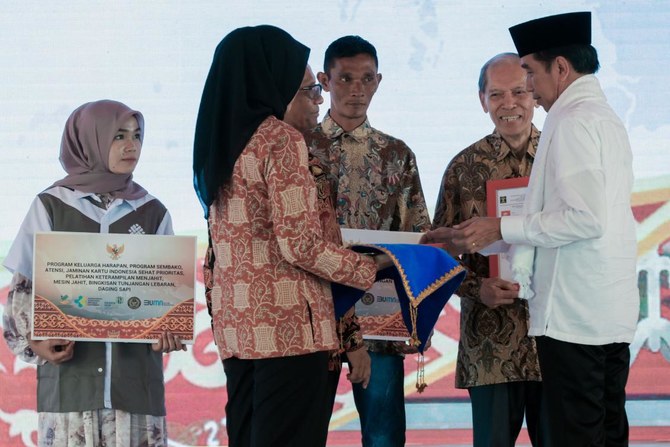
“This (resolution) is needed to heal the nation’s pain caused by past gross human rights violations which have left a heavy burden for the victims,” President Joko Widodo said Monday in northwestern Aceh province.
The region hosted a nearly three-decade-long insurgency that ended in 2005 and was the site of at least three recorded mass killings that resulted in dozens of deaths.
“This wound must be healed immediately so we can move forward,” Widodo added during a ceremony in Pidie, near a site once used by the military to torture civilians.
In January, Widodo said the government deeply regretted a dozen state-orchestrated mass human rights violations committed in the country’s past.
A bloody anti-communist purge in the 1960s saw half a million leftists massacred, and in 1998 dozens of student activists disappeared during mass street protests that brought down the three-decade-long Suharto dictatorship.
Widodo also mentioned 10 other violations that took place between the 1960s and the early 2000s.
“The government is now focusing on the nonjudicial resolution, which focuses on rehabilitating the victims’ rights without negating the judicial mechanism,” he said.
Under the program, the government will provide financial settlements, scholarships, and direct cash aid for the victims and their children.
Human rights activists welcomed the government’s gesture but said the task was still huge.
“This is a step forward, better than nothing, but of course, it’s not enough,” Human Rights Watch researcher Andreas Harsono told AFP.
One of the victims of a mass killing in North Aceh on May 3, 1999, recalled the moment that left him with lifelong trauma.
Murtala was 28 years old when military personnel opened fire on a crowd gathering near a paper mill in the town of Lhokseumawe.
The shooting followed reports that a soldier had gone missing at a time when rebels were fighting government forces for Aceh’s independence.
“I heard shots fired, and I hid under a truck to save myself, but somebody grabbed me and hit me in the head and chest with a gun repeatedly. They also stomped on my body,” Murtala told AFP.
He fell unconscious when a man was shot dead in front of him. He woke up three days later in a hospital only to be told his older brother was killed in the riot.
The National Human Rights Commission or Komnas HAM reported 21 people were killed in the clash, but activists claim 46 people died.
Murtala, also the head of the victims association, said many of them have not been identified or recognized and therefore might not receive any compensation.
“This is unacceptable, and this will hurt justice. We, as the victims, hope for justice to prevail,” he said.


![]()

Indonesia to compensate victims of bloody past
Short Url
https://arab.news/5j6gq
Indonesia to compensate victims of bloody past
- A bloody anti-communist purge in the 1960s saw half a million leftists massacred
- Under the program, the government will provide financial settlements, scholarships, and direct cash aid for the victims and their children


Latest updates


© 2026 SAUDI RESEARCH & PUBLISHING COMPANY, All Rights Reserved And subject to Terms of Use Agreement.