

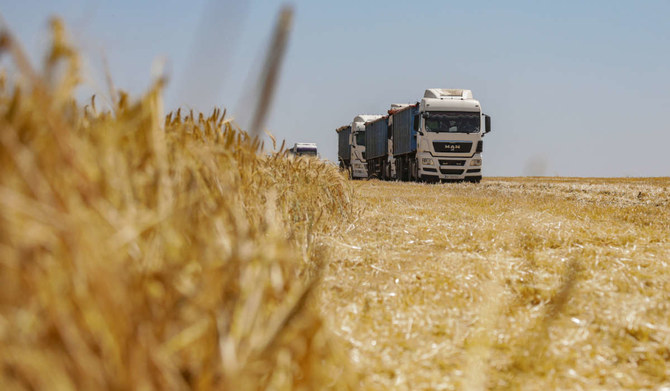

GENEVA: The Ukrainian grain exports deal, which could collapse within weeks, is critical for millions of people in the Horn of Africa, where some are already starving, the United Nations said Monday.
The Black Sea Grain Initiative aimed at easing the global food crisis is set to expire at the end of July 17 unless Russia agrees to its renewal — while Moscow remains unhappy about the operation of a parallel agreement.
If the export deal collapses, it would “absolutely hit eastern Africa very, very hard,” said Dominique Ferretti, the UN World Food Programme’s senior emergency officer in the region.
“There’s a number of countries that depend on Ukraine’s wheat. And without it, you would see significantly higher food prices,” he told reporters via video-link from Nairobi.
Russia’s full-scale invasion of Ukraine in February 2022 saw Ukraine’s Black Sea ports blocked by warships until the deal, signed in July 2022, allowed for the passage of critical grain exports.
Ukraine was one of the world’s top producers and the grain deal has helped soothe the global food crunch triggered by the conflict.
Some 32.4 million tons have been exported so far under the agreement, according to the UN. Just over half of the exports have been corn, while more than a quarter was wheat.
The initial 120-day agreement struck with the UN and Turkiye last July has been extended three times: in November, March and in May.
The parallel agreement, between Moscow and the UN, is aimed at facilitating the export of Russian food and fertilizers, which are exempt from Western sanctions imposed on Moscow.
But Russia consistently claims that this parallel agreement is not being upheld.
On June 13, Russia again threatened to pull the plug, arguing that certain clauses were still not being respected, despite successive UN assurances.
The Ukraine grain deal “is absolutely critical, not just for East Africa but all over Africa,” said Ferretti.
Millions of people in the Horn of Africa are trapped in a hunger emergency, he said.
The situation is being driven by compounding crises, including climate change, conflict, high food cost and post-Covid economic problems.
A UN-backed conference last month raised $2.4 billion to prevent famine in the Horn of Africa, which is reeling from its worst drought in decades as global temperatures rise.
In 2016, 26 million people were severely food insecure in eastern Africa: Djibouti, Ethiopia, Kenya, Somalia, South Sudan, Sudan and Uganda. The figure is now nearly 60 million people.
The March-May rainy season finally ended the longest drought in recent history — two and a half years — but it is not enough to end the crisis.
Some 43,000 in South Sudan and 40,350 in Somalia are in catastrophic food insecurity, eating once or twice a week, said Ferretti.
The UN has not declared a famine — which depends on various other factors — but UN leaders have affirmed on several occasions that people in the region are already dying of hunger.


