

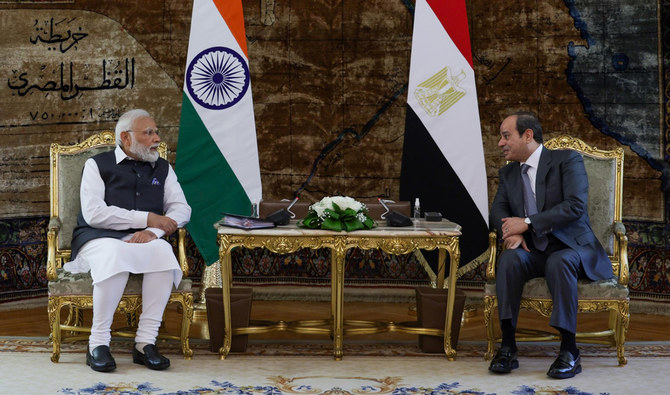
India, Egypt raise ties to strategic partnership on Modi’s visit to Cairo

Egypt and India share deep ties that date back to the 1950s, when the two nations played key roles in founding the Non-Aligned Movement (twitter/@MEAIndia)
Short Url
Updated 26 June 2023
Follow

India, Egypt raise ties to strategic partnership on Modi’s visit to Cairo

  • Modi’s visit is the first by an Indian premier since 1997
  • PM awarded with Order of the Nile civilian honor in Cairo

NEW DELHI: Indian Prime Minister Narendra Modi and Egyptian President Abdel Fattah El-Sisi signed on Sunday a strategic partnership agreement, underscoring growing ties between the two countries that experts say can spark geopolitical and economic significance. 

Modi arrived in Cairo on Saturday afternoon following a four-day trip to the US, marking the first state visit to Egypt by an Indian premier since 1997. 

He was awarded Egypt’s highest civilian honor, known as the Order of the Nile, during the trip that comes less than six months after El-Sisi’s visit to India earlier this year, when the leaders first announced plans to elevate their partnership. 

“An agreement to elevate the bilateral relationship to a ‘Strategic Partnership’ was signed by the leaders,” Arindam Bagchi, spokesperson of India’s Ministry of External Affairs, said in a tweet on Sunday. 

“The leaders discussed ways to further deepen the partnership between the two countries, including in trade & investment, defense & security, renewable energy, cultural and people to people ties.” 

Bagchi said their meeting was “productive,” with India and Egypt also signing three other memoranda of understanding in agriculture, archaeology and antiquities, and competition law. 

Modi also visited on Sunday the historic Al-Hakim Mosque in Cairo, recently renovated with the help of the India-based Dawoodi Bohra community, and met with Grand Mufti Shawki Allam, Egypt’s Islamic jurist. 

In January, Modi and El-Sisi agreed to increase bilateral trade to $12 billion in the next five years, up from $7.3 billion in 2021-22. 

The two countries signed several agreements in New Delhi then on expanding cooperation in cybersecurity, information technology, culture, and broadcasting.   

Navdeep Suri, former Indian ambassador to Egypt, said India and Egypt had been drifting apart prior to this year’s engagements. 

“After allowing the relationship to drift for years, it’s back on track,” Suri told Arab News. 

According to Suri, India had built momentum by inviting El-Sisi as a chief guest on India’s Republic Day in January and had Egypt among special invitees for meetings of the Group of 20 biggest economies under Delhi’s presidency this year, which he said sends “a strong signal.” 

Suri said: “​​There is now an opportunity to develop a special relationship with a country that, despite its present economic difficulties, will always be an important player in the Middle East. 

“This kind of intensity and engagement have been missing for a long time.” 

Closer ties with Egypt may also bring strategic benefits for India, experts say. 

“Egypt’s pivotal position in the region is important for growing India’s profile in the region,” Dr. Zakir Hussain, a Middle East expert based in New Delhi, told Arab News. 

“(India is) securing favorable treatment in trade, an industrial berth in the Suez Canal Free Zone, to access the Europe market and all those areas where Egypt has free trade deals such as Latin America, Africa, and the Middle East,” Hussain said, adding that “India needs to access these markets at preferential terms to achieve the target of $1 trillion merchandise exports by 2030.” 

Modi’s visit to Cairo “holds great significance” in strengthening India-Egypt bilateral relations, said Mohammed Soliman, tech program director at the Middle East Institute in Washington DC. 

With the countries discussing potential deals, such as the allocation of an economic zone for India in the Suez Canal area, they have the “potential to significantly impact the economic and strategic collaboration between the two nations,” he told Arab News.  

“With India now surpassing the UK as the fifth-largest global economy, it sees Egypt as a potential launchpad for Indian manufacturing and defense industries,” Soliman said.  

“Egypt’s strategic location, particularly with the Suez Canal, is central to Delhi’s global posture.” 


Beirut’s Commodore Hotel, a haven for journalists during Lebanon’s civil war, shuts down

Updated 6 sec ago
Follow

Beirut’s Commodore Hotel, a haven for journalists during Lebanon’s civil war, shuts down

  • The hotel, located in Beirut’s Hamra district, shut down over the weekend
  • Officials have not commented on the decision
BEIRUT: During Lebanon’s civil war, the Commodore Hotel in western Beirut’s Hamra district became iconic among the foreign press corps.
For many, it served as an unofficial newsroom where they could file dispatches even when communications systems were down elsewhere. Armed guards at the door provided some sense of protection as sniper fights and shelling were turning the cosmopolitan city to rubble.
The hotel even had its own much-loved mascot: a cheeky parrot at the bar.
The Commodore endured for decades after the 15-year civil war ended in 1990 — until this week, when it closed for good.
The main gate of the nine-story hotel with more than 200 rooms was shuttered Monday. Officials at the Commodore refused to speak to the media about the decision to close.
Although the country’s economy is beginning to recover from a protracted financial crisis that began in 2019, tensions in the region and the aftermath of the Israel-Hezbollah war that was halted by a tenuous ceasefire in November 2024 are keeping many tourists away. Lengthy daily electricity cuts force businesses to rely on expensive private generators.
The Commodore is not the first of the crisis-battered country’s once-bustling hotels to shut down in recent years.
But for journalists who lived, worked and filed their dispatches there, its demise hits particularly hard.
“The Commodore was a hub of information — various guerrilla leaders, diplomats, spies and of course scores of journalists circled the bars, cafes and lounges,” said Tim Llewellyn, a former BBC Middle East correspondent who covered the civil war. “On one occasion (late Palestinian leader) Yasser Arafat himself dropped in to sip coffee with” with the hotel manager’s father, he recalled.
A line to the outside world
At the height of the civil war, when telecommunications were dysfunctional and much of Beirut was cut off from the outside world, it was at the Commodore where journalists found land lines and Telex machines that always worked to send reports to their media organizations around the globe.
Across the front office desk in the wide lobby of the Commodore, there were two teleprinters that carried reports of The Associated Press and Reuters news agencies.
“The Commodore had a certain seedy charm. The rooms were basic, the mattresses lumpy and the meal fare wasn’t spectacular,” said Robert H. Reid, the AP’s former Middle East regional editor, who was among the AP journalists who covered the war. The hotel was across the street from the international agency’s Middle East head office at the time.
“The friendly staff and the camaraderie among the journalist-guests made the Commodore seem more like a social club where you could unwind after a day in one of the world’s most dangerous cities,” Reid said.
Llewellyn remembers that the hotel manager at the time, Yusuf Nazzal, told him in the late 1970s “that it was I who had given him the idea” to open such a hotel in a war zone.
Llewellyn said that during a long chat with Nazzal on a near-empty Middle East Airlines Jumbo flight from London to Beirut in the fall of 1975, he told him that there should be a hotel that would make sure journalists had good communications, “a street-wise and well-connected staff running the desks, the phones, the teletypes.”
During Israel’s 1982 invasion of Lebanon and a nearly three-month siege of West Beirut by Israeli troops, journalists used the roof of the hotel to film fighter jets striking the city.
The parrot at the bar
One of the best-known characters at the Commodore was Coco the parrot, who was always in a cage near the bar. Patrons were often startled by what they thought was the whiz of an incoming shell, only to discover that it was Coco who made the sound.
AP’s chief Middle East correspondent Terry Anderson was a regular at the hotel before he was kidnapped in Beirut in 1985 and held for seven years, becoming one of the longest-held American hostages in history.
Videos of Anderson released by his kidnappers later showed him wearing a white T-shirt with the words “Hotel Commodore Lebanon.”
With the kidnapping of Anderson and other Western journalists, many foreign media workers left the predominantly-Muslim western part of Beirut, and after that the hotel lost its status as a safe haven for foreign journalists.
Ahmad Shbaro, who worked at different departments of the hotel until 1988, said the main reason behind the Commodore’s success was the presence of armed guards that made journalists feel secure in the middle of Beirut’s chaos as well as functioning telecommunications.
He added that the hotel also offered financial facilities for journalists who ran out of money. They would borrow money from Nazzal and their companies could pay him back by depositing money in his bank account in London.
Shbaro remembers a terrifying day in the late 1970s when the area of the hotel was heavily shelled and two rooms at the Commodore were hit.
“The hotel was full and all of us, staffers and journalists, spent the night at Le Casbah,” a famous nightclub in the basement of the building, he said.
In quieter times, journalists used to spend the night partying by the pool.
“It was a lifeline for the international media in West Beirut, where journalists filed, ate, drank, slept, and hid from air raids, shelling, and other violence,” said former AP correspondent Scheherezade Faramarzi. “It gained both fame and notoriety,” she said, speaking from the Mediterranean island of Cyprus.
The hotel was built in 1943 and kept functioning until 1987 when it was heavily damaged in fighting between Shiite and Druze militiamen at the time. The old Commodore building was later demolished and a new structure was build with an annex and officially opened again for the public in 1996.
But Coco the parrot was no longer at the bar. The bird went missing during the 1987 fighting. Shbaro said it is believed he was taken by one of the gunmen who stormed the hotel.