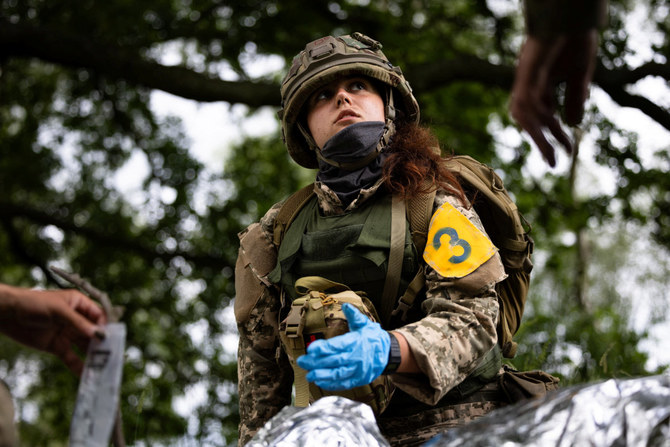
17,000 Ukrainian army recruits trained by UK and allies; 30K by 2024

1 / 2
2 / 2
Short Url
Updated 26 June 2023
Follow

17,000 Ukrainian army recruits trained by UK and allies; 30K by 2024

  • Operation Interflex taught the recruits various skills including weapons handling, battlefield first aid and patrol tactics
  • UK defense chief says partners to provide vital support, helping Ukraine defend against Russian aggression, for as long as it take

LONDON: More than 17,000 Ukrainian recruits have been trained by Britain and other allies over the last year to help Kyiv fight Russia’s invasion, the UK Ministry of Defense said Monday.

The recruits, from many different walks of life, all went through a “gruelling” five-week program which the ministry said had transformed them “from civilians to soldiers.”
Britain and nine partner nations — Canada, Australia, New Zealand, Norway, Finland, Sweden, Denmark, Lithuania and The Netherlands — opened the initiative for new volunteer recruits to the Armed Forces of Ukraine in June last year.
The UK-led training program dubbed Operation Interflex taught the recruits, who had little to no previous military experience, various skills including weapons handling, battlefield first aid and patrol tactics.
“The determination and resilience of the Ukrainian recruits that arrive on British soil, from all walks of life, to train to fight alongside our British and international forces, is humbling to witness,” UK Defense Secretary Ben Wallace said.
“The UK and our international partners will continue to provide this vital support, helping Ukraine defend against Russian aggression, for as long as it takes.”
Britain initially offered to train up to 10,000 Ukrainian soldiers in battlefield skills, based on the UK’s basic soldier training.
The program has now been extended and is on track to train some 30,000 recruits by 2024, according to the British defense ministry.
It said intelligence has shown that the training has made “a significant difference to the combat effectiveness of Ukraine.”
“The UK Armed Forces maintains close communication with Ukraine to improve and evolve the course based on the skills most needed on the battlefield,” the ministry added.


US envoy says Trump questioning why Iran has not ‘capitulated’

Updated 6 sec ago
Follow

US envoy says Trump questioning why Iran has not ‘capitulated’

  • US envoy Steve Witkoff said on Saturday that President Donald Trump is questioning why Iran has not “capitulated” in the face of Washington’s military build-up
WASHINGTON: US envoy Steve Witkoff said on Saturday that President Donald Trump is questioning why Iran has not “capitulated” in the face of Washington’s military build-up aimed at pressuring them into a nuclear deal.
The United States and Iran this week resumed Oman-mediated talks in Geneva aimed at averting the possibility of military action, after Washington dispatched two aircraft carriers, jets and weaponry to the region to back its warnings.
In a Fox News interview with Trump’s daughter-in-law Lara, Witkoff said the president was “curious” about Iran’s position after he had warned them of severe consequences in the event they failed to strike a deal.
“I don’t want to use the word ‘frustrated,’ because he understands he has plenty of alternatives, but he’s curious as to why they haven’t... I don’t want to use the word ‘capitulated,’ but why they haven’t capitulated,” he said.
“Why, under this pressure, with the amount of seapower and naval power over there, why haven’t they come to us and said, ‘We profess we don’t want a weapon, so here’s what we’re prepared to do’? And yet it’s sort of hard to get them to that place.”
The US envoy also confirmed in the interview that he had met with Reza Pahlavi, who has not returned to Iran since before the 1979 Islamic Revolution that ousted the monarchy.
“I met him at the direction of the president,” he said, without providing further details.
US-based Pahlavi last week told a crowd in Munich that he was ready to lead the country to a “secular democratic future” after Trump said regime change would be best for the country.
Witkoff’s comments come after Iranian Foreign Minister Abbas Araghchi said a draft proposal for an agreement with Washington would be ready in a matter of days.
Trump said on Thursday that Iran had at most 15 days to make a deal on concerns starting with its nuclear program.
As talks between the two nations continued in Geneva, Iran’s supreme leader Ayatollah Ali Khamenei on Tuesday said that Trump would not succeed in destroying the Islamic republic.
Western countries accuse the Islamic Republic of seeking to acquire nuclear weapons, which Tehran denies, though it insists on its right to enrichment for civilian purposes.
Iran, for its part, is seeking to negotiate an end to sanctions that have proven to be a massive drag on its economy, which played a role in sparking anti-government protests in December.