

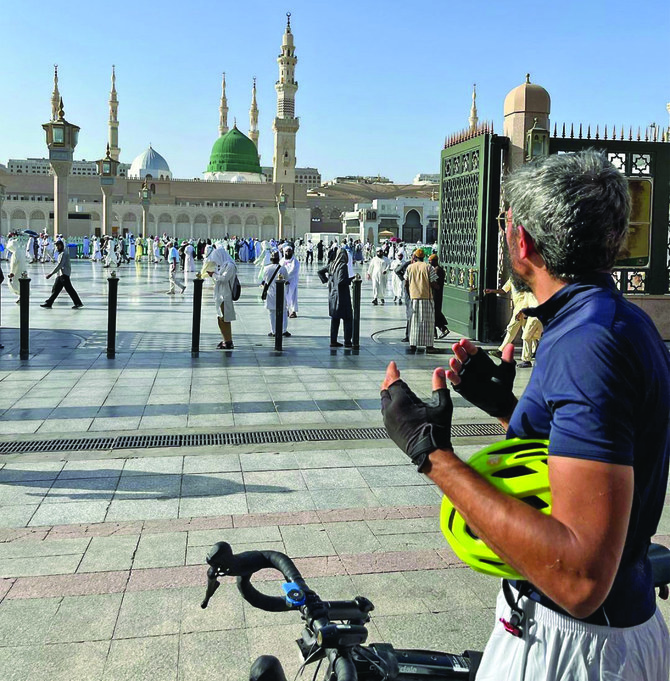
French Muslim cycles over 5,000 km to perform Hajj

French cyclist Nabil Ennasri at the Prophet’s Mosque in Madinah, after crossing 11 countries on bicycle to perform Hajj this year. (Instagram/nabilennasr)
Short Url
Updated 25 June 2023
Follow

French Muslim cycles over 5,000 km to perform Hajj

  • Nabil Ennasri crossed 11 countries over 57 days, documenting the trip on social media
  • 41-year-old says wants to revive traditional pilgrimage experience Muslims followed before

JEDDAH: Nabil Ennasri, a French Hajj pilgrim of Moroccan origin, recently arrived in Saudi Arabia after covering a distance of over 5,000 km by bicycle.

He began his journey in Paris on April 22, and has crossed 11 countries including Italy, Slovenia, Croatia, Montenegro, Bosnia and Herzegovina, Albania, Greece, Jordan and Turkiye.

Ennasri is a French affairs analyst, writer and civil society activist focusing on a variety of social issues, including discrimination and education.


Nabil Ennasri pedals to raise climate change awareness. (Supplied)

While sharing updates from his journey on social media, the 41-year-old said that he wanted to revive the traditional pilgrimage experience that Muslims followed in the past and also to draw attention to global warming.

Ennasri shared an emotional video of his arrival at the Prophet’s Mosque in Madinah, in which he said: “It is difficult to express these feelings because your prayer is not the same as when you have been on a 57-day trip to come and pray at the Prophet’s Mosque, and when you take a seven-hour flight.”

During his short stay in Jeddah, en route to Makkah, the French cyclist was warmly welcomed by the Saudi Cycling Federation and held a practice session with the members of the club on the Jeddah Corniche.
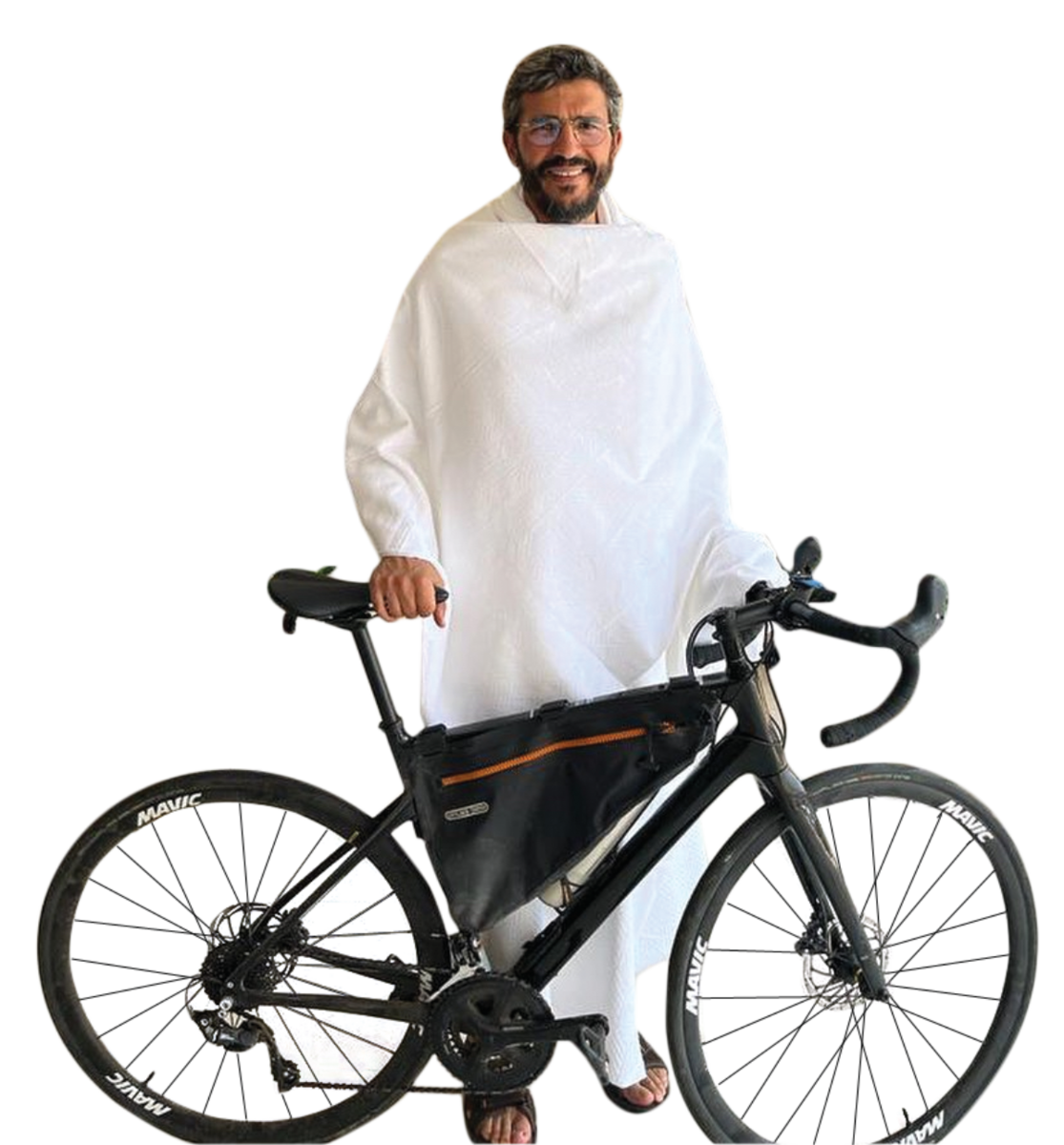
Leaving for Makkah on Saturday, Ennasri was able to retrace the slow journey taken by Muslims, and some of his own relatives, in the past.

“Some members of my family also traveled on foot. It could have taken months or even years. Some lost their lives during the journey,” he said.

“When I remember these moments, I find the strength in me.”

Explaining the significance of his journey, he added: “My first objective is to explain global warming; it is very important for our children and future generations.

“My second goal is to understand what kind of difficulties people (experienced) on pilgrimage in ancient times, to understand their long journeys on foot.”

Our planet is our home and we have to preserve it for future generations.

Nabil Ennasri, French pilgrim

In another video shot in Madinah, Ennasri said: “I received a message from my friend Thomas who is not a Muslim. He says that even if he does not share my faith, he is enthusiastic about my project, about the fact that we try to raise awareness around ecology and environment.

“I liked his message and replied back saying that it is beyond our philosophical or religious differences because our faith in human beings reunite us. Our planet is our home and we have to preserve it for future generations.”

According to Ennasri, global warming is a major problem facing humanity today.

“It is important for me to protect nature and our world, and to explain this to the Muslim community. I think there is a misunderstanding about global warming; people don’t understand what it is about.”

Ennasri hopes that his trip will inspire other Muslims and community members to rethink their own approaches to travel.


Philippines signs free trade pact with UAE

Updated 58 min 42 sec ago
Follow

Philippines signs free trade pact with UAE

  • UAE deal is Philippines’ fourth free trade pact, after South Korea, Japan, and EFTA
  • Business body warns of uneven gains if domestic safeguard mechanisms insufficient

MANILLA: The Philippines signed on Tuesday a comprehensive economic partnership agreement with the UAE, its first such deal with a Middle Eastern nation.

The Philippines and the UAE first agreed to explore a free trade pact in February 2022 and formalized the process with terms of reference in late 2023. Negotiations started in May 2024 and were finalized in 2025.

The CEPA signing was witnessed by President Ferdinand R. Marcos Jr. who led the Philippine delegation to Abu Dhabi.

“The CEPA is the Philippines’ first free trade pact with a Middle Eastern country, marking a milestone in expanding the nation’s global trade footprint,” Marcos’s office said.

“The agreement aims to reduce tariffs, enhance market access for goods and services, increase investment flows, and create new opportunities for Filipino professionals and service providers in the UAE.”

The UAE is home to some 700,000 Filipinos, the second-largest Filipino diaspora after Saudi Arabia.

With bilateral trade worth about $1.8 billion, it is also a key trading partner of the Philippines in the Middle East, and accounted for almost 39 percent of Philippine exports to the region in 2024.

The Philippine Department of Trade and Industry earlier estimated it would lead to at least 90 percent liberalization in tariffs and give the Philippines wider access to the GCC region.

“Preliminary studies indicate the CEPA could boost Philippine exports to the UAE by 9.13 percent, generate consumer savings, and strengthen overall trade linkages with the Gulf region,” Marcos’s office said.

The Philippine Chamber of Commerce and Industry-Makati expects the pact to bring stronger trade flows, capital and technology for renewable energy, infrastructure, food, and water security projects as long as domestic policy supports it.

“CEPA can serve as a trade accelerator and investment catalyst for the Philippines,” Nunnatus Cortez, the chamber’s chairman, told Arab News.

The pact could result in “expanding exports, attracting capital, diversifying economic partners, upgrading industries, and supporting long-term growth — provided the country actively supports exporters and converts provisions into concrete commercial outcomes,” said Cortez.

“The main downside risk of CEPA lies in domestic readiness. Without strong industrial policy, MSME (Micro, Small and Medium Enterprises) support, safeguard mechanisms, and export development, CEPA could lead to import dominance, uneven gains, fiscal pressure, and limited structural transformation.”

The deal with the UAE is the Philippines’ fourth bilateral free trade pact, following agreements with South Korea, Japan, and the European Free Trade Association, which comprises Iceland, Liechtenstein, Norway, and Switzerland.