


DUBAI: As the world marks the International Day against Drug Abuse and Illicit Trafficking, leading Captagon trade researcher Caroline Rose says she is doubtful the Bashar Assad regime would relinquish its lucrative drug business income, despite apparent support and commitments to Arab countries during the Jeddah Arab League Summit last month.
Appearing on Frankly Speaking, Arab News’ current affairs talk show, the director of New Lines Institute pointed out that not only does Captagon production in Syria provide the regime with “a large source of revenue,” but “it also upholds a very delicate system of power in patronage inside of regime-held areas that the Assad regime has relied on throughout the civil war.”
She explained that many of the “big players” deeply involved in the Captagon trade, “such as Maher Assad,” are “relatives of Bashar Assad himself, or members of Syria’s very deep and very influential security apparatus,” and “they all have a role to play in continuing and keeping up the Syrian regime’s hold on power and territorial control across the country.
Asked about the impact of the Saudi-Jordanian-Egyptian airstrike that killed Captagon kingpin Merhi Al-Ramthan inside Syria on May 8, Rose replied that although Al-Ramthan was an “influential trafficker and smuggler in the south (of Syria),” he was not a key actor in production, making him a “smaller fish … that the regime could give up as a show of goodwill.”
She noted that “while Al-Ramthan was given up, a number of other key individuals were not,” meaning the move was “an opportunity for the Syrian regime to … show it was genuine about cracking down on the Captagon trade.”

Speaking to Jensen, Rose pointed out that Captagon is popular among different demographics in the Gulf. (AN Photo)
The joint airstrike came a week after Syria committed to assisting in ending drug trafficking along its borders with Jordan and Iraq. The foreign ministers of Syria, Egypt, Iraq, Saudi Arabia and Jordan met in Amman in early May and discussed developing a roadmap to reach a political settlement for the 12-year war.
Elaborating on the significance of Al-Ramthan’s killing, Rose pointed out that in southern Syria, which “has grown in importance in the Captagon trade,” the deceased kingpin “operated a very large network of traffickers that would be enlisted and recruited — many of them were local tribes or traffickers that had been participating in illicit trades for decades.”
She added that Al-Ramthan “was responsible for trying to export the Captagon trade out of Syria,” emphasizing that traffickers in south Syria attempted to find new routes “that could serve as a pathway to Arab Gulf destination markets.”
Rose believes Al-Ramthan’s killing has “served a message to a number of traffickers” that “if you are not in close, close coordination with the Syrian regime, then you have a target on your back.”
For this reason, she believes the world is braced for “much more creative and sophisticated ways of smuggling and Captagon production as a result,” but not necessarily comparable to the opioid epidemic, which “coincided with a huge uptick in deaths and fatality,” particularly in the US.
With Captagon, “we have not necessarily seen the fatality rate that we have seen with the opioid epidemic, so I do not want to put that on the same plane,” she said.
In 2017, the US Department of Health and Human Services declared the opioid crisis a public health emergency. It was reported that from 1999 to 2019, there were more than 760,000 deaths due to overdoses, and in 2020, opioids were involved in approximately 75 percent of all overdose fatalities.
However, citing the diverse and broad Captagon smuggling capacity, Rose added that “in terms of the sophisticated and advanced smuggling techniques, I think that Captagon is definitely competitive in that aspect.”
She added: “We have seen fruit and vegetables used (and) machinery. We have seen designer bags, school desks, sometimes even drone technology used to smuggle Captagon — and this counts for not only Captagon shipments that are being sent to maritime ports, but also Captagon that is being seized along overland border crossings as well.
“These smugglers are closely monitoring the different shifts in trade, but also interdiction capacity amongst law-enforcement entities, and they are very much calculating new ways that they can traffic Captagon to reach new destination markets and carve out new transit markets in the process.”
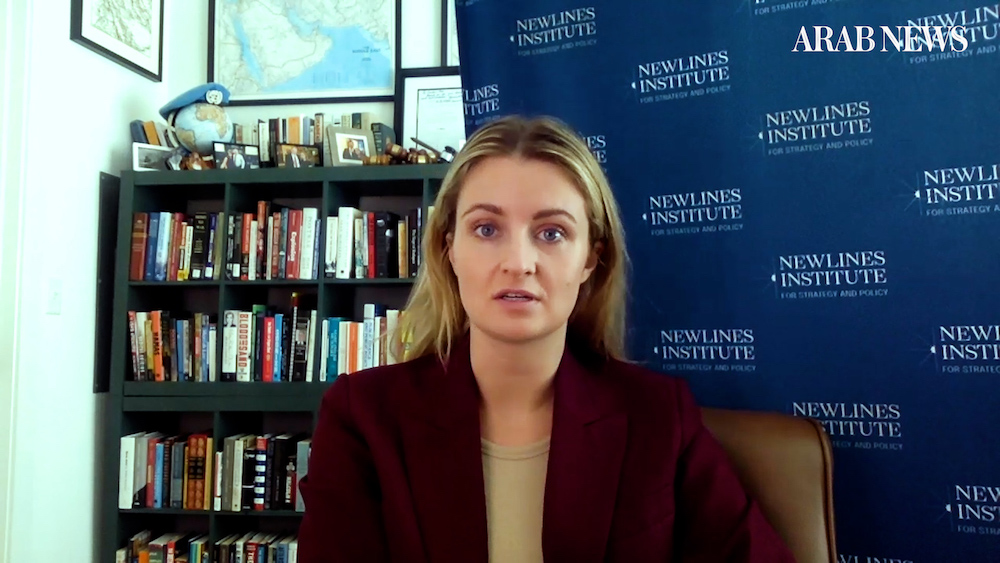
Rose during her Frankly Speaking interview said become extremely popular primarily due to its “variety of different uses.” (AN Photo)
Last month, the Biden administration said it would release a congressional-approved strategy to curb the flow of Captagon from Syria. This has prompted the question of why it took the US almost a decade to act when Syria’s narco-trade began after the war erupted in 2011.
Rose said that the strategy to stem Syria’s Captagon trade was “originally an NDAA (National Defense Authorization Act) amendment in the previous year,” and “it took two years to get it passed.”
She added that “the recognition (of) Captagon as an issue and as a crisis in the region … took quite a while. It took a while to also compound and compile evidence of the regime’s participation in the trade, and for the United States to really wake up to the fact that this was not necessarily just any illicit economy that was in the region, but it was something that had real security and geopolitical implications.
“I think also … just typical bureaucracy as well. It takes very, very long, especially in the US legislative system, to get initiatives like these passed.”
On the prevalence of Captagon in the Middle East and its expanding global reach, Rose said the drug, which is sold at relatively low prices, has become extremely popular primarily due to its “variety of different uses” — it can suppress trauma, improve productivity, and induce a euphoric feeling.
She pointed out that the drug is popular among different demographics in the Gulf, with some people using it recreationally, “but also amongst university students studying for exams to increase productivity. We have seen it across the region used by taxi drivers, by lorry drivers and truck drivers … as well as workers that are looking to work a second shift.”
“The biggest piece of information about Captagon that really should be better communicated to the public, particularly in destination markets like Saudi Arabia, is the fact that we do not know what is inside of Captagon pills anymore,” Rose said.
Elaborating on the point, she said: “It used to be ethylene in the 1960s to the 1980s … but really since the early 2000s, we have seen a variety of different Captagon formulas pop up through one of the very few chemical analyses that have been conducted.”
“And because of this lack of uniformity, producers can make Captagon whatever they want it to be, and that causes and should spark serious, serious public health concerns.”
Saudi Arabia, according to Rose, is a “lucrative” market for Captagon-trafficking networks mainly due to wealth and demographic composition, including “a considerable population of youth with a lot of cash to spend.”
A new documentary by Arab News, titled “Abu Hilalain: Inside the Kingdom’s crackdown on Captagon,” delves into Saudi Arabia’s battle against Captagon, examining the origins, methods of production, and trafficking of the drug while investigating its consumption within the country.

keywords


