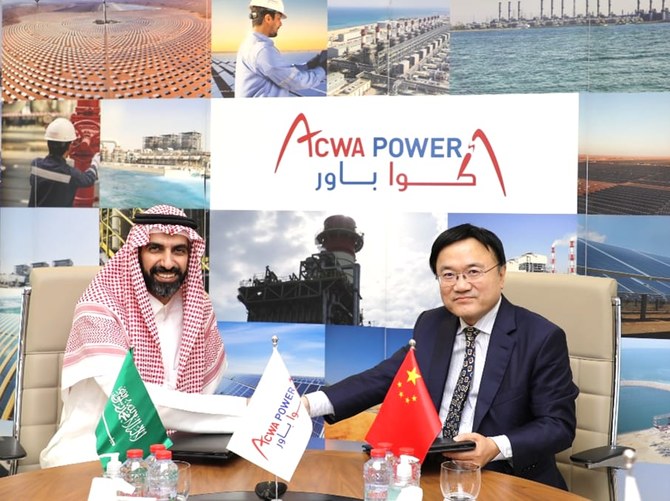
RIYADH: In an effort to boost its operations, Saudi energy firm ACWA Power secured $100 million in a revolving credit facility from China Construction Bank.
Engaged in collaboration with the Chinese bank since 2016, ACWA Power signed the three-year revolver agreement to scale up its power generation and water desalination portfolio in the Middle East, Uzbekistan and Kazakhstan.
“The revolving credit facility by China Construction Bank is an outcome of the ongoing collaboration between ACWA Power and Chinese entities, boosting our near-term liquidity and funding flexibility as we pursue strategic growth opportunities,” said Abdulhameed Al-Muhaidib, the chief financial officer of ACWA Power.
The new revolving facility provides the energy behemoth with additional financing options, enhancing its ability to develop sustainable utility infrastructure in other regions.
The move further strengthens ACWA Power’s commitment to delivering low-carbon solutions and supporting the transition to clean energy.
The agreement also aims to boost the company’s social and economic development operations in the communities it serves.
“Most importantly, it goes to show the confidence that financiers have in our business performance and in our ability to deliver large-scale projects of transformative social and economic value,” said Al-Muhaidib.
Yuan Shengrui, a senior executive of China Construction Bank at the Dubai International Financial Centre branch, said: “The credit facility is reflective of the branch’s interest to strengthen its strategic partnership with ACWA Power and to promote the development of renewable energy projects in line with the directives of the Belt and Road Initiative.”
Both parties have collaborated in the UAE’s 2,400 megawatts Hassyan power plant, a project jointly developed by a consortium of China’s Harbin Electric International and Dubai Electricity and Water Authority.
Moreover, the 485 MW Zarqa gas power plant in Jordan and the 1,500 MW Sirdarya combined-cycle gas turbine power plant in Uzbekistan were also a result of a collaboration between the two parties.
Chinese financiers have also been instrumental in backing ACWA Power’s global project portfolio, with a total investment of $10 billion since 2009, according to a company release.
Chinese engineering, procurement and construction contractors, suppliers and financiers have also played a crucial role in 47 ACWA Power projects, including significant renewable energy and seawater desalination initiatives worldwide.
ACWA Power’s portfolio comprises 77 projects in operation, advanced development, or construction with an investment value of SR293 billion ($78.2 billion) and the capacity to generate 50.4 gigawatts of power and manage 6.8 million cubic meters per day of desalinated water.

ACWA Power secures $100m credit facility from Chinese bank to scale up operations
https://arab.news/j3ruy
ACWA Power secures $100m credit facility from Chinese bank to scale up operations
Arab food and beverage sector draws $22bn in foreign investment over 2 decades: Dhaman
JEDDAH: Foreign investors committed about $22 billion to the Arab region’s food and beverage sector over the past two decades, backing 516 projects that generated roughly 93,000 jobs, according to a new sectoral report.
In its third food and beverage industry study for 2025, the Arab Investment and Export Credit Guarantee Corp., known as Dhaman, said the bulk of investment flowed to a handful of markets. Egypt, Saudi Arabia, the UAE, Morocco and Qatar attracted 421 projects — about 82 percent of the total — with capital expenditure exceeding $17 billion, or nearly four-fifths of overall investment.
Projects in those five countries accounted for around 71,000 jobs, representing 76 percent of total employment created by foreign direct investment in the sector over the 2003–2024 period, the report said, according to figures carried by the Kuwait News Agency.
“The US has been the region's top food and beverage investor over the past 22 years with 74 projects or 14 projects of the total, and Capex of approximately $4 billion or 18 percent of the total, creating more than 14,000 jobs,” KUNA reported.
Investment was also concentrated among a small group of multinational players. The sector’s top 10 foreign investors accounted for roughly 15 percent of projects, 32 percent of capital expenditure and 29 percent of newly created jobs.
Swiss food group Nestlé led in project count with 14 initiatives, while Ukrainian agribusiness firm NIBULON topped capital spending and job creation, investing $2 billion and generating around 6,000 jobs.
At the inter-Arab investment level, the report noted that 12 Arab countries invested in 108 projects, accounting for about 21 percent of total FDI projects in the sector over the past 22 years. These initiatives, carried out by 65 companies, involved $6.5 billion in capital expenditure, representing 30 percent of total FDI, and generated nearly 28,000 jobs.
The UAE led inter-Arab investments, accounting for 45 percent of total projects and 58 percent of total capital expenditure, the report added, according to KUNA.
The report also noted that the UAE, Saudi Arabia, Egypt, and Qatar topped the Arab ranking as the most attractive countries for investment in the sector in 2024, followed by Oman, Bahrain, Algeria, Morocco, and Kuwait.
Looking ahead, Dhaman expects consumer demand to continue rising. Food and non-alcoholic beverage sales across 16 Arab countries are projected to increase 8.6 percent to more than $430 billion by the end of 2025, equivalent to 4.2 percent of global sales, before exceeding $560 billion by 2029.
Sales are expected to remain highly concentrated geographically, with Egypt, Saudi Arabia, Algeria, the UAE and Iraq accounting for about 77 percent of the regional total. By product category, meat and poultry are forecast to lead with sales of about $106 billion, followed by cereals, pasta and baked goods at roughly $63 billion.
Average annual per capita spending on food and non-alcoholic beverages in the region is projected to rise 7.2 percent to more than $1,845 by the end of 2025, approaching the global average, and to reach about $2,255 by 2029. Household spending on these products is expected to represent 25.8 percent of total expenditure in 13 Arab countries, above the global average of 24.2 percent.
Arab external trade in food and beverages grew more than 15 percent in 2024 to $195 billion, with exports rising 18 percent to $56 billion and imports increasing 14 percent to $139 billion. Brazil was the largest foreign supplier to the region, exporting $16.5 billion worth of products, while Saudi Arabia ranked as the top Arab exporter at $6.6 billion.


