

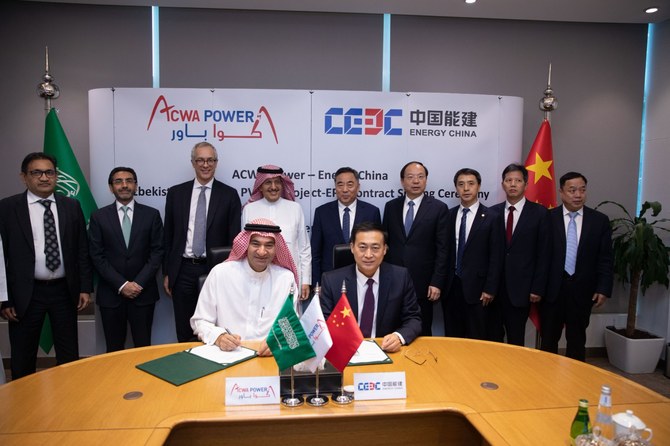
ACWA Power signs deal with Chinese firm for Uzbekistan solar project 

Raad Al-Saady, vice chairman and managing director of ACWA Power, and Lyu Zexiang, chairman of the China Energy International Group Co. signed the agreement. Supplied
Short Url
Updated 20 June 2023
Follow

ACWA Power signs deal with Chinese firm for Uzbekistan solar project 

RIYADH: Saudi Arabia’s ACWA Power has teamed up with Energy China Group Corp. to develop a solar power project in Uzbekistan. 

The two companies signed an engineering, procurement, and construction contract during a meeting in Riyadh, according to a press release. Raad Al-Saady, vice chairman and managing director of ACWA Power, and Lyu Zexiang, chairman of the China Energy International Group Co. signed the agreement.

The power purchase deal for the project was signed in March 2023 between ACWA Power, National Electric Grid of Uzbekistan, and the Central Asian country’s Ministry of Investment, Industry, and Trade. 

The project will form part of Uzbekistan’s ambitious targets to transition to a low-carbon economy as well as diversify its energy sources. 

This deal further consolidates ACWA Power’s ties with Uzbekistan, with the country now the firm’s second most-valuable market after Saudi Arabia. 

The company currently has a range of active projects in Uzbekistan, including four wind projects and a combined gas cycle turbine facility.

In May, the firm signed a hydrogen purchase deal with Uzkimyosanoat, the state-owned chemical company, focusing on decarbonizing the sector through green hydrogen projects, with construction being executed in two phases. 

“Uzbekistan has emerged as one of the most exciting growth countries for ACWA Power in recent years and is our biggest investment geography outside of the Kingdom. We are proud that our giga scale development experience in green hydrogen is making us the preferred choice of partners across the world,” Mohammad Abunayyan, chairman of ACWA Power, said in January.  

The latest deal also strengthens ties between the firm and Chinese companies. 

In December 2022, ACWA Power signed memorandums of understanding with nine Chinese entities during the first Riyadh Arab-China Summit for Cooperation and Development, which also coincided with the state visit of Chinese President Xi Jinping to Saudi Arabia. 


Bahrain to roll out fiscal reforms to bolster public finances

Updated 30 December 2025
Follow

Bahrain to roll out fiscal reforms to bolster public finances

RIYADH: Bahrain’s government has unveiled a comprehensive package of fiscal reforms aimed at curbing public expenditure, generating new revenue streams, and safeguarding essential subsidies for citizens.

According to a report by the Bahrain News Agency, the measures include increases in fuel prices, higher electricity and water tariffs for certain categories, and greater dividend contributions from state-owned enterprises.

The Cabinet emphasized that electricity and water prices will remain unchanged for the first and second tariff bands for citizens’ primary residences, including homes accommodating extended families.

These reforms are aligned with Bahrain’s Economic Vision 2030, which seeks to reinforce fiscal discipline, diversify revenue sources beyond crude oil, and ensure long-term fiscal sustainability.

“The Cabinet confirmed that electricity and water tariffs for the first and second tariff bands for citizens’ primary residences will remain unchanged, taking into account extended families residing in a single household,” BNA reported.

The Cabinet also agreed to defer any changes to the subsidy mechanisms for electricity and water used in citizens’ primary residences until further studies are completed. At the same time, it approved amendments to electricity and water consumption tariffs for other categories, with implementation scheduled to begin in January 2026.

Under the proposed reforms, a 10 percent corporate income tax will be levied on companies with revenues exceeding 1 million Bahraini dinars ($2.6 million) or annual net profits above 200,000 dinars.

The new corporate tax framework is expected to come into force in 2027, subject to the completion of necessary legislative and regulatory approvals.

In addition, Bahrain plans to increase natural gas prices for businesses and reduce administrative government spending by 20 percent as part of broader cost-cutting efforts.

The government also aims to improve the utilization of undeveloped investment land that already has infrastructure in place by introducing a monthly fee of 100 fils per square meter, with implementation anticipated in January 2027.

The Cabinet further tasked the ministers of labor, legal affairs, and health with reviewing fees related to worker permits and health care services.

According to the report, revised fees will be phased in gradually over a four-year period starting in January 2026, with domestic workers exempt from the changes.

Authorities stressed that the reforms are designed to streamline government procedures that support investment, attract foreign capital, and strengthen the role of the private sector in driving economic growth.