Pakistan parliament passes Budget FY2023-24 in line with IMF demands 

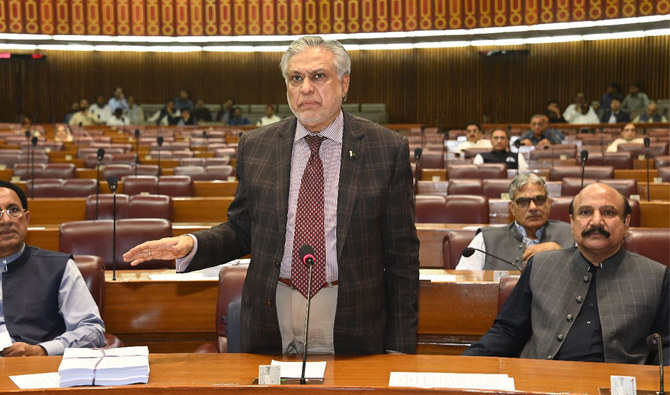
Pakistan's finance minister Ishaq Dar addresses a session of the National Assembly of Pakistan in Islamabad, Pakistan, on June 20, 2023. (@NAofPakistan/Twitter)
Short Url
Updated 25 June 2023
Follow

Pakistan parliament passes Budget FY2023-24 in line with IMF demands 

  • Pakistan to raise Rs215 billion ($752 million) in new tax, cut Rs85 billion ($300 million) in spending 
  • Development comes a day after PM Shehbaz Sharif’s meeting with IMF chief Kristalina Georgieva 

ISLAMABAD: The National Assembly, the lower house of Pakistan parliament, on Sunday approved Federal Budget 2023-24, a day after Prime Minister Shehbaz Sharif’s government added several fiscal tightening measures to it in order to meet the International Monetary Fund (IMF) requirements. 

For the fiscal year starting next month, Pakistan will raise a further 215 billion rupees ($752 million) in new tax and cut 85 billion rupees in spending as well as a number of other measures to shrink the fiscal deficit, according to Finance Minister Ishaq Dar. The measures will revise Pakistan’s revenue collection target to 9.415 trillion rupees ($33 billion) and put total spending at 14.480 trillion rupees ($51 billion). 

Pakistan made the last-ditch effort to secure a $1.1 billion loan tranche from the IMF before its Extended Fund Facility agreed in 2019 expires on June 30. The $6.5 billion program has been stalled since November. With the central bank's foreign exchange reserves barely enough to cover a month of imports, Pakistan is facing an acute balance-of-payment crisis, which analysts say may spiral into a debt default if the IMF funds do not come through. 

The budget was passed during a session that included only 70 lawmakers from the treasury, with Dar defending the government’s move to implement various reforms in the pensions scheme. 

“If someone has a job on a contract then he will have to choose between the two pensions. This should have been corrected a long time ago,” the finance minister said. 

“It is a matter of principle... Our pension bill went to Rs800bn in this budget. It is a huge amount.” 

When a pensioner died, their widowed spouse would receive the stipend, but if the spouse died too, their dependents would get pension for only 10 years, according to Dar. 

The finance minister said the reforms were the need of the hour. 

On Saturday, PM Sharif also held a meeting with IMF Managing Director Kristalina Georgieva in Paris, at which he reiterated Pakistan’s commitment to complete the $6.5 billion loan program. 

The prime minister agreed that “inevitable measures” would have to be taken to overcome the economic crisis that has engulfed Pakistan over the last four years, Pakistani state media reported. 

Pakistan has changed its budget for the financial year starting on July 1 to clinch the stalled IMF bailout. The IMF funding is critical to unlock other bilateral and multilateral financing for the debt-ridden South Asian economy. 


Pakistan accuses India of manipulating Indus waters, warns of risks to regional peace

Updated 58 min 57 sec ago
Follow

Pakistan accuses India of manipulating Indus waters, warns of risks to regional peace

  • India announced in April it was putting the Indus Waters Treaty in abeyance over a gun attack in disputed Kashmir it blamed on Pakistan
  • Islamabad says it has witnessed ‘unusual, abrupt variations’ in the flow of Chenab river, accusing New Delhi of ‘material breaches’ of treaty

ISLAMABAD: Pakistan on Friday accused India of manipulating flows of Indus waters in violation of a 1960 water-sharing treaty, warning that unilateral actions over the transboundary waters could heighten tensions and pose risks to regional peace.

The Indus Waters Treaty (IWT), mediated by the World Bank, divides control of the Indus basin rivers between the two nuclear-armed neighbors. India said in April it was holding the treaty “in abeyance” after a gun attack in Indian-administered Kashmir killed more than 26 tourists. New Delhi blamed the assault on Pakistan, Islamabad denied it.

The treaty grants Pakistan rights to the Indus basin’s western rivers — Indus, Jhelum, and Chenab — for irrigation, drinking, and non-consumptive uses like hydropower, while India controls the eastern rivers — Ravi, Beas, and Sutlej — for unrestricted use but must not significantly alter their flow. India can use the western rivers for limited purposes such as power generation and irrigation, without storing or diverting large volumes, according to the agreement.

Speaking to foreign envoys in Islamabad, Pakistani Deputy Prime Minister Ishaq Dar accused New Delhi of “material breaches” of the IWT that may have consequences for regional stability, citing “unusual, abrupt variations” in the flow of Chenab river from April 30 to May 21 and from Dec. 7 to Dec. 15.

“These variations in water flows are of extreme concern for Pakistan as they point to unilateral release of water by India into River Chenab. India has released this water without any prior notification or any data- or information-sharing with Pakistan as required under the treaty,” he said.

“India’s most recent action clearly exemplifies the weaponization of water to which Pakistan has been consistently drawing attention of the international community.”

There was no immediate response from New Delhi to the statement.

Dar said this water “manipulation” occurs at a critical time in Pakistan’s agricultural cycle and directly threatens the lives and livelihoods as well as food and economic security of its citizens.

He shared that Indian actions prompted Indus Water Commissioner Mehar Ali Shah to write a letter to his Indian counterpart, seeking clarification on the matter as provided under the Indus Waters Treaty.

“We expect India to respond to the queries raised by Pakistan’s Indus water commissioner, refrain from any unilateral manipulation of river flows, and fulfill all its obligations in letter and spirit under the Indus Waters Treaty provisions,” the Pakistani deputy premier said.

Dar also accused India of consistently trying to undermine the IWT by building various dams, including Kishenganga and Ratle hydropower projects, which he said sets “a very dangerous precedent.”

“Alarmingly, India is now subverting the treaty’s own dispute resolution mechanism by refusing to participate in the Court of Arbitration and neutral expert proceedings. India is pursuing a deliberate strategy to sabotage the well-established arbitration process under the treaty provisions,” he said.

The South Asian neighbors have been arguing over hydroelectric projects on the shared Indus river system for decades, with Pakistan complaining that India’s planned hydropower dams will cut its flows.

In August, the International Court of Arbitration rendered an award on issues of general interpretation of the IWT, explaining the designed criteria for the new run-of-river hydropower projects to be constructed by India on the western rivers of Chenab, Jhelum and Indus, which Islamabad said vindicated its stance.

In its findings, the Court of Arbitration declared that India shall “let flow” the waters of the western rivers for Pakistan’s unrestricted use. In that connection, the specified exceptions for generation of hydro-electric plants must conform strictly to the requirements laid down in the Treaty, rather than to what India might consider an “ideal” or “best practices approach,” according to the Pakistani foreign office.

“Pakistan would like to reiterate that Indus Waters Treaty is a binding legal instrument that has made an invaluable contribution to peace and stability of South Asia,” Dar said.

“Its violation, on the one hand, threatens the inviolability of international treaties and on the other, it poses serious risks to regional peace and security, principles of good neighborhood, and norms that govern inter-state relations.”