Muscovites made uneasy by revolt, Ukrainians pleased at internal turmoil

1 / 3
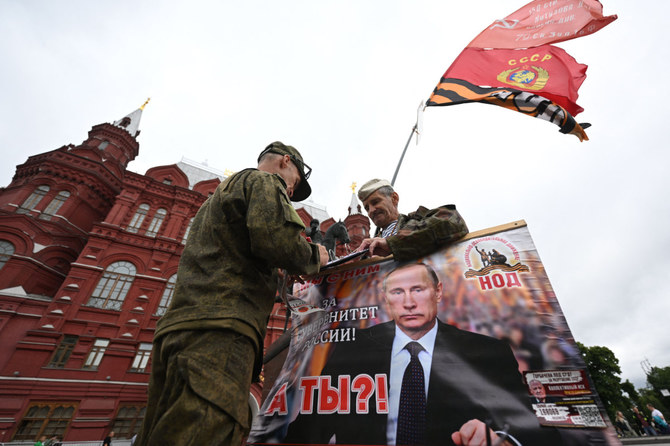
Activists hold a portrait of Russian President Vladimir Putin near Red Square in Moscow, on June 24, 2023, amid a rebellion by the Wagner mercenary group. (AFP)
2 / 3
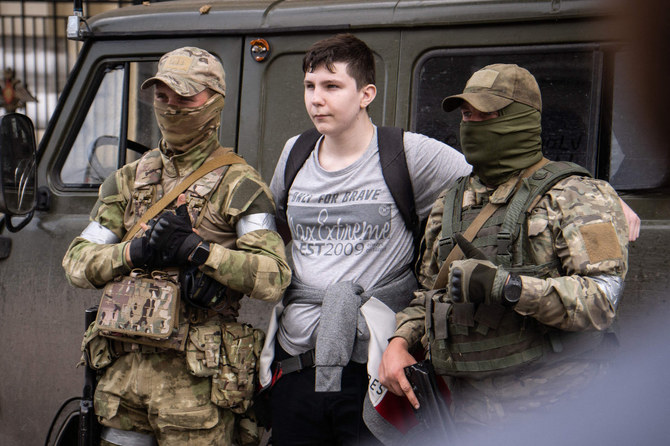
A man poses for a photo with members of Wagner group in a street in the city of Rostov-on-Don on June 24, 2023, as the mercenary allies of President Putin announced a rebellion. (AFP)
3 / 3
A man waves a Russian national flag near Moscow's Red Square on June 24, 2023, amid a rebellion by the Wagner mercenary group. (AFP)
Short Url
Updated 25 June 2023
Follow

Muscovites made uneasy by revolt, Ukrainians pleased at internal turmoil

  • Moscow's mayor declared that a “counter-terrorism regime” was in force before Wagner leader Yevgeny Prigozhin announced that his fighters would turn back to avoid bloodshed
  • In Kyiv’s Independence Square, residents enjoying a stroll acknowledged a certain pleasure in watching the Russian standoff

MOSCOW/KYIV: Muscovites on Saturday expressed unease or dismissed as political theater a standoff pitting the Kremlin against Wagner mercenaries who had vowed to descend on the capital in a “march of justice” denouncing the conduct of the war in Ukraine.

Ukrainians, on the other hand, were clearly satisfied, sometimes gleeful, at the prospect of a split in Russian ranks 16 months after the Kremlin’s troops invaded their country.
Moscow Mayor Sergei Sobyanin, an ally of President Vladimir Putin, had declared that a “counter-terrorism regime” was in force, before the leader of the Wagner private militia announced that his fighters would turn back to avoid bloodshed.
Yevgeny Prigozhin had said he wanted to oust the army’s top brass and “restore justice,” while Putin had promised to crush the mutiny.
One Moscow resident who gave his name as Nikolai — declining like others to give his surname — watched the military take up positions to protect the city.
“It’s frightening of course — you sit at home thinking about what might happen,” he told Reuters. “It’s disturbing, both for you and your loved ones.”
Some residents found it hard to grasp the scale of events.
“It’s really tough news, really unexpected. I’ve just come back from university. I’ve just done my last exam — and the news was really unexpected as I was prepping (for the exam) last night,” said Vladimir, a student. “I don’t really know how to react. I haven’t really got my head around it yet.”
In Kyiv’s Independence Square, packed with residents enjoying a stroll, Natalia Tanich, 48, acknowledged a certain pleasure in watching the Russian standoff.
“I enjoy what is happening in Russia. The inevitable conflict between Prigozhin and Putin was expected,” she said. “I don’t know what may come out of it. But I wish for them to shoot each other and die.”
In Kkarkiv, Ukraine’s second city subjected to frequent shelling since the invasion, Ivan said the confrontation was a consequence of volatile politics and the protracted conflict.
“They started the war and now they are getting it back. The harder you compress a spring, the harder it comes back,” he said. “The situation was compressed to such an extent in Russia that it became hopeless. I consider what happened a natural event. It will influence the war but I think it will not be over in a day. We will have to endure a bit.”

POST-SOVIET SHOWCASE
In Moscow, under Mayor Sobyanin, the state has spent vast amounts to transform the city into an urban showcase with relatively low crime. That is a far cry from the drab Soviet era, and the 1990s when it was plagued by contract killings or, later, suffered attacks by Chechen separatists.
A woman called Galina said she thought what was happening was some kind of “provocation.”
“It doesn’t frighten me at all,” she said. “I have confidence in our president and our people.”
One man who declined to be named at all said he thought it was just politics playing out.
“They might cancel a few events, and I make my living from events. I have an event going on now, so I could lose out because of this,” he said.
“But otherwise, it’s their business, it’s politics — let them get on with it.”


South Africa defends naval drills with Iran, Russia as ‘essential’

Updated 4 sec ago
Follow

South Africa defends naval drills with Iran, Russia as ‘essential’

  • The drills — led by China — were more than a military exercise, Captain Thamaha said
  • “It is a demonstration of our collective resolve to work together“

SIMON’S TOWN, South Africa: South Africa on Saturday began naval drills with Russia, Iran and China, describing the maneuvers off its coast as not merely a show of force but a vital response to rising maritime tensions.
The weeklong ‘Will for Peace 2026’ exercises come just days after the United States seized a Russian-flagged oil tanker in the North Atlantic, saying it carried crude bound for Venezuela, Russia and Iran in violation of Western sanctions.
The seizure followed an American raid that toppled Moscow’s ally Nicolas Maduro in Caracas.
The drills — led by China — were more than a military exercise and a statement of intent among the BRICS group of emerging nations, Captain Nndwakhulu Thomas Thamaha, South Africa’s joint taskforce commander, told the opening Ceremony.
“It is a demonstration of our collective resolve to work together,” he said.
BRICS, originally made up of Brazil, Russia, India, China and South Africa, has expanded to include Egypt, Ethiopia, Iran, Saudi Arabia, the United Arab Emirates and, more recently, Indonesia.
China and Iran deployed destroyer warships, while Russia and the United Arab Emirates sent corvette vessels. Host South Africa dispatched a frigate.
Indonesia, Ethiopia and Brazil joined as observers.
“In an increasingly complex maritime environment, cooperation such as this is not an option, it is essential,” said Thamaha.
The exercises were to “ensure the safety of shipping lanes and maritime economic activities,” he said.
Previously known as Exercise Mosi, the drills were initially scheduled for last November but postponed due to a clash with the G20 summit in Johannesburg, boycotted by the United States.
Washington has accused South Africa and the BRICS bloc of ‘anti?American’ policies and warned members they could face an additional 10 percent tariff on top of existing duties already applied worldwide.
South Africa has also drawn US criticism for its close ties with Russia and a range of other policies, including its decision to bring a genocide case against Washington ally Israel at the International Court of Justice over the Gaza war.
South Africa drew criticism for hosting naval drills with Russia and China in 2023, coinciding with the first anniversary of Moscow’s invasion of Ukraine.
The three nations first conducted joint naval drills in 2019.