

Search for missing Titanic sub ends on grim note with no survivors found

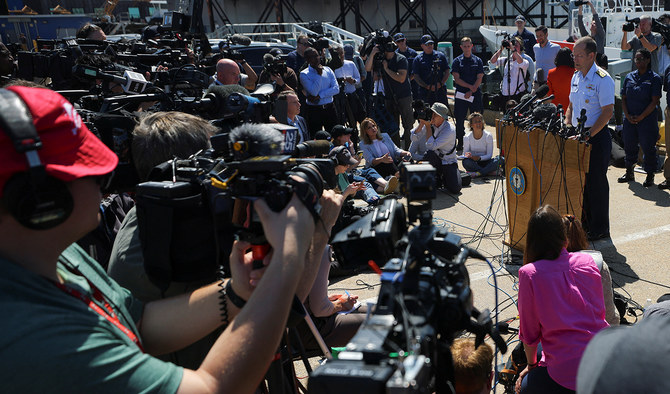
Rear Admiral John Mauger, the First Coast Guard District commander, speaks during a press conference updating about the search of the missing submersible, which is carrying five people to explore the wreck of the sunken Titanic, in Boston, Massachusetts, United States, on June 22, 2023. (REUTERS)
Short Url
Updated 22 June 2023
Follow

Search for missing Titanic sub ends on grim note with no survivors found

  • Unmanned, deep-sea robot discovers submersible's wreckage on Thursday morning
  • Pakistani business magnate, son, and three others were among crew members on sub

The five people aboard a missing submersible died in a "catastrophic" event, a Coast Guard official said on Thursday, bringing a grim end to the massive search for the vessel that was lost during a voyage to the Titanic.

"These men were true explorers who shared a distinct spirit of adventure, and a deep passion for exploring and protecting the world's oceans," OceanGate Expeditions said in a statement.

 "Our hearts are with these five souls and every member of their families during this tragic time."

An unmanned deep-sea robot deployed from a Canadian ship discovered the wreckage of the submersible on Thursday morning about 1,600 feet (488 meters) from the bow of the century-old wreck, 2-1/2 miles (4 km) below the surface, U.S. Coast Guard Rear Admiral John Mauger said at a press conference.

"The debris is consistent with a catastrophic loss of the pressure chamber," Mauger said.
Rescue teams from several countries have spent days searching thousands of square miles of open seas with planes and ships for any sign of the 22-foot (6.7-meter) Titan, operated by U.S.-based OceanGate Expeditions.

The submersible lost contact on Sunday morning with its support ship about an hour and 45 minutes into what should have been a two-hour descent.

The five people aboard included the British billionaire and explorer Hamish Harding, 58; Pakistani-born business magnate Shahzada Dawood, 48, and his 19-year-old son, Suleman, both British citizens; French oceanographer and Titanic expert Paul-Henri Nargeolet, 77, who had visited the wreck dozens of times; and Stockton Rush, the American founder and chief executive of OceanGate, who was piloting the submersible.

The detection of undersea noises on Tuesday and Wednesday using sonar buoys dropped from Canadian aircraft had temporarily offered hope that the people on board the submersible were alive and trying to communicate by banging on the hull.

But officials warned that analysis of the sound was inconclusive and that the noises might not have emanated from the Titan at all.

Even if the Titan has survived, the air supply on board was estimated at 96 hours when it entered the water on Sunday around 8 a.m. (1200 GMT), meaning that the occupants likely would have run out of oxygen by Thursday morning.

The Titanic, which sank in 1912 on its maiden voyage after hitting an iceberg, killing more than 1,500 people, lies about 900 miles (1,450 km) east of Cape Cod, Massachusetts, and 400 miles (640 km) south of St. John's, Newfoundland.

The expedition to the wreck, which OceanGate has been operating since 2021, cost $250,000 per person, according to OceanGate's website.

Questions about Titan's safety were raised in 2018 during a symposium of submersible industry experts and in a lawsuit by OceanGate's former head of marine operations, which was settled later that year.

The sweeping search covered more than 10,000 square miles of ocean - about the size of the U.S. state of Massachusetts. On Thursday, the deployment of two specialized deep-sea unmanned vehicles expanded the effort to the ocean's depths, where immense pressure and pitch-black darkness had promised to complicate any rescue mission.

The missing submersible and subsequent hunt captured worldwide attention, in part due to the mythology surrounding the Titanic. 

The "unsinkable" British passenger liner has inspired both nonfiction and fiction accounts for a century, including the James Cameron blockbuster 1998 movie, which rekindled popular interest in the story.


Venezuela’s acting president calls for oil industry reforms to attract more foreign investment

Updated 4 sec ago
Follow

Venezuela’s acting president calls for oil industry reforms to attract more foreign investment

  • In her speech, Rodríguez said money earned from foreign oil sales would go into two funds: one dedicated to social services for workers and the public health care system, and another to economic development and infrastructure projects

CARACAS, Venezuela: Venezuela’s acting President Delcy Rodriguez used her first state of the union address on Thursday to promote oil industry reforms that would attract foreign investment, an objective aggressively pushed by the Trump administration since it toppled the country’s longtime leader less than two weeks ago.
Rodríguez, who has been under pressure from the US to fall in line with its vision for the oil-rich nation, said sales of Venezuelan oil would go to bolster crisis-stricken health services, economic development and other infrastructure projects.
While she sharply criticized the Trump administration and said there was a “stain on our relations,” the former vice president also outlined a distinct vision for the future between the two historic adversaries, straying from her predecessors, who have long railed against American intervention in Venezuela.
“Let us not be afraid of diplomacy” with the US, said Rodriguez, who must now navigate competing pressures from the Trump administration and a government loyal to former President Nicolás Maduro.
The speech, which was broadcast on a delay in Venezuela, came one day after Rodríguez said her government would continue releasing prisoners detained under Maduro in what she described as “a new political moment” since his ouster.
Trump on Thursday met at the White House with Venezuelan opposition leader María Corina Machado, whose political party is widely considered to have won 2024 elections rejected by Maduro. But in endorsing Rodríguez, who served as Maduro’s vice president since 2018, Trump has sidelined Machado.
In her speech, Rodríguez said money earned from foreign oil sales would go into two funds: one dedicated to social services for workers and the public health care system, and another to economic development and infrastructure projects.
Hospitals and other health care facilities across the country have long suffered. Patients are asked to provide practically all supplies needed for their care, from syringes to surgical screws. Economic turmoil, among other factors, has pushed millions of Venezuelans to migrate from the South American nation in recent years.
In moving forward, the acting president must walk a tightrope, balancing pressures from both Washington and top Venezuelan officials who hold sway over Venezuela’s security forces and strongly oppose the US Her recent public speeches reflect those tensions — vacillating from conciliatory calls for cooperation with the US, to defiant rants echoing the anti-imperialist rhetoric of her toppled predecessor.
American authorities have long railed against a government they describe as a “dictatorship,” while Venezuela’s government has built a powerful populist ethos sharply opposed to US meddling in its affairs.
For the foreseeable future, Rodríguez’s government has been effectively relieved of having to hold elections. That’s because when Venezuela’s high court granted Rodríguez presidential powers on an acting basis, it cited a provision of the constitution that allows the vice president to take over for a renewable period of 90 days.
Trump enlisted Rodríguez to help secure US control over Venezuela’s oil sales despite sanctioning her for human rights violations during his first term. To ensure she does his bidding, Trump threatened Rodríguez earlier this month with a “situation probably worse than Maduro.”
Maduro, who is being held in a Brooklyn jail, has pleaded not guilty to drug-trafficking charges.
Before Rodríguez’s speech on Thursday, a group of government supporters was allowed into the presidential palace, where they chanted for Maduro, who the government insists remains the country’s president. “Maduro, resist, the people are rising,” they shouted.