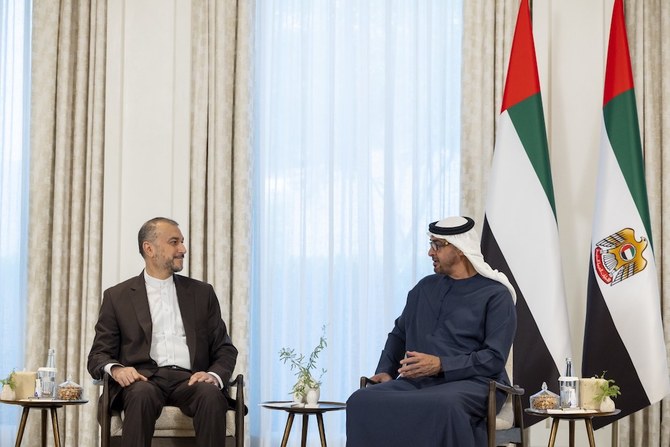
UAE President Sheikh Mohamed meets Iran’s top envoy

UAE President Sheikh Mohamed bin Zayed Al-Nahyan on Thursday met with Iran’s foreign affairs minister Hossein Amir-Abdollahian. (WAM)
Short Url
Updated 22 June 2023
Follow

UAE President Sheikh Mohamed meets Iran’s top envoy

  • Abdollahian earlier met with leaders and officials during his visit to Qatar and Oman

DUBAI: UAE President Sheikh Mohamed bin Zayed Al-Nahyan on Thursday met with Iran’s foreign affairs minister Hossein Amir-Abdollahian, who is on the second leg of his tour of Gulf countries.

The two officials discussed bilateral relations and ways to enhance cooperation, state news agency WAM reported, and also “exchanged views on a number of regional and international issues, and also discussed the importance of building on positive developments to benefit the people of the region and enhance regional stability and prosperity.”

Sheikh Mohamed conveyed his greetings to his Iranian counterpart, along with his wishes for further growth and development for Iran and its people, WAM added.

Abdollahian earlier met with leaders and officials during his visit to Qatar and Oman, and is also expected to have dialogues with the Kuwaiti leadership after his stop in the UAE.

On Wednesday, Iran’s top diplomat met Sultan bin Mohammed Al-Numani, minister of Oman’s royal office, for talks on ties between their countries and “several areas of cooperation.”

Abdollahian also sat down with his Omani counterpart Sayyid Badr Albusaidi for follow-up discussions related to Sultan Haitham bin Tariq’s two-day visit in Iran last month.


Death toll in Iran protests over 3,000, rights group says

Updated 7 sec ago
Follow

Death toll in Iran protests over 3,000, rights group says

  • The protests erupted on December 28 over economic hardship and swelled into widespread demonstrations calling for the end of clerical rule
  • President Donald Trump, who had threatened ‘very strong action’ if Iran executed protesters, said Tehran’s leaders had called off mass hangings

DUBAI: More than 3,000 people have died in Iran’s nationwide protests, rights activists said on Saturday, while a “very slight rise” in Internet activity was reported in the country after an eight-day blackout.

The US-based HRANA ​group said it had verified 3,090 deaths, including 2,885 protesters, after residents said the crackdown appeared to have broadly quelled protests for now and state media reported more arrests.

The capital Tehran has been comparatively quiet for four days, said several residents reached by Reuters. Drones were flying over the city, but there were no signs of major protests on Thursday or Friday, said the residents, who asked not to be identified ‌for their safety.

A ‌resident of a northern city on the ‌Caspian ⁠Sea ​said ‌the streets there also appeared calm.

The protests erupted on December 28 over economic hardship and swelled into widespread demonstrations calling for the end of clerical rule in the Islamic Republic, culminating in mass violence late last week. According to opposition groups and an Iranian official, more than 2,000 people were killed in the worst domestic unrest since Iran’s 1979 Islamic Revolution.

“Metrics show a very ⁠slight rise in Internet connectivity in #Iran this morning” after 200 hours of shutdown, the ‌Internet monitoring group NetBlocks posted on X. Connectivity ‍remained around 2 percent of ordinary levels, ‍it said.

A few Iranians overseas said on social media that ‍they had been able to message users living inside Iran early on Saturday.

US President Donald Trump, who had threatened “very strong action” if Iran executed protesters, said Tehran’s leaders had called off mass hangings.

“I greatly respect the fact that all scheduled ​hangings, which were to take place yesterday (Over 800 of them), have been canceled by the leadership of Iran. Thank you!” he ⁠posted on social media.

Iran had not announced plans for such executions or said it had canceled them.

Indian students and pilgrims returning from Iran said they were largely confined to their accommodations while in the country, unable to communicate with their families back home.

“We only heard stories of violent protests, and one man jumped in front of our car holding a burning baton, shouting something in the local language, with anger visible in his eyes,” said Z Syeda, a third-year medical student at a university in Tehran.

India’s External Affairs Ministry said on Friday that commercial flights were available and that ‌New Delhi would take steps to secure the safety and welfare of Indian nationals.