

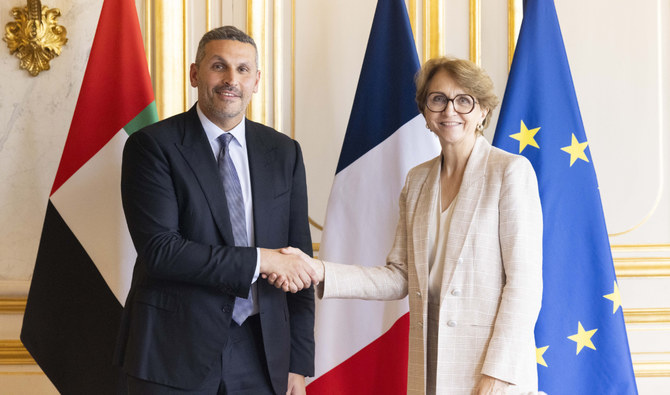


DUBAI: The 15th session of the UAE-France Strategic Dialogue held in Paris underlined the commitment to expanding cooperation in key fields and sectors, as directed by UAE President Sheikh Mohammed bin Zayed Al-Nahyan and French President Emmanuel Macron, Emirates News Agency reported.
The two sides on Monday discussed the status of the strategic bilateral investment partnerships, which were signed in December 2021. They praised Etihad Rail’s developing partnership with its equivalent French enterprises.
In the energy sector, the UAE and France are continuing their engagement under the Comprehensive Strategic Energy Partnership, which aims to deepen bilateral cooperation.
Both countries are expanding talks on a collaboration to finance the energy transition, which will be unveiled at COP28. They also emphasized the urgent need for the international community to significantly increase efforts in order to meet the Paris Agreement’s goals.
The two parties also agreed to highlight the importance of nuclear energy as the foundation of low-carbon electricity generation. They emphasized the importance of reforming international financial institutions and better mobilizing resources for developing-country climate transitions.
Both parties welcomed progress in institutional cooperation to support the UAE’s nuclear program, including the signing of multiple memorandums of understanding, and programs in R&D, capacity building, and nuclear industrial cooperation in the areas of maintenance and engineering services, as well as collaboration between the French and Emirati supply chains through the “E-Fusion” initiative.
The UAE and French representatives underlined their long-term commitment to cooperative projects such as the Louvre Abu Dhabi and Sorbonne University Abu Dhabi. They explored new partnership programs in the museum sector, as well as the cultural and creative sectors.
Both parties also discussed a cultural cooperation proposal aimed at assisting with the renovation of the Chateau of Versailles’ Grand Trianon, a UNESCO World Heritage Site.
An intergovernmental agreement between the two parties is being considered in order to strengthen bilateral cooperation in higher education.
The discussion praised the establishment of new French university programs and campuses in the UAE, and it anticipates the arrival of Rubika, an international gaming and animation school, in Abu Dhabi in September 2023.
Both parties applauded the UAE’s strong momentum in French education, which has resulted from the opening of new French schools and a new Alliance Francaise in Sharjah, as well as the continued French language instruction program in public schools.
They also praised ICAN Institute’s research collaboration in cardiology with many UAE institutions, as well as the long-running medical residency program that allows 18 Emirati doctors to be trained in France each year, and recently launched vocational training in nursing.


