RIYADH: Saudi Arabia has hits yet another milestone in its efforts to improve the quality of life and promote a sustainable multimodal mobility system with the testing of air taxi flights in NEOM.
The flight test campaign lasted over a week and built on 18 months of collaboration between NEOM, the General Authority of Civil Aviation and Volocopter, with the aim of implementing and scaling an electric urban air mobility ecosystem and test bed in NEOM, said a statement issued on Wednesday.
Nadhmi Al-Nasr, CEO of NEOM, said: “The successful test flight of a Volocopter eVTOL (electric Vertical Take-Off and Landing) is a tangible example of NEOM as a global accelerator and incubator of solutions to the world’s most pressing challenges. Driving the development of smart, sustainable, and safe mobility systems will improve livability and connectivity in cities around the world and reduce carbon emissions, creating a cleaner future for all.”
The parties worked closely to ensure full regulatory compliance and safety ahead of the test flights.
Commenting on the achievement, GACA President Abdulaziz A. Al-Duailej said it is yet another steady step toward achieving the goals of the Kingdom’s aviation sector’s strategy “through innovation and employing emerging technologies to create new industries that contribute to the output GDP (gross domestic product) and create more jobs.”
He added: “It also confirms GACA’s commitment to enabling the safe integration of innovative air transport patterns that improve the mobility experience of individuals in urban areas and the quality of life in the Kingdom of Saudi Arabia.”
In 2021, NEOM and Volocopter founded a joint venture to scale advanced air mobility, positioning NEOM as a collaborative, global living lab for the future of transportation.
Christian Bauer, chief commercial officer of Volocopter, said: “It is beyond exciting to see our work from the past 18 months come to fruition. As the first eVTOL aircraft to ever test in Saudi Arabia, we are proud to have laid the groundwork for our future collaboration here in NEOM.”
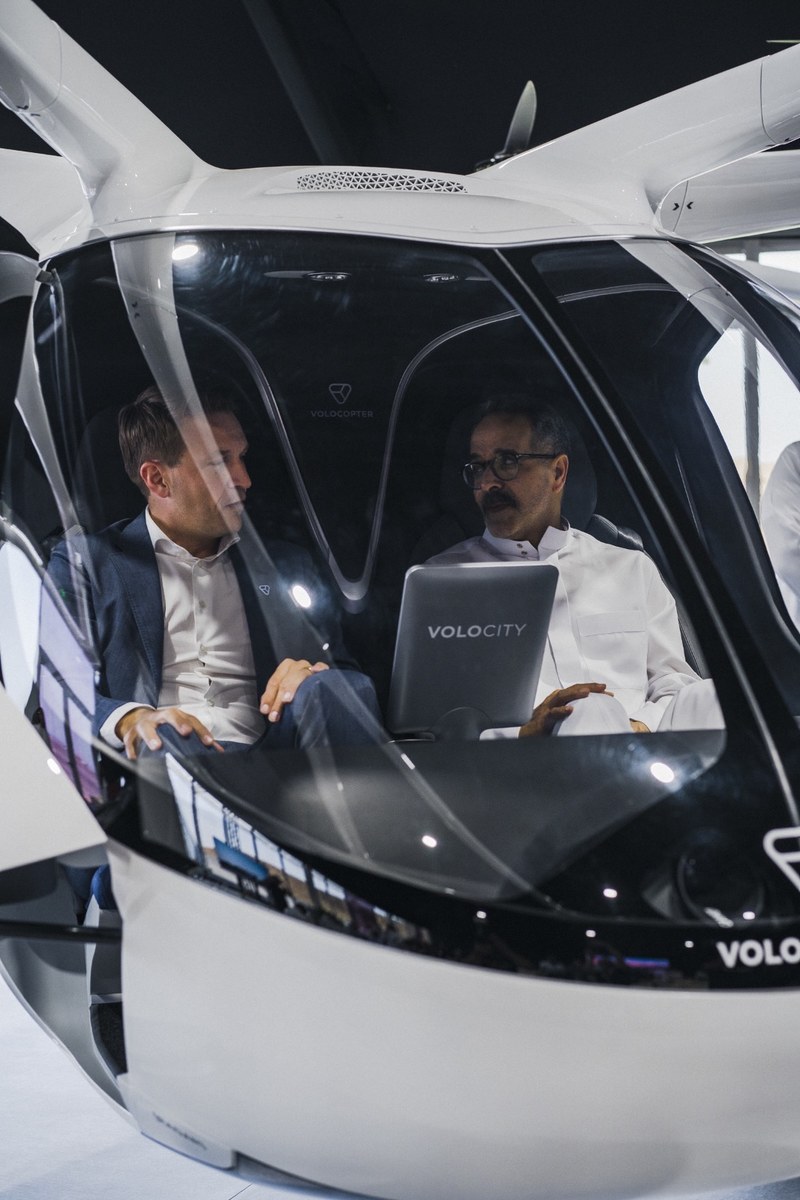
NEOM CEO Nadhmi Al-Nasr, right, and Christian Bauer, chief commercial officer of Volocopter (Supplied)
The test campaign focused on the flight performance of the Volocopter aircraft in local climate and environmental conditions, as well as testing its integration into the local unmanned aircraft system traffic management system, the statement said.
Volocopter eVTOLs will be key to NEOM’s smart and sustainable multimodal mobility system, which will be powered by 100 percent renewable energy, generated by solar and wind energy sources.
According to the statement, eVTOL aircraft will be used as air taxis and emergency response vehicles. These aircraft are quieter, more easily adaptable and cheaper to operate than the helicopters often employed today.
“They have smaller on-ground infrastructure footprint, fewer operating restrictions, and employ smart and autonomous capabilities that ensure both safety and sustained relevance in future contexts,” it added.
The test flight announcement builds on NEOM’s over $190 million investment and joint venture with Volocopter and positions the $500 billion giga-project as a leader in future mobility solutions.
Volocopter expects to obtain type certification of its VoloCity air taxi in 2024, enabling future commercial operations. The company also recently announced the commencement of VoloCity serial production at its facilities in Bruchsal, Germany, with a capacity to deliver more than 50 aircraft a year under one-shift conditions.