UNITED NATIONS: Praising yoga as “truly universal,” Indian Prime Minister Narendra Modi joined a crowd of diplomats and dignitaries for a morning yoga session on Wednesday at the United Nations and kicked off the public portion of his US visit by calmly flexing India’s cultural reach.
With a checkerboard of made-in-India yoga mats covering the UN headquarters’ spacious north lawn, Modi stopped and bowed at a statue of the assassinated Indian independence leader Mahatma Gandhi. Then, in brief remarks, Modi turned to the topic at hand, portraying yoga as an all-ages, try-it-anywhere practice accessible to all faiths and cultures.
“When we do yoga, we feel physically fit, mentally calm and emotionally content. But it is not just about doing exercise on a mat,” Modi said. “Yoga is a way of life.”
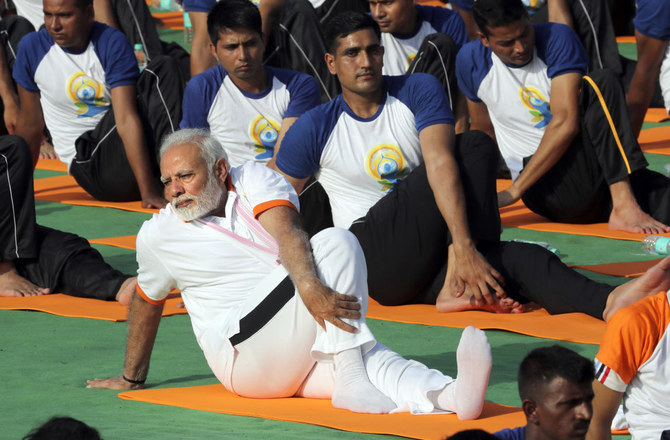
Then the leader of the world’s most populous nation took his spot on a mat amid the throng, hands folded, as a yoga instructor led the opening chants and a cloud-filtered sun glinted off the adjacent East River and the flags of the world body’s member nations rippled in the breeze.
The event honors the International Day of Yoga, which Modi persuaded the UN to designate in 2014 as an annual observance.
Modi arrived in New York on Tuesday for a trip that will offer plenty of time to discuss global tensions. But starting out by highlighting an ancient pursuit of inner tranquility is a savvy and symbolic choice for a premier who has made yoga a personal practice and a diplomatic tool.
Modi, a Hindu nationalist, casts himself as an ascetic who adheres to his religion’s strictures on vegetarianism and yoga. He has posted social media videos over the years of himself practicing yoga poses (to say nothing of providing live visuals of him meditating in a Himalayan mountain cave after national elections in 2019).
Modi last visited the UN during the 2021 General Assembly, where he said that “all kinds of questions have been raised about the UN” and its effectiveness on matters including climate change, the coronavirus pandemic and terrorism.
He also made a point of staking out his country’s place in the international community, noting that “every sixth person in the world is Indian.” In the years since his speech, India has surpassed China to claim the world’s largest population, at 1.425 billion.
India has long sought a permanent seat on the Security Council, the UN’s most powerful organ. India has been elected to a two-year seat several times, most recently for 2021-22.
Modi planned to head to Washington later Wednesday for a three-day visit that includes an Oval Office meeting with President Joe Biden, an address to a joint meeting of Congress, a White House state dinner and more. Among the plans: a State Department luncheon hosted by Vice President Kamala Harris, whose mother was born in India, and by Secretary of State Antony Blinken.
The visit comes as both countries are interested in strengthening ties.
The US has been looking to India, also the world’s biggest democracy, as a key partner on matters that include checking China’s ambitions in the Indo-Pacific region. India, meanwhile, wants to bolster military and trade connections with the US
However, human rights advocates are urging Biden to press Modi on human rights issues, both international and within India. Modi has faced criticism over legislation that fast-tracks citizenship for some migrants but excludes Muslims; a rise in violence against Muslims and other religious minorities by Hindu nationalists; and the recent conviction of India’s top opposition leader, Rahul Gandhi, for mocking Modi’s surname. (Gandhi recently visited the US himself, speaking to private organizations and university students.)
The Indian government defends its human rights record and insists that the nation’s democratic principles remain rock-solid.
On Tuesday evening, Modi met with a range of prominent US academics and health experts, scientists and business leaders, including Tesla CEO Elon Musk.
Speaking to media afterwards, Musk said he was excited about India’s future and the opportunities it presented.
“I think India has more promise than any large country in the world,” Musk said, adding that he was confident Tesla “will be in India … as soon as humanly possible.” The tech billionaire last month said his company may pick a location for a new factory by the end of this year and that India was an interesting place for it.


![]()

Indian Prime Minister Modi showcases yoga and his country’s cultural diplomacy on the UN lawn
Short Url
https://arab.news/nvc8p
Indian Prime Minister Modi showcases yoga and his country’s cultural diplomacy on the UN lawn
- “When we do yoga, we feel physically fit, mentally calm and emotionally content. But it is not just about doing exercise on a mat,” Modi said
- The event honors the International Day of Yoga, which Modi persuaded the UN to designate in 2014 as an annual observance


Latest updates


Recommended


© 2026 SAUDI RESEARCH & PUBLISHING COMPANY, All Rights Reserved And subject to Terms of Use Agreement.