

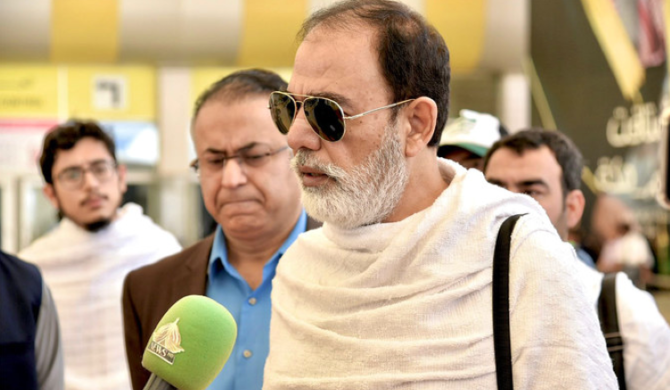
Pakistan’s religion minister leaves for Saudi Arabia to review Hajj arrangements

Pakistan’s Religious Affairs Minister Talha Mahmood. (Supplied)
Short Url
Updated 19 June 2023
Follow

Pakistan’s religion minister leaves for Saudi Arabia to review Hajj arrangements

  • Talha Mahmood will meet Saudi officials as well as Pakistani pilgrims during Hajj
  • Saudi Arabia has reinstated Pakistan’s pre-pandemic Hajj quota of 179,210 pilgrims

Pakistan’s Religious Affairs Minister Talha Mahmood has left for Saudi Arabia to review arrangements made by Pakistani authorities for the country’s Hajj pilgrims in the Kingdom, the Pakistani Religious Affairs Ministry said on Monday. 

Hajj is an obligatory religious ritual for adult Muslims who are physically and financially capable of carrying it out. It involves visiting the holy cities of Makkah and Madinah at least once in a lifetime and takes place during the last month of the lunar Islamic calendar called Dul Hijjah. 

This year, Saudi Arabia reinstated Pakistan’s pre-pandemic Hajj quota of 179,210 pilgrims and scrapped the upper age limit of 65 in January. About 80,000 Pakistani pilgrims are expected to perform the pilgrimage under the government scheme this year, while the rest will be facilitated by private tour operators. 

“Religious Affairs Minister Talha Mahmood will perform Umrah today,” the ministry said in a statement. 

“After performing Umrah, he will review (Pakistan’s) Hajj operation.” 

Mahmood would also meet Saudi officials as well as Pakistani pilgrims during the Hajj pilgrimage, the ministry added. 

More than 70,000 Pakistani pilgrims have reached Saudi Arabia so far while the remaining are scheduled to reach there by this next week, according to the ministry. 

Pakistan started the pre-Hajj flight operation to Saudi Arabia from different cities, including Karachi, Lahore and Faisalabad, on May 21 and it is expected to continue until June 21.


Foreign ministers chair Saudi-Omani coordination council meeting in Muscat

Updated 23 December 2025
Follow

Foreign ministers chair Saudi-Omani coordination council meeting in Muscat

MUSCAT: Saudi Foreign Minister Prince Faisal bin Farhan met with Oman’s Foreign Minister Sayyid Badr bin Hamad Al-Busaidi on Monday.

They reviewed bilateral relations between their nations and ways to enhance and develop them across various fields. Additionally, they discussed regional and international developments.

The ministers co-chaired the third meeting of the Saudi-Omani Coordination Council in the Omani capital, Muscat, with the participation of the heads of the Council’s subsidiary committees and the two heads of the Council’s General Secretariat teams.

The meeting comes as an affirmation of the keenness of Saudi and Omani leaders to strengthen ties and advance them toward greater prosperity for both nations.

In his remarks during the meeting, Prince Faisal affirmed that gathering builds on the previous council meeting, held last year in AlUla, and on its positive and fruitful outcomes within the framework of the approved recommendations and initiatives. 

He stressed the importance of continuing the work of the council’s subsidiary committees to complete the necessary procedures to implement the remaining initiatives, and of the General Secretariat’s role in follow-up and in addressing any challenges that may hinder implementation.

He also underscored the importance of developing and enhancing trade relations, stimulating investment, and strengthening cooperation between the public and private sectors.

He also praised the ongoing work to establish and launch the Coordination Council’s electronic platform, which aims to connect all committee work and initiatives to facilitate follow-up on the Council’s progress. 

Al-Busaidi affirmed in his remarks the qualitative progress in relations between the two countries and the notable development witnessed across numerous sectors toward achieving economic integration and enhancing intra-trade and joint investments. 

The Omani foreign minister also highlighted deeper cooperation in the security and judicial fields, as well as the cultural and tourism sectors, noting the advanced and continuous political cooperation, consultation, and coordination on regional and international issues.