

Pakistan, Iran agree to enhance trade, cooperation in energy and transport 

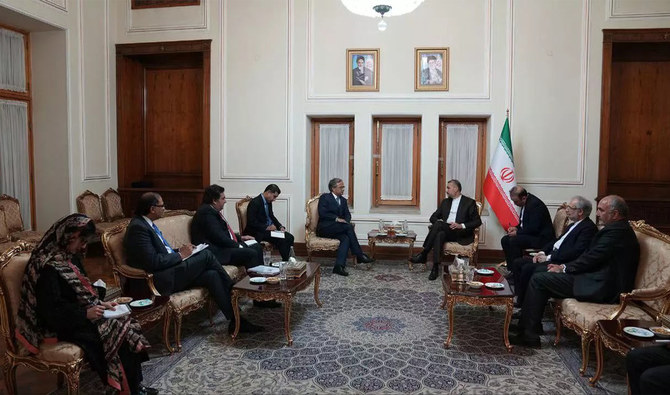
Pakistan’s Foreign Secretary Dr. Asad Majeed Khan (center left) and Foreign Minister of Iran, Hossein Amir-Abdollahian, hold a meeting in Tehran, Iran, on June 18, 2023. (Foreign Office of Pakistan)
Short Url
Updated 19 June 2023
Follow

Pakistan, Iran agree to enhance trade, cooperation in energy and transport 

  • The development comes after 12th round of bilateral political consultations between Pakistan and Iran 
  • Both sides held discussions covering the entire range of bilateral relations, Pakistani foreign office says 

ISLAMABAD: Pakistan and Iran have agreed to enhance trade and bilateral cooperation in various sectors, including energy and transport, the Pakistani foreign office said on Monday, a day after the two sides concluded two-day bilateral political consultations in Tehran. 

Pakistan’s Foreign Secretary Dr. Asad Majeed Khan and Deputy Foreign Minister of Iran, Mr. Ali Bagheri Kani, led their respective sides at the 12th round of bilateral political consultations. Pakistan’s Ambassador Rahim Hayat Qureshi and other senior officials from both sides also attended the meeting on June 17-18. 

Pakistan’s foreign office said in a statement the two sides held discussions covering the entire range of bilateral relations and reviewed the status of implementation of decisions of the last meeting. 

“It was agreed to enhance and diversify bilateral trade and expand cooperation in energy, transport connectivity, education and people-to-people exchanges. The two sides had a comprehensive exchange of views on the regional situation,” it said in a statement. 

“Both sides underscored the significance of regular convening of various institutional mechanisms, including Joint Economic Commission (JEC) and Joint Trade Committee (JTC) to forge closer cooperation in areas of mutual interest.” 

The Pakistani foreign secretary welcomed the normalization of diplomatic relations between Iran and Saudi Arabia. 

Tehran and Riyadh announced in March an agreement to restore relations severed seven years ago when protesters in Iran attacked Saudi diplomatic missions. The rapprochement has the potential to reshape relations across a region characterized by turbulence for decades. 

“The two sides reaffirmed their commitment to continue cooperation at multilateral fora, including the UN, OIC and ECO and strengthen dialogue on global and regional issues of common concern,” the foreign office added. 

In Khan’s meeting with Iranian Foreign Minister Hossein Amir-Abdollahian, they agreed to maintain the current momentum of high-level exchanges and strengthen mutually-beneficial cooperation in diverse fields. 

The Pakistani foreign secretary also interacted with the Iranian intelligentsia and scholars at the leading Iranian think tank, the Institute of Peace and International Studies (IPIS), where he highlighted Pakistan’s role toward promotion of peace and development in the region. 


Pakistan hails Bangladesh’s ‘historic democratic transition’ as ties gather momentum

Updated 6 sec ago
Follow

Pakistan hails Bangladesh’s ‘historic democratic transition’ as ties gather momentum

  • Ahsan Iqbal visits Dhaka for the swearing-in of PM-elect Tarique Rahman after recent elections
  • Islamabad calls for building connectivity, expanding trade and shaping a stable region together

ISLAMABAD: Pakistan’s Planning Minister Ahsan Iqbal on Tuesday congratulated Bangladesh on a “historic democratic transition,” as he pointed to positive momentum in Pakistan-Bangladesh relations during a visit to Dhaka for the oath-taking of Prime Minister-elect Tarique Rahman.

Bangladesh’s parliament was sworn in earlier in the day, marking the first elected legislature since a deadly 2024 uprising that toppled the government of Sheikh Hasina. Rahman, 60, is chief of the Bangladesh Nationalist Party (BNP) and won a landslide victory in the February 12 elections.

He is set to formally take office later on Tuesday after lawmakers pledged loyalty before their country’s chief election commissioner.

The Pakistani minister said in a social media post on X he met Bangladesh’s Chief Adviser, Muhammad Yunus, and congratulated him “on the successful conduct of elections and the historic democratic transition.”

“Our discussions focused on opening a new, forward-looking chapter in Pakistan-Bangladesh relations,” he said. “I expressed appreciation for the positive momentum in bilateral ties, including growing trade engagement, revival of direct air connectivity, and renewed people-to-people contacts.”

Pakistan’s Minister for Planning, Development and Special Initiatives, Ahsan Iqbal (left), paid a courtesy call on Chief Adviser Professor Muhammad Yunus (right) at the State Guest House Jamuna in Dhaka, Bangladesh, on February 17, 2026. (AhsanIqbal/X)

“We agreed that the current regional and geopolitical environment demands greater economic cooperation, connectivity, and collaboration between our two countries,” he added.

Iqbal also extended an invitation to Yunus to visit Pakistan to institutionalize cooperation in youth empowerment, innovation and sustainable development.

“Pakistan and Bangladesh share deep cultural, historical, and social affinities,” he said. “It is time to transform these affinities into structured economic partnerships, academic exchanges, and regional cooperation. Our future lies in building connectivity, expanding trade, empowering youth, and shaping a stable and prosperous South Asia together.”

Bangladesh’s Prime Minister-elect Rahman has pledged to restore economic stability and revive growth after months of turmoil that rattled investor confidence in the world’s second-largest garment exporter. In his victory speech, he described the outcome as a win for democracy but warned of challenges, including a fragile economy and weakened institutions.

Pakistan and Bangladesh have improved bilateral ties amid a recent thaw in relations. The two countries were part of the same state until Bangladesh’s secession following a bloody civil war in 1971, an event that long cast a shadow over ties.

Relations have warmed since August 2024, after the ouster of Hasina, who was widely viewed as close to India. While Islamabad and Dhaka have moved closer, ties between Bangladesh and New Delhi remain strained over India’s decision to grant asylum to Hasina.