

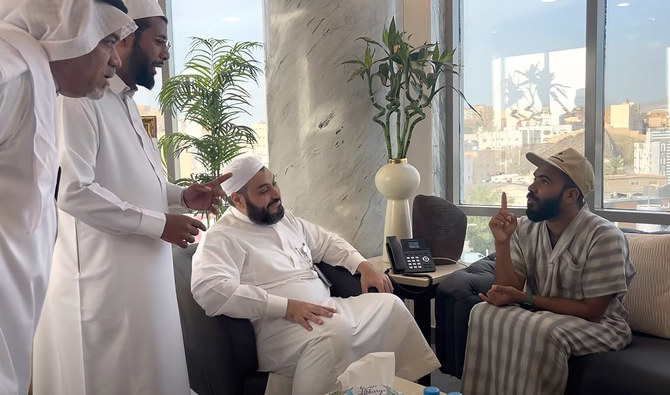

NEW DELHI: Many Muslims try to go the extra mile in fulfilling the sacred obligation of pilgrimage — an effort Shihab Chottur took to another level as he walked over 8,600 km from southern India to reach Makkah for Hajj.
Chottur departed from his home in Malappuram in Kerala on June 2, 2022, and on his year-long journey crossed Pakistan, Iran, Iraq, and Kuwait before reaching his destination.
He arrived in Saudi Arabia in late May and after spending three weeks in Madinah entered Makkah on June 7.
“I achieved my dream. This was my dream, childhood dream. I reached here, Makkah. Very proud moment that I achieved my dream,” he told Arab News.
“Everything is possible. We can do anything.”
Now 31 years old, Chottur first imagined the journey when he was eight. He remembered a dream in which he saw the Kaaba shrine, the towering black cube at the center of the Great Mosque of Makkah, which the most sacred place for Islam and considered the House of God.
“I started thinking, why can’t I reach the Kaaba walking?” Chottur said. “At that time, I was not aware of the route and how many countries I would cross.”
The journey was not easy. While in Pakistan he was warmly welcomed in the villages and towns he crossed and often accompanied for some time by locals, when he entered Iran, the journey was mostly lonely.
“Different experiences in Iran and Iraq ... Climate is very different. It was minus 14 degrees. That time I was alone with my 12 kg of luggage,” he said.
A father of two and owner of a shop in Malappuram, Chottur enjoyed the support of his family, especially mother, as told them about the plan to reach Makkah by foot.
Later, he was also assisted by Saudi authorities and exempted from all fees.
“I carried $8,500 when I started, and I did not use that money because the Saudi government and the Indian consulate supported my free Hajj,” he said. “That money that I carried, my mother will use to for performing the Hajj.”
Now waiting for the pilgrimage to begin next week, Chottur has found a new resolve, which is to encourage other young Muslims to embark on the spiritual journey when they are still physically fit.
“Everyone thinks of going on Hajj after completing 70 years, at old age. I would like to change that thinking. I would like to do that in my youth,” he said. “In our healthy time we can do the Hajj.”
After he completes the rites of pilgrimage, his journey will be nearly complete.
He still hopes he will be able to go to Palestine and see Al-Aqsa Mosque — the third most sacred place after the Great Mosque of Makkah and the Prophet’s Mosque in Madinah.
“There are three holy sites,” he said. “I would like to go to Al-Aqsa Mosque, and then fly back to India.”


