
RIYADH: Saudi Arabia, a country which has been dependent on its rich oil reserves for several decades, is now on a path of economic diversification. With Vision 2030, Saudi Arabia’s Crown Prince Mohammed bin Salman is proving that the Kingdom could perform well in non-oil private sectors too.
As Saudi Arabia’s private sector expands rapidly, the Kingdom is expected to provide more job opportunities to nationals and foreign talents alike in the coming years.
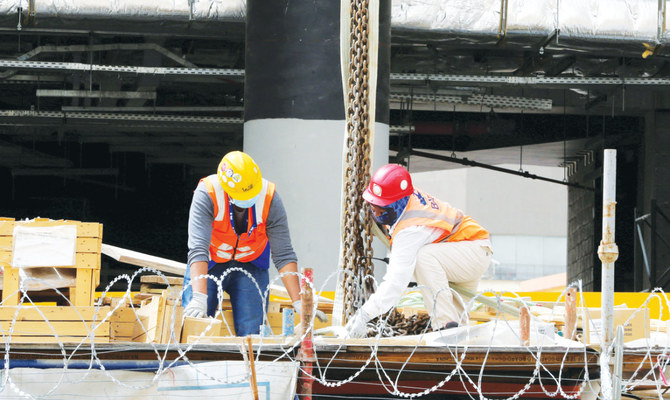
Giga-projects like NEOM are presenting enormous job opportunities in the construction sector, along with offering employment in various other areas including advanced technologies like artificial intelligence.
Spotlight on construction sector
According to Grace Najjar, Project Management Institute’s regional managing director for the Middle East and North Africa region, the construction industry is expected to play a crucial role in achieving the goals set forth by Vision 2030, providing immense job opportunities in the future.
She further noted that Saudi Arabia’s construction sector will witness high demand for skilled professionals which include project managers, engineers and architects.
“Over 5,200 projects across Saudi Arabia, with a combined worth of $819 billion, are currently underway, representing 35 percent of all active GCC (Gulf Cooperation Council) project values. With such a vast number of projects, there will be a significant demand for skilled professionals in the construction industry, including project managers, engineers, architects and skilled labor,” said Najjar.
She added: “This demand is expected to continue to rise in the coming years, especially as Saudi Arabia and the entire GCC are on a path of economic diversification.”
Earlier in May, a report released by the US-Saudi Business Council noted that the Kingdom’s construction sector saw the value of awarded contracts increasing to $51.3 billion in 2022 — a 35 percent rise compared to the previous year.
“The surge in contract awards continues unabated on the back of a growing economy that was fueled by significant oil revenues and the acceleration of giga-projects following the COVID-19 slowdown,” said Albara’a Alwazir, director of economic research at the USSBC.
Najjar further pointed out that local talent in Saudi Arabia will get ample chance to explore employment opportunities in the construction sector.
“In recent years, there has been a push to develop local talent in Saudi Arabia, including in the construction sector. The government has implemented several initiatives to develop skills and create employment opportunities for Saudis, including the National Transformation Program,” added Najjar.
Advanced technologies in focus
The growth of the construction sector in Saudi Arabia is expected to simultaneously increase job opportunities in advanced technologies like artificial intelligence, especially considering the fact that building firms are making use of AI to elevate efficiency and safety.
“AI-powered construction is taking the industry by storm, and it has the potential to improve productivity, safety and quality in construction projects. AI can be used to streamline project management, including scheduling, resource allocation and risk management,” said Najjar.
According to the latest Future of Jobs report by the World Economic Forum, the fastest-growing roles in Saudi Arabia will be driven by technology and digitization in the Kingdom. The report noted that Saudi Arabia will witness a sharp rise in demand for AI and machine learning specialists, as almost all businesses are currently undergoing a digital transformation.

Over 5,200 projects across Saudi Arabia, with a combined worth of $819 billion, are currently underway, representing 35 percent of all active GCC project values.
Grace Najjar, Project Management Institute’s regional managing director for the Middle East and North Africa region
Ranim Al-Amin, head of government strategic partnerships in Saudi Arabia at LinkedIn, also shared similar views and noted that the employment-focused social media platform has witnessed a massive uptick in AI-related jobs in the region.
“It is exciting to think of the transformation that new technologies like AI will bring to the region. We’ve already witnessed this change accelerate on LinkedIn since November, with AI starting to upend work everywhere for everyone all at once. It’s only been a few months, but we’ve seen the number of jobs on LinkedIn mentioning GPT for example increase by 51 percent from 2021 to 2022,” said Al-Amin.
She added: “We also saw the usage of keywords such as ChatGPT, Prompt Engineering, Prompt Crafting, Generative AI, and Generative Artificial Intelligence on profiles globally increase 71 percent from February to March 2023 — a massive jump in just one month.”
Rise in hybrid mode of work
It was during the pandemic outbreak that several companies gave employees a provision to work from home. However, even as the pandemic waned, many companies and employees all over the world still prefer a hybrid mode of work and the Kingdom is no different.
“Our recent data shows that ‘software engineer’ came in sixth place among the top jobs in the Kingdom in 2022, with 45.7 percent of those openings offering a hybrid option; the highest percentage among the top 10 jobs,” said Al-Amin.

It is exciting to think of the transformation that new technologies like AI will bring to the region. We’ve already witnessed this change accelerate on LinkedIn.
Ranim Al-Amin, Head of government strategic partnerships in Saudi Arabia at LinkedIn
She added: “It is also worth noting that 10.3 percent of all entry-level jobs allowed a remote or hybrid format, witnessing a 5.7 percent increase from last year whereas senior-level jobs remained unchanged from last year with only 8.9 percent offering remote work.”
Meanwhile, Saudi Arabia, in line with the targets outlined in Vision 2030, is making great strides in reducing the unemployment rate.
According to the General Authority for Statistics’ labor force survey, the unemployment rate fell to 8 percent in the fourth quarter of 2022, from 9.9 percent in the previous three months.
Hardly surprising then that the Kingdom has set itself a target unemployment rate of 7 percent by 2030.