AMSTERDAM: It is “highly likely” that the collapse of the Kakhovka dam in southern Ukraine was caused by explosives planted by Russians, a team of legal experts assisting Ukraine’s prosecutors in their investigation said in preliminary findings released on Friday.
Russian President Vladimir Putin has accused Ukraine of destroying the Kakhovka dam as a Western-backed tactic to escalate the conflict.
Ukraine is investigating the blast as a war crime and possible criminal environmental destruction, or “ecocide.”
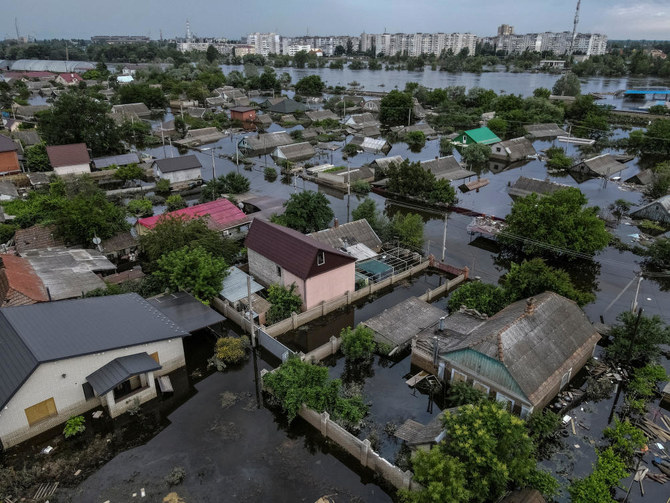
The vast Soviet-era Kakhovka hydroelectric dam, under Russian control since the Feb. 24 invasion, was breached in the early hours of June 6, unleashing floodwater across a swathe of the battleground in southern Ukraine, destroying farmland and cutting off water supplies to a large part of the population.
Experts with the international human rights law firm Global Rights Compliance, which is implementing Western-back efforts to support accountability for atrocities in Ukraine, visited the Kherson region from June 10-11 with Ukraine’s prosecutor general and a team from the International Criminal Court.
“The evidence and analysis of the information available – which includes seismic sensors and discussions with top demolition experts – indicates that there is a high probability the destruction was caused by pre-emplaced explosives positioned at critical points within the dam’s structure,” a summary of preliminary findings from the law firm’s team seen by Reuters said.
Senior lawyer Yousuf Syed Khan at Global Rights Compliance, who participated in the field mission to Kherson, said the finding that the dam was blown up with pre-emplaced explosives by the Russian side “is an 80 percent and above determination.”
The finding is based “not only on seismic sensors, and one of the leading open-source intelligence providers, but also based on patterns of attack and other attacks that we have documented,” he said in an interview. That included previous attacks on critical water infrastructure, including installations and pipelines, he said.
They dismissed the theory that a catastrophic dam breach could have been caused by mismanagement alone.
The destruction of the dam and impact on the Kakhovka reservoir and surrounding area has created conditions which the investigators said could constitute a starvation crime by targeting “an object indispensable to the survival of the civilian population,” Khan said.
The attack may form part of a broader crime against humanity, but the group has not yet made that determination.
Attacking a dam intentionally may constitute a war crime under international humanitarian law because they are presumed to be civilian in nature, unless there is a valid military objective, British Barrister Catriona Murdoch, who led the mobile justice team investigation, said in a statement.
“Even in the highly unlikely scenario the dam, or indeed the area nearby, posed a valid military objective commensurate with eviscerating the dam, it is still afforded an elevated protection under international humanitarian law,” she said.
The ICC, the world’s permanent war crimes tribunal, is also investigating the attacks on Ukraine’s infrastructure, which may violate international law.


![]()

‘Highly likely’ Russia behind Ukraine dam collapse – international experts
Short Url
https://arab.news/bgur5
‘Highly likely’ Russia behind Ukraine dam collapse – international experts
- Vladimir Putin has accused Ukraine of destroying Kakhovka dam as a Western-backed tactic to escalate the conflict
- The vast Soviet-era Kakhovka hydroelectric dam was breached in the early hours of June 6


Latest updates


© 2026 SAUDI RESEARCH & PUBLISHING COMPANY, All Rights Reserved And subject to Terms of Use Agreement.