High concentrations of phosphorus, an essential element for all biological processes on Earth, have been detected in ice crystals spewed from the interior ocean of Saturn’s moon Enceladus, adding to its potential to harbor life, researchers reported on Wednesday.
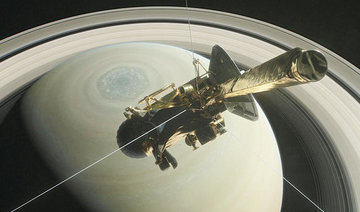
The discovery was based on data collected by NASA’s Cassini spacecraft, the first to orbit Saturn, during its 13-year landmark exploration of the gaseous giant planet, its rings and its moons from 2004 to 2017.
The findings were published by a German-led international team of scientists in the journal Nature and announced by NASA’s Jet Propulsion Laboratory (JPL) outside of Los Angeles, which designed and built the Cassini probe.
The same team previously confirmed that Enceladus’ ice grains contain a rich assortment of minerals and complex organic compounds, including the ingredients for amino acids, associated with life as scientists know it.
But phosphorus, the least abundant of six chemical elements considered necessary to all living things — the others are carbon, oxygen, hydrogen, nitrogen and sulfur — was still missing from the equation until now.
“It’s the first time this essential element has been discovered in an ocean beyond Earth,” the study’s lead author, Frank Postberg, a planetary scientist at the Free University in Berlin, said in a JPL press release.
Phosphorus is fundamental to the structure of DNA and a vital part of cell membranes and energy-carrying molecules existing in all forms of life on Earth.

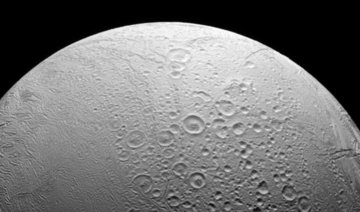
A mosaic image of Saturn's moon Enceladus, composed from high-resolution pictures captured by NASA's Cassini spacecraft during a 2005 flyby, shows the long fissures in the moon's icy crust at its south pole that allows water from the subsurface ocean to spew into space. (NASA/JPL/Space Science Institute/Handout via REUTERS)
The latest study stems from measurements taken by Cassini as it flew through salt-rich ice grains ejected into space from geysers erupting from the subsurface ocean beneath Enceladus’ frozen crust at its south pole.
The spacecraft gathered its data during passes through a plume of ice crystals itself, and through the same material that feeds Saturn’s faint “E” ring with icy particles outside the planet’s brighter main rings.
The interior ocean discovered by Cassini has made Enceladus — about one-seventh the size of Earth’s moon and the sixth largest among Saturn’s 146 known natural satellites — a prime candidate in the search for places in our solar system beyond Earth that are habitable, if only to microbes.
Another is Jupiter’s larger moon Europa, which also is believed to harbor a global ocean of liquid water beneath its icy surface.
One notable aspect of the latest Enceladus discovery was geochemical modeling by the study’s co-authors in Europe and Japan showing that phosphorus exists in concentrations at least 100 times that of Earth’s oceans, bound water-soluble forms of phosphate compounds.
“This key ingredient could be abundant enough to potentially support life in Enceladus’ ocean,” said co-investigator Christopher Glein, a planetary scientist at Southwest Research Institute in San Antonio, Texas. “This is a stunning discovery for astrobiology.”
Still, scientists stressed that the presence of phosphorus, complex organic compounds, water and other fundamental building blocks of life are evidence only that a place such as Enceladus is potentially habitable, not that is inhabited. Life, either past or present, has not been confirmed anywhere beyond Earth.
“Whether life could have originated in Enceladus’ ocean remains an open question,” Glein said. (Reporting by Steve Gorman in Los Angeles; Editing by Lisa Shumaker)