

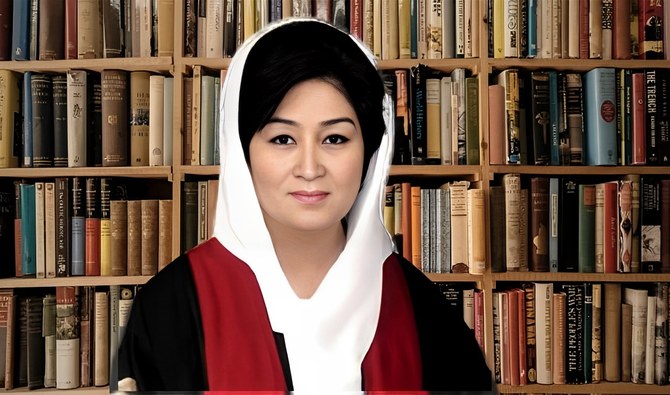
Peshawar High Court’s first ever woman chief justice to be elevated to Supreme Court

The image shared by the Associated Press of Pakistan on March 29, 2023, shows first ever woman chief justice of Peshawar High Court, Justice Musarrat Hilali. (Photo courtesy: APP)
Short Url
Updated 14 June 2023
Follow

Peshawar High Court’s first ever woman chief justice to be elevated to Supreme Court

  • Justice Musarrat Hilali became acting CJ of Peshawar High Court on April 1
  • In January, Pakistan appointed Justice Ayesha Malik as first woman SC judge

ISLAMABAD: The Judicial Commission of Pakistan (JCP) on Wednesday approved the elevation of Peshawar High Court (PHC) Chief Justice Musarrat Hilali to the Supreme Court (SC), Law Minister Azam Nazeer Tarar said.

Hilali became the acting chief justice of the Peshawar High Court on April 1, making history as the first woman to be appointed to the position. With her elevation to the SC, she has become only the second female judge in Pakistan to rise to the apex court.

This year, Pakistani women have achieved many firsts in legal history. In January, Justice Ayesha Malik was appointed as the first female Supreme Court judge. Last month, Pakistani lawyers Sabahat Rizvi and Rabbiya Bajwa made history by getting elected to the positions of secretary and vice president of the Lahore High Court Bar Association respectively.

“The President … is pleased to appoint Ms Justice Musarrat Hilali, being the most senior judge of the Peshawar High Court Peshawar, to act as Chief Justice of the said court with effect from April 1 2023 till the appointment of a regular chief justice by the Judicial Commission of Pakistan,” a notification from the law ministry had said in March.

The Judicial Commission is a nine-member body that decides on the promotion of judges in Pakistan.

Justice Hilali was born in Peshawar on August 8, 1961 at the home of Mir Hilali, an activist with the Khudai Khedmatgar, a predominantly Pashtun nonviolent resistance movement known for its activism against the British Raj in colonial India. She studied law from Khyber Law College at Peshawar University and enrolled as an advocate at the district courts in 1983, going on to become a high court advocate in 1988 and an advocate of the Supreme Court in 2006.

Justice Hilali was the first elected female secretary of the Peshawar Bar Association from 1988-1989, vice president twice from 1992 to 1994, and the first female General Secretary from 1997-1998. She was also the first woman twice elected as executive member of the Supreme Court Bar Association from 2007-2008 and 2008-2009 respectively.

Justice Hilali was appointed the first female Additional Advocate General of Pakistan's Khyber Pakhtunkhwa province from November 2001 till March 2004, the first woman Chairperson of the Khyber Pakhtunkhwa Environmental Protection Tribunal and the first female Ombudsperson for 'Protection against the Harassment of Women in the Workplace.'

Justice Hilali is set to retire on August 7, 2023.


Pakistan’s president defends ongoing strikes in Afghanistan, urges Kabul to dismantle militants

Updated 7 sec ago
Follow

Pakistan’s president defends ongoing strikes in Afghanistan, urges Kabul to dismantle militants

  • Afghanistan on Thursday launched attacks in retaliation for Pakistani airstrikes the previous Sunday
  • Pakistan’s military says it is only targeting Afghan military installations to avoid civilian casualties

ISLAMABAD: Pakistan’s president on Monday defended his country’s ongoing military strikes in neighboring Afghanistan, saying Islamabad tried all forms of diplomacy before targeting militants operating from Afghan territory, and called on the Taliban government in Kabul to disarm groups responsible for attacks in Pakistan.

Pakistan earlier said it is in “open war” with Afghanistan, alarming the international community. The border area remains a stronghold for militant organizations including Al-Qaeda and the Daesh (Islamic State) group.

“(The Afghan Taliban) must choose to dismantle the terror groups that survive on conflict and its war economy,” Asif Ali Zardari said during a speech to lawmakers, adding that “no state accepts serial attacks on its soil.”

Afghanistan on Thursday launched attacks in retaliation for Pakistani airstrikes the previous Sunday. Since then, Pakistan has carried out operations along the border, with Information Minister Attaullah Tarar claiming the killing of 435 Afghan forces and the capture of 31 Afghan positions.

Kabul has denied such claims.

In Afghanistan, the deputy government spokesman Hamdullah Fitrat said Pakistan’s military fired mortar shells at a refugee camp in eastern Kunar province, killing three children and injuring three others.

Afghanistan’s defense ministry said Afghan forces carried out strikes targeting a Pakistani military facility near Paktia province, causing “substantial losses and heavy casualties.”

Pakistan’s military did not respond to questions. It has said Pakistan is only targeting Afghan military installations to avoid civilian casualties.

Pakistan has witnessed a surge of violence in recent months and blames it on the outlawed Pakistani Taliban, known as Tehreek-e-Taliban Pakistan or TTP. It operates both inside Pakistan and from Afghan territory.
Islamabad accuses Afghanistan’s Taliban government of providing safe havens for the TTP, which Kabul denies.

The latest cross-border fighting ended a ceasefire brokered by Qatar and Turkiye in October. The two sides failed to reach a permanent agreement during talks in Istanbul.

Zardari reiterated Pakistan’s call for talks, saying, “We have never walked away from dialogue.”

The Pakistani leader again accused Afghanistan of acting as a proxy for India by sheltering militant groups.

“Stop being used by another country as a battlefield for their ambitions,” he said.

Zardari cited a recent report from the United Nations Security Council’s monitoring team that described the presence of militant groups in Afghanistan as an extra-regional threat.