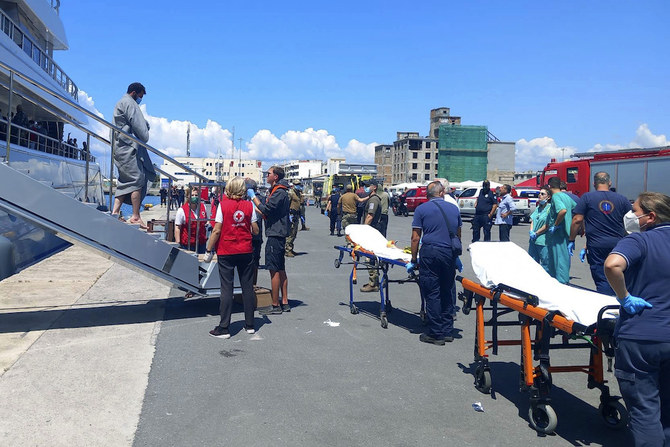
ATHENS: At least 78 migrants drowned early on Wednesday and more were feared missing after their overloaded boat capsized and sank off Greece, in one of Europe’s deadliest shipwrecks this year.
By midday, 104 people had been rescued, authorities said, but it remained unclear how many were on board when the vessel — whose occupants the coast guard said had refused an offer of help late on Tuesday — went under.
“We fear the number of dead will rise,” said a shipping ministry official who spoke on condition of anonymity.
Greece is one of the main routes into the European Union for refugees and migrants from the Middle East, Asia and Africa. Most cross over to Greek islands from nearby Turkiye, but a growing number of boats also undertake a longer, more dangerous journey from Turkiye to Italy via Greece.
State broadcaster ERT said the boat that sank had set sail from the Libyan town of Tobruk, which lies south of the Greek island of Crete, and was headed to Italy.
The disaster is the deadliest off Greece this year, and among the worst in Europe. In February, 96 people died when their wooden boat smashed into rocks on Italy’s Calabrian coast during a storm.
Filippo Grandi, the UN High Commissioner for Refugees, called on governments to work together on creating safe pathways for people fleeing poverty and war.
“Only sadness and anger after another deadly tragedy at sea in the Mediterranean,” he wrote on Twitter.
Greece is currently led by a caretaker government ahead of a national election on June 25.
The Greek coast guard said the boat was first spotted late on Tuesday by EU border agency Frontex in international waters around 50 miles (80 km) southwest of the southern Greek coastal town of Pylos.
A Greek coast guard vessel then approached the boat, which was en route to Italy, and offered help.
The large number of migrants on its outer deck “refused assistance and stated their desire to continue their voyage,” the coast guard said.
A few hours later the boat capsized and sank, triggering a search and rescue operation.
Broadcaster ERT said most of those on board were young men in their 20s.
The shipping ministry official said most were from Egypt, Syria and Pakistan, though Greek authorities did not confirm the vessels port of departure.
Survivors were taken to the town of Kalamata, where the country’s president Katerina Sakellaropoulou was expected to visit.
Greece was at the frontline of Europe’s 2015 migration crisis, when nearly 1 million people arrived on its islands from Turkiye before heading north to wealthier European states.
Numbers have fallen dramatically since a 2016 deal struck between Brussels and Ankara to stem the flows, while the previous conservative government of Kyriakos Mitsotakis had said a tough policy — which included more border patrols and migrant camps under heavy surveillance — helped keep arrivals low.
About 72,000 refugees and migrants have arrived so far this year in Europe’s frontline Mediterranean countries, according to United Nations data, with the majority landing in Italy and around 6,500 in Greece.
Nearly 1,000 people are estimated to have died or gone missing in the Mediterranean this year, according to the UN.

Scores drown in Greece’s deadliest migrant shipwreck this year
Short Url
https://arab.news/bnwh3
Scores drown in Greece’s deadliest migrant shipwreck this year
- “We fear the number of dead will rise,” said a shipping ministry official who spoke on condition of anonymity
- The disaster is the deadliest off Greece this year, and among the worst in Europe
Paraguay lawmakers approve defense agreement allowing an increased US military presence
ASUNCIÓN: Paraguay’s Chamber of Deputies on Tuesday approved a defense agreement allowing the temporary presence of US military and civilian personnel inside its borders, widely seen as a victory for the Trump administration, which has sought to strengthen its presence in Latin America.
The Status of Forces Agreement, or SOFA, was approved by a large majority of lawmakers and now awaits the signature of President Santiago Peña to take effect. Peña, one of Trump’s closest allies in the region, is expected to sign the deal in the coming days.
The agreement passed with 53 votes in favor and eight against, and four abstentions out of a total 80 lawmakers. Fifteen were not present for the vote.
Signed by both countries in Washington in December, the agreement establishes a legal framework for the presence of US security forces in Paraguay for training, joint exercises, and humanitarian assistance. It also authorizes the United States to have criminal jurisdiction over its personnel while in the country.
The treaty, praised as “historic” by both the US State Department and Paraguayan Foreign Minister Rubén Ramírez Lezcano, was approved by the Paraguayan Senate last week, where debate was more polarized due to concerns over potential violations of sovereignty.
Some legislators argued against the agreement, citing a controversial provision to grant foreign troops immunity from prosecution, equivalent to that handed to diplomatic personnel.
“We believe in international cooperation, but we also believe in strong states, respected institutions and real democratic sovereignty,” said independent congressman Raúl Benítez.
Despite criticisms, Paraguay’s foreign minister backed the agreement, arguing in December that its main purpose is to strengthen cooperation between the United States and Paraguay in fighting transnational organized crime and “terrorism.” He also clarified that “there is no possibility of the installation of US military bases” in Paraguay.
Washington has also praised SOFA, with US Secretary of State Marco Rubio calling it a “historic agreement” that would help facilitate bilateral and multinational training, humanitarian assistance, disaster response, and other shared security interests.
The approval of SOFA comes as Washington seeks to expand its influence in Latin America under the Trump administration’s national security strategy and as a sector of civil society in Paraguay continues to raise its voice against it.
“The security of a country is not built by importing troops or shielding foreign agents with diplomatic immunities,” said Peace and Justice Service, a civil organization which has a presence across Latin America, in a statement released days before the final vote. The treaty, it added, “does not represent progress in security, but rather the formalization of a geopolitics of impunity that undermines the pillars of our national dignity.”
The Status of Forces Agreement, or SOFA, was approved by a large majority of lawmakers and now awaits the signature of President Santiago Peña to take effect. Peña, one of Trump’s closest allies in the region, is expected to sign the deal in the coming days.
The agreement passed with 53 votes in favor and eight against, and four abstentions out of a total 80 lawmakers. Fifteen were not present for the vote.
Signed by both countries in Washington in December, the agreement establishes a legal framework for the presence of US security forces in Paraguay for training, joint exercises, and humanitarian assistance. It also authorizes the United States to have criminal jurisdiction over its personnel while in the country.
The treaty, praised as “historic” by both the US State Department and Paraguayan Foreign Minister Rubén Ramírez Lezcano, was approved by the Paraguayan Senate last week, where debate was more polarized due to concerns over potential violations of sovereignty.
Some legislators argued against the agreement, citing a controversial provision to grant foreign troops immunity from prosecution, equivalent to that handed to diplomatic personnel.
“We believe in international cooperation, but we also believe in strong states, respected institutions and real democratic sovereignty,” said independent congressman Raúl Benítez.
Despite criticisms, Paraguay’s foreign minister backed the agreement, arguing in December that its main purpose is to strengthen cooperation between the United States and Paraguay in fighting transnational organized crime and “terrorism.” He also clarified that “there is no possibility of the installation of US military bases” in Paraguay.
Washington has also praised SOFA, with US Secretary of State Marco Rubio calling it a “historic agreement” that would help facilitate bilateral and multinational training, humanitarian assistance, disaster response, and other shared security interests.
The approval of SOFA comes as Washington seeks to expand its influence in Latin America under the Trump administration’s national security strategy and as a sector of civil society in Paraguay continues to raise its voice against it.
“The security of a country is not built by importing troops or shielding foreign agents with diplomatic immunities,” said Peace and Justice Service, a civil organization which has a presence across Latin America, in a statement released days before the final vote. The treaty, it added, “does not represent progress in security, but rather the formalization of a geopolitics of impunity that undermines the pillars of our national dignity.”
© 2026 SAUDI RESEARCH & PUBLISHING COMPANY, All Rights Reserved And subject to Terms of Use Agreement.


