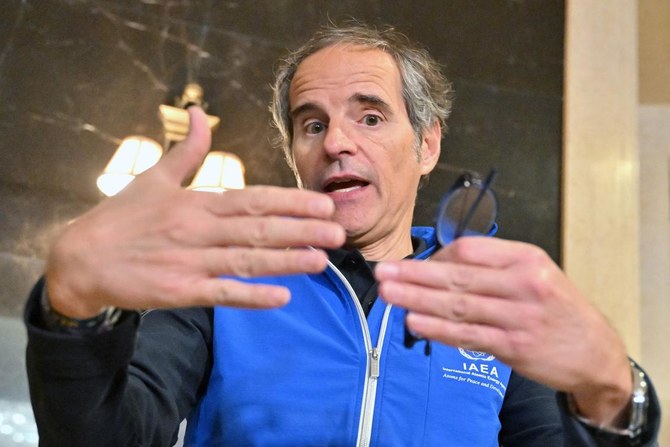
KYIV: UN nuclear chief Rafael Grossi has delayed a planned trip to Ukraine’s Russian-held Zaporizhzhia nuclear power plant until it is safer to travel, a senior Ukrainian government official said on Wednesday.
Grossi had been expected to visit the facility on Wednesday following talks in Kyiv on Tuesday, but a diplomatic source said the visit would be delayed by “some hours.” Russian news agency Interfax quoted a Russian-installed local official as saying Grossi would visit the plant on Thursday.
“He’s waiting to be able to travel safely,” said the senior Ukrainian government official, who spoke on condition of anonymity. The official did not say when Grossi would arrive at the plant in southeastern Ukraine.
Moscow and Kyiv have reported heavy fighting in southern and eastern Ukraine since the start of a Ukrainian counteroffensive.
Grossi, the head of the International Atomic Energy Agency (IAEA), said in Kyiv on Tuesday that he was “very concerned” that the nuclear plant could be caught in Ukraine’s counteroffensive to retake Russian-occupied territory.
The IAEA said on Sunday it needed access to a site near the Zaporizhzhia plant to check water levels after the nearby reservoir lost much of its water because of the destruction of the Kakhovka dam downstream.
Both sides have accused each other of sabotaging the dam, leading to catastrophic flooding. Western countries say they are still gathering evidence but believe Ukraine would have had no reason to inflict such a disaster on itself.
Russian forces captured the hydroelectric dam and the nuclear plant in southern Ukraine shortly after their February 2022 invasion.
The Zaporizhzhia nuclear plant uses a cooling pond to keep its six reactors from potentially disastrous overheating.
Ukraine’s nuclear energy company said on Tuesday the level of the pond was stable and that the water was high enough.
Speaking to reporters in Kyiv, where he had talks with President Volodymyr Zelensky, Grossi said there was no immediate danger but that it was a “serious situation.” He said his visit to the nuclear power plant, Europe’s largest, would provide a more accurate assessment of the risk.
The Kakhovka reservoir was normally used to refill the pond but cannot do so now because of its falling water level, Ukrainian nuclear authorities have said.
Instead, the pond, which is separated from the reservoir, can be replenished using deep underground wells, they said.

UN nuclear chief delays visit to Ukraine’s Zaporizhzhia nuclear plant
Short Url
https://arab.news/4p6wz
UN nuclear chief delays visit to Ukraine’s Zaporizhzhia nuclear plant
- Rafael Grossi had been expected to visit the facility on Wednesday following talks in Kyiv
- UN nuclear agency needs access to a site near the Zaporizhzhia plant to check water levels
Terror at Friday prayers: Witnesses describe blast rocking Islamabad mosque
- The Daesh group has claimed responsibility for the attack, according to the SITE Intelligence Group, which monitors jihadist communications
ISLAMABAD: A worshipper at the Shiite mosque in Islamabad where dozens of people were killed in a suicide blast on Friday described an “extremely powerful” explosion ripping through the building just after prayers started.
Muhammad Kazim, 52, told AFP he arrived at the Imam Bargah Qasr-e-Khadijatul Kubra mosque shortly after 1:00 p.m. (0800 GMT) on Friday and took up a place around seven or eight rows from the Imam.
“During the first bow of the Namaz (prayer ritual), we heard gunfire,” he told AFP outside the Pakistan Institute of Medical Sciences (PIMS) hospital, where many of the wounded were brought for treatment.
“And while we were still in the bowing position, an explosion occurred,” he said.
Kazim, who is from Gilgit-Baltistan in northern Pakistan and lives in Islamabad, escaped unharmed, but accompanied his wounded friend to the PIMS hospital for treatment.
“It was unclear whether it was a suicide bombing, but the explosion was extremely powerful and caused numerous casualties,” Kazim said.
“Debris fell from the roof, and windows were shattered,” he added. “When I got outside, many bodies were scattered... Many people lost their lives.”
The Daesh group has claimed responsibility for the attack, according to the SITE Intelligence Group, which monitors jihadist communications.
Another worshipper, Imran Mahmood, described a gunfight between the suicide bomber, a possible accomplice and volunteer security personnel at the mosque.
“The suicide attacker was trying to move forward, but one of our injured volunteers fired at him from behind, hitting him in the thigh,” Mahmood, in his fifties, told AFP.
“He fell but got up again. Another man accompanying him opened fire on our volunteers,” he said, adding the attacker “then jumped onto the gate and detonated the explosives.”
As of Saturday morning, the death toll stood at 31, with at least 169 wounded.
The attack was the deadliest in the Pakistani capital since September 2008, when 60 people were killed in a suicide truck bomb blast that destroyed part of the five-star Marriott hotel.
Lax security
Describing the aftermath of the attack, Kazim said unhurt worshippers went to the aid of those wounded.
“People tried to help on their own, carrying two or three bodies in the trunks of their vehicles, while ambulances arrived about 20 to 25 minutes later,” he told AFP.
“No one was allowed near the mosque afterwards.”
Kazim, who has performed Friday prayers at the mosque “for the past three to four weeks,” said security had been lax.
“I have never seen proper security in place,” he told AFP.
“Volunteers manage security on their own, but they lack the necessary equipment to do it effectively,” he said.
“Shiite mosques are always under threat, and the government should take this seriously and provide adequate security,” he added.
Muhammad Kazim, 52, told AFP he arrived at the Imam Bargah Qasr-e-Khadijatul Kubra mosque shortly after 1:00 p.m. (0800 GMT) on Friday and took up a place around seven or eight rows from the Imam.
“During the first bow of the Namaz (prayer ritual), we heard gunfire,” he told AFP outside the Pakistan Institute of Medical Sciences (PIMS) hospital, where many of the wounded were brought for treatment.
“And while we were still in the bowing position, an explosion occurred,” he said.
Kazim, who is from Gilgit-Baltistan in northern Pakistan and lives in Islamabad, escaped unharmed, but accompanied his wounded friend to the PIMS hospital for treatment.
“It was unclear whether it was a suicide bombing, but the explosion was extremely powerful and caused numerous casualties,” Kazim said.
“Debris fell from the roof, and windows were shattered,” he added. “When I got outside, many bodies were scattered... Many people lost their lives.”
The Daesh group has claimed responsibility for the attack, according to the SITE Intelligence Group, which monitors jihadist communications.
Another worshipper, Imran Mahmood, described a gunfight between the suicide bomber, a possible accomplice and volunteer security personnel at the mosque.
“The suicide attacker was trying to move forward, but one of our injured volunteers fired at him from behind, hitting him in the thigh,” Mahmood, in his fifties, told AFP.
“He fell but got up again. Another man accompanying him opened fire on our volunteers,” he said, adding the attacker “then jumped onto the gate and detonated the explosives.”
As of Saturday morning, the death toll stood at 31, with at least 169 wounded.
The attack was the deadliest in the Pakistani capital since September 2008, when 60 people were killed in a suicide truck bomb blast that destroyed part of the five-star Marriott hotel.
Lax security
Describing the aftermath of the attack, Kazim said unhurt worshippers went to the aid of those wounded.
“People tried to help on their own, carrying two or three bodies in the trunks of their vehicles, while ambulances arrived about 20 to 25 minutes later,” he told AFP.
“No one was allowed near the mosque afterwards.”
Kazim, who has performed Friday prayers at the mosque “for the past three to four weeks,” said security had been lax.
“I have never seen proper security in place,” he told AFP.
“Volunteers manage security on their own, but they lack the necessary equipment to do it effectively,” he said.
“Shiite mosques are always under threat, and the government should take this seriously and provide adequate security,” he added.
© 2026 SAUDI RESEARCH & PUBLISHING COMPANY, All Rights Reserved And subject to Terms of Use Agreement.


