

IAEA chief warns of dangers around Ukraine’s Zaporizhzhia nuclear plant

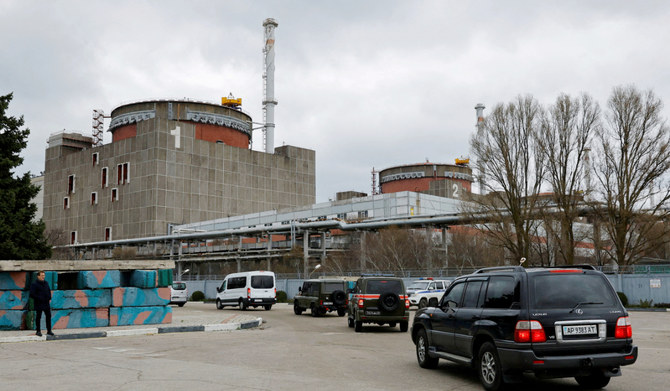
A motorcade transporting the International Atomic Energy Agency (IAEA) expert mission, escorted by the Russian military, arrives at the Zaporizhzhia Nuclear Power Plant in the course of Russia-Ukraine conflict outside Enerhodar in the Zaporizhzhia region, Russian-controlled Ukraine, March 29, 2023. (REUTERS)
Short Url
Updated 07 May 2023
Follow

IAEA chief warns of dangers around Ukraine’s Zaporizhzhia nuclear plant

  • Russian forces seized the Zaporizhzhia plant days after President Vladimir Putin ordered the invasion of his neighbor in February 2022

SWITZERLAND: The head of the UN’s nuclear power watchdog warned on Saturday that the situation around the Russian-held Zaporizhzhia nuclear station had become “increasingly unpredictable and potentially dangerous” and called for measures to ensure its safe operation.
Rafael Grossi, director general of the International Atomic Energy Agency, issued the warning in view of what he said were evacuations under way in the nearby town of Enerhodar, ordered by the local Russian-installed governor.
“The general situation in the area near the Zaporizhzhia nuclear power plant is becoming increasingly unpredictable and potentially dangerous,” Grossi said on the agency’s website.
“I’m extremely concerned about the very real nuclear safety and security risks facing the plant. We must act now to prevent the threat of a severe nuclear accident and its associated consequences for the population and the environment.”
Russian forces seized the Zaporizhzhia plant days after President Vladimir Putin ordered the invasion of his neighbor in February 2022. Exchanges of fire have frequently occurred near the facility, with each side blaming the other.
Grossi last visited the Zaporizhzhia station, Europe’s largest nuclear power installation, in March, as part of efforts to speak to both sides to secure an agreement on safeguards to ensure the plant’s safe operation.
He has repeatedly warned of the dangers of military operations around the plant.
Russia last September proclaimed the annexation of four Ukrainian regions, including Zaporizhzhia region.
The plant is located in the part of that region under Russian control, with many of the staff operating it living in Enerhodar on the south bank of the Dnipro River.
Yevgeny Balitsky, Russian-installed governor of the Russia-controlled part of Zaporizhzhia region, said on Friday he had ordered the evacuation of villages close to the front line with Ukrainian forces there. He said Ukrainian shelling had intensified in the area in recent days.
A widely expected Ukrainian spring counter-offensive against Russian forces viewed as likely to take in the Zaporizhzhia region, around 80 percent of which is held by Moscow.


Cuba defends military drills as deterrent against US aggression

Updated 2 sec ago
Follow

Cuba defends military drills as deterrent against US aggression

HAVANA: Cuban President Miguel Diaz-Canel defended his country’s military preparedness exercises on Saturday as a deterrent against potential aggression from the United States.
US President Donald Trump this month warned that Cuba “is ready to fall” and told Havana to “make a deal” or pay a price similar to Venezuela, whose ousted leader Nicolas Maduro was taken to America by US forces in a January 3 bombing raid that killed dozens of people.
Venezuela was a key ally of Cuba and a critical supplier of oil and money, which Trump has vowed to cut off.
Diaz-Canel on Saturday supervised military exercises that included a tank unit from Cuba’s armed forces.
He was accompanied by Cuban General Alvaro Lopez Miera, who is the minister of the armed forces, and other high-ranking military officials.
“The best way to prevent aggression is for imperialism to have to calculate the price of attacking our country,” Diaz-Canel said in remarks broadcast on Cuban television.
“And that has a lot to do with our preparation for this type of military action... This takes on significant importance in the current circumstances,” he added.
Cuba’s National Defense Council, which is led by Diaz-Canel, recently met “with the objective of increasing and improving the level of preparedness and cohesion” among the country’s leadership, according to an official government statement.
The council met to “analyze and approve the plans and measures for transitioning to a State of War,” the statement added, without providing further details.
These military exercises are part of the country’s preparation “under the strategic concept of the War of the Entire People,” a term used by authorities for the mobilization of civilians in the event of armed conflict.