

British tourists killed in Egypt boat blaze were below deck: tour company

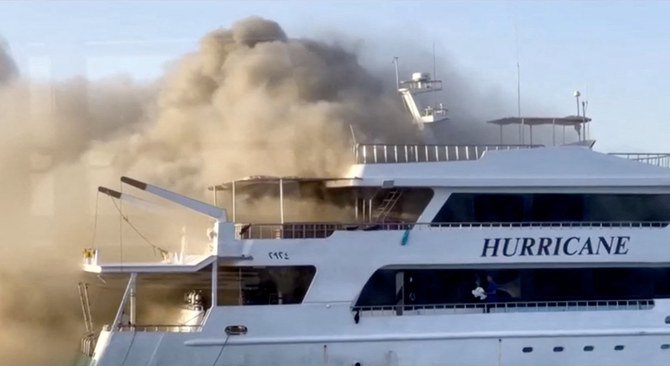
Plumes of smoke erupt from a yacht on fire in Marsa Alam, Egypt, June 11. (Reuters)
Short Url
Updated 14 June 2023
Follow

British tourists killed in Egypt boat blaze were below deck: tour company

  • 12 other guests, 14 crew escaped fire that engulfed Hurricane in Red Sea on Sunday
  • Previous guests say dive boat had been in ‘shocking’ condition as long as a year before tragedy

LONDON: Three holidaymakers from the UK killed during a fire onboard an Egyptian diving boat in the Red Sea on Sunday morning died below deck, the tour operator in charge of the vessel has said.

The three British divers, who were on a week-long tour of the area, are thought to have been in their cabins on board the Hurricane when the fire broke out around 8:30 a.m. local time, as they had chosen not to go diving that morning.

The Hurricane caught fire off the resort of Marsa Alam, and was in a “shocking” condition months beforehand, according to former guests.

The vessel had set out from Port Ghalib on Tuesday, and was making its final stop, near Elphinstone Reef, before returning to the resort.

The fire on the boat, which had 11 cabins, was caused by an electrical fault in the engine room, local authorities said.

The boat’s 12 other guests, who were all on deck at the time, as well as its 14 crew, escaped, with a video clip showing people leaping into the water from the vessel amid flames and smoke.

Over the footage, the person taking the video can be heard shouting: “Look, these oxygen tanks are exploding. The boat has gone.”

The relatives of the deceased have been informed by the UK government, though their bodies have not yet been recovered due to the boat’s condition. 

Statements were taken from guests and crew after they reached the shore following the evacuation.

Mohamed Bendary, secretary-general of the Red Sea governorate, said a “team from the public prosecution and the criminal laboratory is waiting to examine the boat and determine the cause of the fire.”

The Hurricane’s captain confirmed he was under investigation but declined to comment further.

The 12 British survivors, who lost all their belongings in the blaze, will now travel to Hurghada, where they will receive support and emergency travel documents.

In a statement, Scuba Travel, the company that ran the tour, confirmed that the three British tourists missing after the blaze broke out had died below deck, after crew attempted to reach them before being forced to abandon ship.

“It is with great regret that we, as tour operator, with heavy hearts, must accept that three of our much-valued dive guests perished in the tragic incident,” a spokesman said.

“Our sincere and heartfelt condolences go out to their families and friends at this very sad time.”

Former guests said they had previously complained about the conditions onboard the Hurricane, but were ignored.

Steve Evans told The Times: “We were on the Hurricane last May and wrote emails to complain about the state of the boat. We warned them.

“No one, absolutely no one should have died. Justice should be served to honor the victims and families if it can be proven of lax safety.”

A British tourist from Oxford wrote to Scuba Travel in May 2022 saying: “I was absolutely shocked at the state of the boat. We were told this boat was refurbished but it was quite the contrary.”

The guest added that bathroom facilities were “disgusting” and that there were multiple leaks in the bedrooms.

“We warned you about the state of the refurbishments last year ... It was inevitable that a tragedy would one day happen. You were told. Shame on you for not listening. It’s a disgrace,” the former guest wrote to the company following news of the fire.

Scuba Travel said the Hurricane — operated by another company, Tornado Marine Fleet — had an “excellent safety record with us” at the time of previous complaints.


Tourism on hold as Middle East war casts uncertainty

Updated 2 sec ago
Follow

Tourism on hold as Middle East war casts uncertainty

  • Cancelled flights, postponed trips and a great deal of uncertainty: the war in the Middle East is casting a long shadow over the tourism outlook for the region
PARIS: Cancelled flights, postponed trips and a great deal of uncertainty: the war in the Middle East is casting a long shadow over the tourism outlook for a region that has become a prized destination for travelers worldwide.
“My last group of tourists left three days ago, and all the other groups planned for March have been canceled,” said Nazih Rawashdeh, a tour guide near Irbid, in northern Jordan.
“This is the start of the high season here. It’s catastrophic,” he told AFP.
“And yet there’s no problem in Jordan. It’s perfectly safe.”
Across the world, tour operators are scrambling to find solutions for clients stranded in the region or who had trips planned there.
“The priority is getting those already there back home,” said Alain Capestan, president of the French tour operator Comptoir des Voyages.
He said however that the war was also affecting customers who have traveled to other parts of the world, as the Gulf region is home to several major aviation hubs — Dubai, Abu Dhabi and Doha.
Like other companies, the German tour operators surveyed by AFP — Alltours, Dertour, Schauinsland-Reisen — announced they would cover the cost of extra nights for clients stranded in the Middle East. They also canceled trips to the UAE and Oman until at least March 7.
Swiss operator MSC Cruises, which has a ship stranded in Dubai, told AFP on Thursday it was sending five charter flights to airlift nearly 1,000 passengers.
The firm said it expected the passengers to be out of the region by Saturday, without specifying the destinations of the flights or the nationalities of the holidaymakers.
The British travel industry association ABTA said agencies “would not be sending customers to the region for as long as the British Foreign Office advises against all non-essential travel.”
Customers whose holidays were canceled in recent days will be able to rebook or receive a refund, it said.
- Economic impact -
The war is disrupting a sector that had been booming in the region.
According to UN Tourism, in 2025 around 100 million tourists visited the Middle East — nearly seven percent of all international tourists recorded worldwide. That figure had grown three percent year-on-year and 39 percent compared to the pre-pandemic period.
Depending on the destination, Europeans make up a large share of visitors, followed by tourists from South Asia, the Americas, and other Middle Eastern countries.
For example, nearby markets accounted for 26 percent of total visitors to Dubai in 2025, according to its Ministry of Tourism and Economy.
Against this backdrop analysts Oxford Economics warns that “a decline in tourist flows to the region will deal a more severe economic blow than in the past, as tourism’s share of GDP has grown, as has employment in the sector.”
“We estimate inbound arrivals to the Middle East could decline 11-27 percent year-on-year in 2026 due to the conflict, compared to our December forecast that projected 13 percent growth,” said Director of Global Forecasting Helen McDermott.
That would translate, according to the firm, to between 23 and 38 million fewer international visitors compared to the prior scenario, and a loss of $34 to $56 billion in tourist spending.
After Covid and then the conflict in Gaza, tourists had been coming back, said Rawashdeh, the Jordanian tour guide.
“For the past six months, people working in tourism here had hope. And now there’s a war. This is going to be terrible for the economy,” he said.
“We’ve definitely noticed an understandable slowdown in new bookings from our partners right now, but we fully expect that to bounce back as soon as things settle down and travelers feel more confident,” said Ibrahim Mohamed, marketing director of Middle East Travel Alliance, which offers direct tours to American and British operators.
He remains optimistic: “The Middle East has always been an incredibly resilient market, and demand always bounces back fast once stability returns.”