Taiwan civil defense handbook includes tips on identifying Chinese soldiers

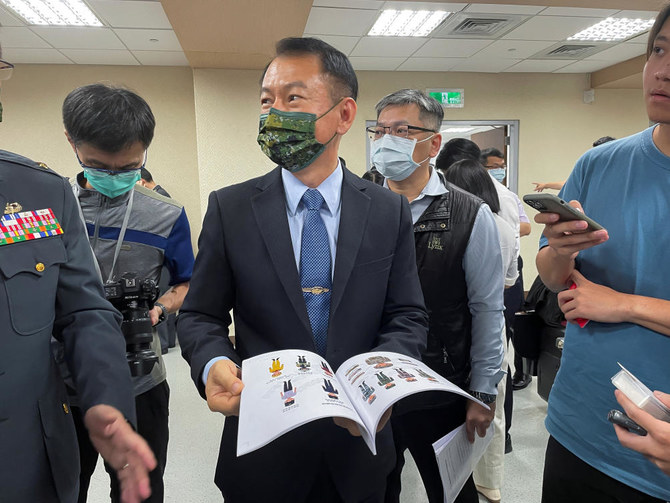
All-Out Defense Mobilization Agency Director Shen Wei-chih says it was ‘actually quite hard to distinguish’ between Taiwanese and Chinese soldiers. (Reuters)
Short Url
Updated 13 June 2023
Follow

Taiwan civil defense handbook includes tips on identifying Chinese soldiers

  • Taiwan unveiled the handbook last year amid a rise in tensions with Beijing
  • Booklet assumes Chinese soldiers will wear People’s Liberation Army uniforms

TAIPEI: Taiwan’s military released an updated civil defense handbook on Tuesday that for the first time includes a section on how to tell the difference between Chinese and Taiwanese soldiers based on their uniforms, camouflage and insignia.
Taiwan unveiled the handbook last year amid a rise in tensions with Beijing and after Russia’s invasion of Ukraine, detailing how to find bomb shelters, water and food supplies via smartphone apps, as well as tips for preparing emergency first aid kits.
Taiwan’s defense ministry said they received feedback that the book needed to better reflect war scenarios, given the conflict in Ukraine, which Russia calls a “special operation.”
One of the changes includes illustrations of Taiwanese service personnel and “enemy soldiers” wearing Chinese military uniforms.
The Taiwanese soldiers are shown smiling, whereas the Chinese ones have downturned mouths and a severe expression.
“It’s actually quite hard to distinguish them,” All-Out Defense Mobilization Agency Director Shen Wei-chih told reporters at the defense ministry.
The booklet assumes Chinese soldiers will wear People’s Liberation Army uniforms; experts say special forces troops may wear different gear as they try to infiltrate Taiwan during an invasion.
Taiwan’s emergency personnel, including police and first responders, are also shown in the new handbook, which will be available for download.
The agency is working on an English translation, Shen said.
Planning for the handbook predates Russia’s attack on its neighbor, which has prompted debate on its implications for Taiwan and ways to boost preparedness, such as reforms to the reservist training and extending military service.
China views democratically governed Taiwan as its own territory despite Taipei’s strong objections and has ramped up military and political pressure over the past three years to push those sovereignty claims.
Taiwan has also been inspecting bomb shelters to make sure they are suitable and updating signs to make them easier to find; markers may eventually include flashing lights, officials said at the same news conference.


Norway says Russia, China seek to up presence on Svalbard

Updated 7 sec ago
Follow

Norway says Russia, China seek to up presence on Svalbard

  • The second-largest town on Svalbard is almost entirely populated by Russian nationals
  • China’s presence was becoming more visible in the Arctic

OSLO: While global tensions have focused on Greenland, Norway’s military intelligence service said on Friday that Russia and China were looking to increase their presence on the Norwegian Arctic archipelago of Svalbard.
In its annual threat assessment, the Norwegian Intelligence Service said that “from Moscow’s perspective, Svalbard’s strategic location makes it necessary to maintain a Russian presence there.”
The second-largest town on Svalbard, the coal mining settlement of Barentsburg, is almost entirely populated by Russian nationals.
“There are signs that the Kremlin is looking to make the Barentsburg settlement less dependent on Norwegian supply and transport infrastructure
“Regular port visits by ships from Russia constitute one planned step in this direction,” the agency said.
It said Beijing was “also expected to work toward enhancing the Chinese presence in Svalbard.”
“The archipelago is strategically placed for future shipping routes and polar research, which are central to cementing China’s role as an Arctic actor,” it said in its report.
It noted that China’s presence was becoming more visible in the Arctic and that five Chinese research vessels had operated in the Arctic Ocean in 2025, compared to three in 2024 and one in previous years.
The service also noted that tensions between the United States and Europe over Greenland and security in the Arctic “could serve both Russian and Chinese interests.”

- ‘Crumbling’ world order -

Andreas Stensones, head of the service, said in the report that Moscow and Beijing stood to benefit as “international cooperation and institutions are being undermined.”
“The same dynamic is evident in the Arctic. Much of the foundation for Norwegian security is being challenged and we must accept that the world order as we have known it is crumbling,” Stensones said.
Speaking at a press conference, Norwegian Defense Minister Tore Sandvik noted: “2026 has so far been characterised by great uncertainty.”
He pointed in particular to US President Donald Trump’s vocally stated desire to take over Greenland.
Trump’s threats against Greenland last month plunged NATO — of which Norway is a member — into its deepest crisis in years.
“There is no denying that relations across the Atlantic are more unpredictable,” Sandvik said.
Stensones told the same press conference that Washington’s actions affected how both Moscow and Beijing were thinking and acting.
“In their view, western unity has already begun to crack, and they see great opportunities to strengthen their influence and secure control in their neighboring areas,” he told reporters.