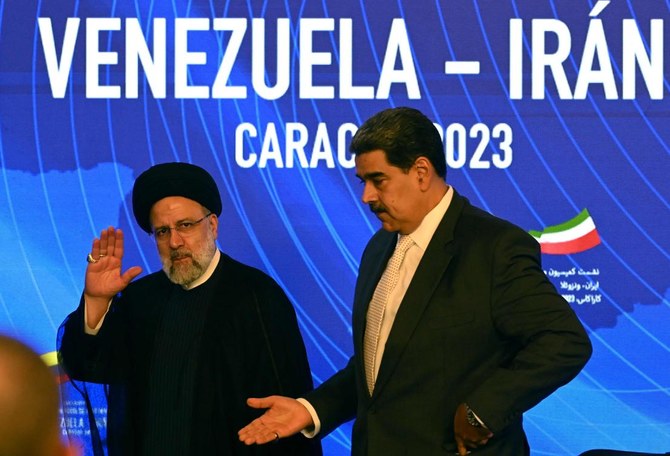
CARACAS, Venezuela: In his first visit to Latin America, Iran’s hard-line president on Monday met with his Venezuelan counterpart and declared that both countries have “a common enemy,” alluding to the United States, before signing a series of cooperation agreements.
President Ebrahim Raisi’s visit to Venezuela came a year and a day after President Nicolás Maduro visited him in Iran. Both countries are under heavy US economic sanctions.
Raisi said the link between the two countries “is not normal, but rather a strategic relationship,” insisting that their nations have “common interests and we have common enemies.”
“They do not want the two countries, Iran and Venezuela, to be independent,” Raisi said referring to the US government. His tour of allied nations in Latin America, including Cuba and Nicaragua, comes amid rising tensions with the administration of US President Joe Biden.
The US has accused Iran of providing Russia with materials to build a drone manufacturing plant east of Moscow, while the Kremlin seeks to ensure a steady supply of weapons for its invasion of Ukraine. US intelligence officials believe the plant in Russia could start operations early next year, but Iran has said it supplied drones to Russia before the start of the war.
The more than dozen agreements signed by officials from the countries Monday include scholarships for Venezuelan students and the importations of cattle to Iran. Maduro’s visit last year to Iran resulted in agreements to expand ties in the oil and petrochemical industries, the military and the economy. But only a handful of the agreements have materialized.
Venezuela and Iran have maintained close relations since the government of the late President Hugo Chávez. Maduro, who became president in 2013 after Chávez death, has promoted trade relations with Iran, China, Russia and Turkiye to try to overcome the effects of the economic sanctions.
Iran, particularly since 2020, has helped alleviate part of a fuel shortage in Venezuela.
“We are on the right side of history and together we will be invincible,” Maduro said.


![]()

Iran’s president begins Latin America tour with stop in Venezuela
Short Url
https://arab.news/p3pnr
Iran’s president begins Latin America tour with stop in Venezuela
- Both countries are under heavy US economic sanctions


Latest updates


© 2026 SAUDI RESEARCH & PUBLISHING COMPANY, All Rights Reserved And subject to Terms of Use Agreement.