

Pakistan’s Russian crude shipment paid in Chinese currency — minister

Pakistani Petroleum Minister Musadik Malik speaks during an interview at the Embassy of Pakistan in Washington, DC, on May 8, 2023. (Photo courtesy: AFP)
Short Url
Updated 12 June 2023
Follow

Pakistan’s Russian crude shipment paid in Chinese currency — minister

  • This marks significant shift in US dollar-dominated export payments policy
  • First cargo of discounted Russian crude oil arrived in Karachi on Sunday

ISLAMABAD: Pakistan paid for its first government-to-government import of discounted Russian crude in Chinese currency, the South Asian country’s petroleum minister said on Monday, a significant shift in its US dollar-dominated export payments policy.

Discounted crude offers respite as Pakistan faces an acute balance of payments crisis, risking a default on its debt obligations. The foreign exchange reserves held by the central bank are scarcely enough to cover four weeks of controlled imports.

The first cargo of discounted Russian crude oil arranged under a new deal struck between Islamabad and Moscow earlier this year arrived in Karachi on Sunday. It is currently being offloaded at the port in the southern city of Karachi.

Petroleum Minister Musadik Malik, talking to Reuters by phone, did not disclose the commercial details of the deal, including pricing or the discount that Pakistan received, but said the payment was made in Chinese currency.

He said the purchase, Pakistan’s first government-to-government (G2G) deal with Russia, consisted of 100,000 tons, of which 45,000 tons had docked at Karachi port and the rest was on its way. Pakistan made the purchase back in April.

Pakistan’s purchase gives Moscow a new outlet to add to growing sales to India and China, as it redirects oil from western markets because of the Ukraine conflict.
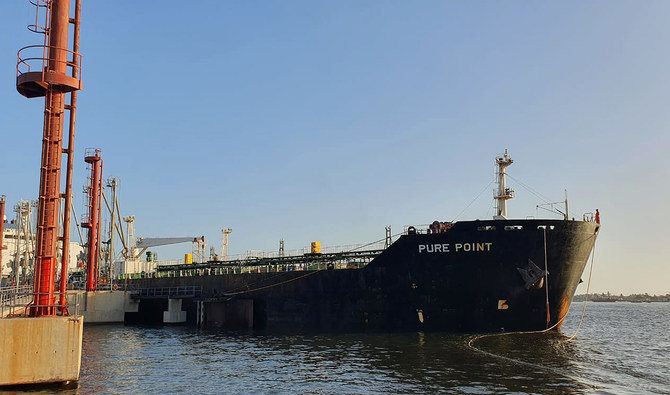


This handout photograph, taken and released by Karachi Port Trust, shows a Russian ship, Pure Point, anchored at the OP2 in Karachi on June 11, 2023, carrying 45,000 metric tons of crude oil. (Photo courtesy: KPT)

Despite being a long-standing Western ally and the arch-rival of neighboring India, which historically is closer to Moscow, analysts say the crude deal also presents a new avenue for Pakistan at a time that its financing needs are great.

Pakistan’s Refinery Limited (PRL) will initially refine the Russian crude, the minister said. He had earlier referred to the purchase of the shipment as a trial run to judge financial and technical feasibility.

Malik on Monday played down concerns around the financial viability and concerns about the ability of local refineries to process Russian crude given the South Asian country’s historical importation of Middle Eastern petroleum products.

“We’ve run iterations of various product mixes, and in no scenario will the refining of this crude make a loss,” Malik said, adding, “We are very sure it will be commercially viable.”

“No adjustments (were) needed at the refinery to refine the Russian crude,” the minister told Reuters.

Energy imports make up the majority of the Pakistan’s external payments. Islamabad imported 154,000 bpd of oil in 2022, around steady with the previous year, data from analytics firm Kpler showed.

The crude was predominantly supplied by the world’s top exporter Saudi Arabia followed by the United Arab Emirates. The 100,000 bpd from Russia in theory greatly reduces Pakistan’s need for Middle Eastern fuel.


Pakistan embassy, UN Tourism mark International Day of Mountains in Riyadh

Updated 6 sec ago
Follow

Pakistan embassy, UN Tourism mark International Day of Mountains in Riyadh

  • Event highlights Pakistan’s mountain ecosystems, mountaineering heritage, climate risks
  • Diplomats, artists and climbers gather to promote sustainable mountain tourism

ISLAMABAD: The Embassy of Pakistan in Riyadh, in collaboration with the UN Tourism Office, hosted an event this week to mark the United Nations-designated International Day of Mountains, bringing together diplomats, civil society members, mountaineers and artists to spotlight the global and Pakistani significance of mountain ecosystems.

Pakistan is home to some of the world’s largest mountain ranges and glacier systems outside the polar regions, including the Himalayas, Karakoram and Hindu Kush, which feed major rivers that sustain agriculture, hydropower and drinking water for millions of people. Rising temperatures linked to climate change are accelerating glacial melt, increasing the risk of floods, landslides and glacial lake outburst floods, while also threatening long-term water security as ice reserves shrink. 

These changes are already affecting mountain communities whose livelihoods depend on farming, tourism and pastoralism, exposing them to displacement, loss of income and environmental degradation, and amplifying the human and economic costs of extreme weather events across downstream regions.

Ambassador of Pakistan to Saudi Arabia Ahmad Farooq is briefing guests about mountain ecosystems in Pakistan at the UN Tourism Office in Riyadh on December 11, 2025. (Pakistan Embassy in Saudi Arabia)

Held at the UN Tourism Office in Riyadh, Thursday’s event focused on the ecological, cultural and economic importance of mountains, with particular attention to Pakistan’s vast high-altitude landscapes.

The evening opened with a micro-documentary titled Mountains of Pakistan, showcasing the country’s mountain ranges and their ecological value. Ambassador of Pakistan to Saudi Arabia Ahmad Farooq, in his opening remarks, highlighted the essential role mountains play in sustaining water systems, food security and communities, while also drawing attention to the growing threats posed by climate change.

“Mountains are not just landscapes, they are life-giving ecosystems, repositories of culture, and sources of inspiration,” Farooq said. “Tonight, we celebrate not only their beauty but our shared responsibility to protect them for future generations.”

Ambassador of Pakistan to Saudi Arabia Ahmad Farooq posing for picture with guests at the UN Tourism Office in Riyadh on December 11, 2025. (Pakistan Embassy in Saudi Arabia)

He also referred to challenges facing Pakistan’s mountain regions, including climate-change-driven glacial melt and related environmental risks, reaffirming Islamabad’s commitment to sustainable mountain development.

The program included remarks by the director of the UN Tourism Office, who underscored the importance of international cooperation in preserving fragile mountain ecosystems. A second micro-documentary, Spirit of Mountaineering, paid tribute to the courage and resilience of Pakistani climbers and their contributions to global mountaineering.

Among the featured speakers was Naila Kiani, a prominent Pakistani mountaineer and environmental advocate, who shared her experiences scaling some of the world’s highest peaks, including K2 and Nanga Parbat. Kiani is the first Pakistani woman and overall third Pakistani to climb 12 of the 14 eight-thousanders.

A prominent Pakistani mountaineer and environmental advocate, Naila Kiani, is addressing an event to mark International Day of Mountains in Riyadh on December 11, 2025. (Pakistan Embassy in Saudi Arabia)

Ambassador Farrukh Amil, a senior Pakistani career diplomat and former ambassador, spoke about Pakistan’s mountain heritage and ongoing initiatives to promote conservation and eco-tourism, while landscape photographer Awais Ali presented a photographic exhibition capturing the majesty of Pakistan’s northern regions and the lives of their communities.

The event concluded with the formal inauguration of the mountain photography exhibition curated by Ali, offering guests an immersive visual journey through Pakistan’s highlands.

The embassy said the celebration reaffirmed Pakistan’s commitment to raising global awareness about mountain ecosystems, promoting sustainable tourism and fostering international collaboration to address climate challenges affecting these fragile environments.