

Pakistan says has no plans to freeze foreign currency accounts

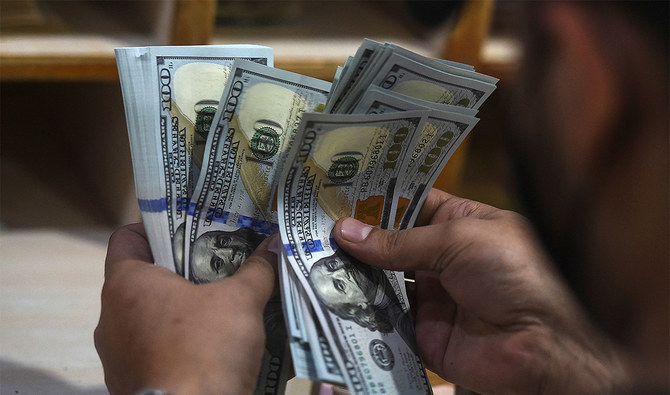
In this picture taken on January 11, 2022, a foreign currency dealer counts US dollar notes at a shop in Karachi. (AFP/File)
Short Url
Updated 12 June 2023
Follow

Pakistan says has no plans to freeze foreign currency accounts

  • Country's reserves have dwindled to barely $3.9 billion, enough to cover less than a month’s worth of imports
  • Then PM Nawaz Sharif froze foreign currency accounts in 1998 as foreign exchange reserves fell to critical levels

ISLAMABAD: Pakistan’s State Minister for Finance Dr Aisha Ghaus Pasha said on Monday the government was not considering freezing foreign currency accounts as reserves held with the central bank have dwindled to barely $3.9 billion, enough to cover less than a month’s worth of imports.

Pakistan is currently going through its most daunting economic crisis to date, with record-high inflation and a rapidly depreciating currency. The government has been pursuing the International Monetary Fund (IMF) for the revival of a stalled $6.5 billion bailout program to receive a tranche of $1.1 billion to stave off a balance of payments crisis but has been unable to reach a staff-level agreements after months of talks.

The economic crisis has reminded of May 1998, when the government of Prime Minister Nawaz Sharif froze all foreign currency accounts as reserves fell to a critical level after the country tested nuclear weapons, leading to international sanctions.

“We do not plan on freezing foreign currency accounts,” the state minister told media in Islamabad. “There have been no proposals to take such an action.”

Pasha said all budget plans had been shared with the IMF and Pakistan was now pushing the lender to complete the ninth review of the bailout program at the earliest.

The government last week presented a Rs14.46 trillion ($50.4 billion) budget for the next fiscal year, setting a tax collection target of Rs9.2 trillion ($32 billion), 23 percent higher than last year, and envisioning a 3.5 percent GDP growth.

“We have asked the IMF to complete the ninth review at the earliest,” the minister said, adding that “friendly countries” had already given assurances to the IMF to bridge external financing gaps.

Saudi Arabia and the UAE have sent their assurances of $2 billion and $1 billion respectively to the IMF as financial support to Pakistan to revive the bailout program which remains suspended since November last year.


Pakistani, Bangladeshi officials discuss trade, investment and aviation as ties thaw

Updated 28 December 2025
Follow

Pakistani, Bangladeshi officials discuss trade, investment and aviation as ties thaw

  • Pakistan and Bangladesh were once one nation, but they split in 1971 as a result of a bloody civil war
  • Ties between Pakistan, Bangladesh have warmed up since last year and both nations have resumed sea trade

ISLAMABAD: Pakistan's High Commissioner to Bangladesh Imran Haider on Sunday met Chief Adviser Muhammad Yunus in Dhaka, the latter's office said on, with the two figures discussing trade, investment and aviation.

Pakistan and Bangladesh were once one nation, but they split in 1971 as a result of a bloody civil war, which saw the part previously referred to as East Pakistan seceding to form the independent nation of Bangladesh.

Ties between Pakistan and Bangladesh have warmed up since former prime minister Sheikh Hasina’s ouster as a result of a student-led uprising in August 2024. Relations remain frosty between Dhaka and New Delhi over India’s decision to grant asylum to Hasina.

Pakistan has attempted to forge closer ties with Bangladesh in recent months and both South Asian nations last year began sea trade, followed by efforts to expand government-to-government commerce.

"During the meeting, both sides discussed ways to expand cooperation in trade, investment, and aviation as well as scaling up cultural, educational and medical exchanges to further strengthen bilateral relations between the two South Asian nations," Yunus's office said in a statement on X.

In 2023-24 Pakistan exported goods worth $661 million to Bangladesh, while its imports were only $57 million, according to the Trade Development Authority of Pakistan. In Aug. this year, the Pakistani and Bangladeshi commerce ministries signed a memorandum of understanding to establish a Joint Working Group on Trade, aiming to raise their bilateral trade volume to $1 billion in the financial year that began in July.

The Pakistani high commissioner noted that bilateral trade has recorded a 20 percent growth compared to last year, with business communities from both countries actively exploring new investment opportunities, according to the statement.

He highlighted a significant increase in cultural exchanges, adding that Bangladeshi students have shown strong interest in higher education opportunities in Pakistan, particularly in medical sciences, nanotechnology, and artificial intelligence. Haider also said that Dhaka-Karachi direct flights are expected to start in January.

"Chief Adviser Professor Muhammad Yunus welcomed the growing interactions between the two countries and emphasized the importance of increased visits as well as cultural, educational and people-to-people exchanges among SAARC (South Asian Association for Regional Cooperation) member states," the statement read.

"Professor Yunus also underscored the need to further boost Bangladesh–Pakistan trade and expressed hope that during Mr. Haider’s tenure, both countries would explore new avenues for investment and joint venture businesses."