

UK MPs find ‘little evidence’ Albanians should claim asylum

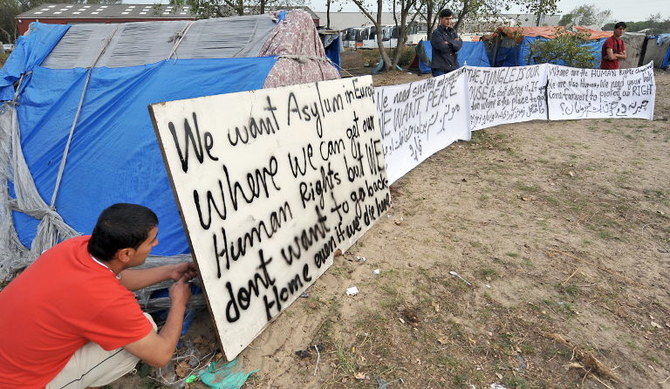
Migrants trying to get to Britain, mostly from Afghanistan, display banners in favour of asylum in Europe, on September 21, 2009 in a wooded area known as "the jungle" in Calais, northern France, where they have set up home. (AFP)
Short Url
Updated 12 June 2023
Follow

UK MPs find ‘little evidence’ Albanians should claim asylum

  • Cross-party committee report: ‘No basis for UK to routinely accept thousands of asylum applications’ from Albanians
  • Prime Minister Rishi Sunak has pledged to tackle illegal migration into Britain

LONDON: A committee of UK MPs has said there is “little evidence” Albanians face risk of persecution in their homeland, raising doubts about the future of many who have claimed asylum in Britain.

Last year, 12,301 Albanians arrived in the UK illegally via small boats across the English Channel, with many going on to claim asylum. In the six months to June 2022, 51 percent of asylum claims made by Albanians were granted. 

The committee said in a report, released Monday, that in the same period, nine other European countries accepted no asylum claims made by Albanians.

In the report, the MPs called on the government to explain why the acceptance rate for claims from a safe country was so high.

“Albania is a safe country,” the MPs said. “It is not at war and is a candidate country to join the European Union. 

“There is no clear basis for the UK to routinely accept thousands of asylum applications from Albanian citizens, the committee finds.”

The report said that the main factor driving migration from Albania to the UK was better job opportunities.

The committee’s chair, Labour MP Dame Diana Johnson, said there had been a “substantial, sudden increase in asylum claims from a seemingly peaceful country,” and that “while it is important that questions are asked and lessons are learnt, it is clear that the immigration picture is not static and will continue to evolve.”

Dame Diana added: “Changes in migration will inevitably place strain on any system, but the government must do much more to ensure it can better handle these stresses.”

The MPs also said that there were “unquestionably cases of Albanian citizens being trafficked to the UK,” noting that women were especially likely to be victims and that more needed to be done to support them and stop the trade. 

The report said seasonal work visas in relevant sectors should also be used to facilitate the flow of Albanians without leading to baseless asylum claims or illegal crossings in the English Channel.

UK Prime Minister Rishi Sunak has made tackling illegal migration to the UK one of the five core pledges of his premiership. 

A recent deal struck between the UK and Albania, he said, had seen 1,800 Albanians sent home, but he added there was still “work to do.”

A Home Office spokesperson said: “Last year, 28 percent of those who arrived by small boat to the UK were from Albania — a safe European country and NATO ally — placing further strain on our asylum system. 

“We’ve worked closely with the Albanian government to disrupt criminal gangs and deter illegal migration. In the five months to the end of May, Albanian small boat arrivals are down 90 percent on last year and we have returned 1,800 illegal migrants and foreign criminals back to Albania. Thanks to changes to our asylum system, we have gone from accepting one in five Albanian asylum claims to just one in 50, in line with other European countries.”


Nigerian police deny church attacks as residents insist 168 people are held by armed groups

Updated 11 sec ago
Follow

Nigerian police deny church attacks as residents insist 168 people are held by armed groups

Kaduna State Police Commissioner Muhammad Rabiu described news reports of the attacks as rumors
It is common for police and locals to have contradicting accounts of attacks in Nigeria’s hard-hit villages

KADUNA, Nigeria: Nigerian police denied reports of simultaneous church attacks in northwestern Kaduna state over the weekend, even as residents shared accounts of kidnappings at the churches in interviews Tuesday.
A state lawmaker, Usman Danlami Stingo, told The Associated Press on Monday that 177 people were abducted by an armed group Sunday. Eleven escaped and 168 are still missing, according to the lawmaker and residents interviewed by AP.
Kaduna State Police Commissioner Muhammad Rabiu described news reports of the attacks as rumors, saying the police visited one of the three churches in the district of Kajuru and “there was no evidence of the attack.”
It is common for police and locals to have contradicting accounts of attacks in Nigeria’s hard-hit villages.
“I am one of the people who escaped from the bandits. We all saw it happen, and anyone who says it didn’t happen is lying,” said Ishaku Dan’azumi, the village head of Kurmin Wali.
Nigeria is struggling with several armed groups that launch attacks across the country, including Boko Haram and Daesh-WAP, which are religiously motivated, and other amorphous groups commonly called “bandits.”
Rights group Amnesty International condemned the “desperate denial” of the attack by the police and government.
“The latest mass abduction clearly shows President Bola Tinubu and his government have no effective plan for ending years of atrocities by armed groups and gunmen that killed thousands of people,” the group said in a statement.
A Kaduna-based Christian group, the Christian Solidarity Worldwide Nigeria, said in a press release that security operatives did not allow its members to visit the sites of the attacks.
“The military officer who stopped the CSWN car said there was a standing order not to allow us in,” Reuben Buhari, the group’s spokesperson, said.
The Chikun/Kajuru Active Citizens Congress, a local advocacy group, published a list of the hostages. The list could not be independently verified by the AP. Police did not respond to a request for questions on the list.
The Christian Association of Nigeria also verified the attacks and has a list of the hostages, according to a senior Christian leader in the state who spoke on condition of anonymity for fear of his safety.
“This happened, and our job is to help them. These people came, attacked and picked people from churches,” he said. “But I think they prefer to play the politics of denying, and I don’t think that’s what we want.”
Attacks against religious worship centers are common in Nigeria’s conflict-battered north. They are a part of the country’s complex security crisis that also affects schools, such as in November when hundreds of schoolchildren and their teachers were abducted in another part of Kaduna.
In the past few months, the West African nation has been in the crosshairs of the US government, which has accused the Nigerian government of not protecting Christians in the country, leading to a diplomatic rift. The USlaunched an attack against an alleged Daesh group members on Nigerian territory on Dec. 25, an operation the Nigerian government said it was aware of.