

Asylum seekers stage London protest over ‘inhuman’ hotel conditions

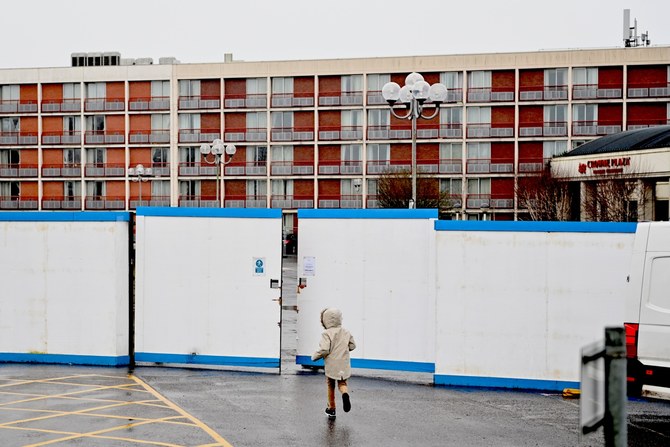
File photo of Crown Plaza which is one of the hotels housing asylum seekers as they wait for their asylum claims to be processed (AFP)
Short Url
Updated 02 June 2023
Follow

Asylum seekers stage London protest over ‘inhuman’ hotel conditions

  • ‘They treat you very, very bad, like an animal,’ says Iranian Kurd
  • Home Office encouraging shared rooms in cost-cutting drive

London: Migrants in the UK are staging a protest by living on the street outside their allocated hotel after complaining of “inhuman” and “prison-like” conditions, the Daily Telegraph reported on Friday.

The 25 men — from Iraq, Iran, Eritrea, Ethiopia, Somalia and Bangladesh — were transferred to central London’s Comfort Inn hotel from Park Hotel in Essex.

They said instead of the single rooms offered at the old hotel, the new London site includes four beds to single rooms and unsanitary bathrooms.

They are protesting by sleeping on the street outside the hotel, demanding that they be moved to single rooms by the UK Home Office.

On Thursday evening, the migrants barricaded the entrance to the hotel with bags and suitcases, as well as stuck posters around the site.

One Iranian migrant, 27, said: “Two square meters is not enough for sleeping four people. And when you go to the toilet, the smell damages you.”

Another Iranian, 21, said: “They said we’re going to move you to another, better place. They gave us this postcode. When we checked on Google Maps, we said, ‘oh this is very nice.’

“But when you get in, it’s like a jail. And they treat you very, very bad. They treat you like an animal.”

The migrants were transferred to the London hotel as part of an effort by the Home Office to cut migrant housing costs.

The UK is believed to be spending up to £6 million ($7.5 million) per day on accommodation for 50,000 asylum seekers, many of whom crossed into Britain via the English Channel on small boats.

Ministers are said to be encouraging the use of shared rooms as a deterrence policy against people smugglers.

Posters placed around the hotel by the 25 migrants read “This is a prison, not a hotel” and “Homeless by the Home Office.”

 About 400 hotels across the UK have been commissioned by the government to house asylum seekers, with individual migrants receiving £45 per week or £9.10 if food is included in their accommodation.

A Home Office spokesperson said the rooms offered to asylum seekers were “of a decent standard and meet all legal and contractual requirements.”


Bangladesh readies for polls, worry among Hasina supporters

Updated 6 sec ago
Follow

Bangladesh readies for polls, worry among Hasina supporters

  • The Muslim-majority nation of 170 million people will hold elections on February 12, its first since the uprising
  • Hasina was sentenced to death for crimes against humanity in Nov. and her former ruling party has been outlawed

Gopalganj: Bangladesh is preparing for the first election since the overthrow of Sheikh Hasina, but supporters of her banned Awami League (AL) are struggling to decide whether to shift their allegiance.

In Gopalganj, south of the capital Dhaka and a strong bastion of Hasina’s iron-grip rule, residents are grappling with an election without the party that shaped their political lives for decades.

“Sheikh Hasina may have done wrong — she and her friends and allies — but what did the millions of Awami League supporters do?” said tricycle delivery driver Mohammad Shahjahan Fakir, 68, adding that he would not vote.

“Why won’t the ‘boat’ symbol be there on the ballot paper?” he said, referring to AL’s former election icon.

The Muslim-majority nation of 170 million people will hold elections on February 12, its first since the uprising.

Hasina, who crushed opposition parties during her rule, won landslide victories in Gopalganj in every election since 1991.

After a failed attempt to cling to power and a brutal crackdown on protesters, she was ousted as prime minister in August 2024 and fled to India.

She was sentenced to death in absentia for crimes against humanity by a court in Dhaka in November, and her former ruling party, once the country’s most popular, has been outlawed.

Human Rights Watch has condemned the AL ban as “draconian.”

“There’s so much confusion right now,” said Mohammad Shafayet Biswas, 46, a banana and betel leaf seller in Gopalganj.

“A couple of candidates are running from this constituency — I don’t even know who they are.”

As a crowd gathered in the district, one man shouted: “Who is going to the polling centers? We don’t even have our candidates this time.”

‘DEHUMANISE’

Hasina’s father, Sheikh Mujibur Rahman, the founding president of Bangladesh, hailed from Gopalganj and is buried in the town.

Statues of Rahman have been torn down nationwide, but in Gopalganj, murals and statues are well-maintained.

Since Hasina’s downfall, clashes have broken out during campaigning by other parties, including one between police and AL supporters in July 2025, after which authorities filed more than 8,000 cases against residents.

Sazzad Siddiqui, a professor at Dhaka University, believes voter turnout in Gopalganj could be the lowest in the country.

“Many people here are still in denial that Sheikh Hasina did something very wrong,” said Siddiqui, who sat on a government commission formed after the 2025 unrest.

“At the same time, the government has constantly tried to dehumanize them.”

This time, frontrunners include candidates from the Bangladesh Nationalist Party (BNP) and Jamaat-e-Islami, the country’s largest religious party.

Both are from Hasina’s arch-rivals, now eyeing power.

“I am going door to door,” BNP candidate S.M Zilany, 57, told AFP, saying many would-be voters had never had a candidate canvass for their backing.

“I promise them I will stand by them.”

Zilany said he had run twice against Hasina — and was struck down by 34 legal cases he claimed had been politically motivated.

This time, he said that there was “a campaign to discourage voters from turning up.”

Jamaat candidate M.M Rezaul Karim, 53, said that under Hasina, the party had been driven underground.

“People want a change in leadership,” Karim told AFP, saying he was open to all voters, whatever their previous loyalties.

“We believe in coexistence; those involved in crimes should be punished; others must be spared,” Karim said.

Those once loyal to Hasina appear disillusioned. Some say they had abandoned the AL, but remain unsure whom to support.

“I am not going to vote,” said one woman, who asked not to be named.

“Who should I vote for except Hasina? She is like a sister.”