

China likely ‘to benefit from $10 trillion Mideast sovereign funds boost’

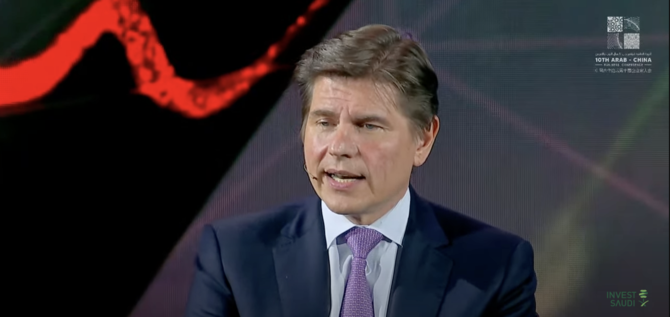
Nicolas Aguzin, CEO of Hong Kong Exchanges and Clearing Ltd.
Short Url
Updated 13 June 2023
Follow

China likely ‘to benefit from $10 trillion Mideast sovereign funds boost’

RIYADH: China is likely to benefit from the Middle East’s sovereign funds, as their investment capital is forecast to reach $10 trillion by 2030, according to the CEO of the Hong Kong Stock Exchanges and Clearing Ltd.

Speaking on the second day of the 10th Arab-China Business Conference, Nicolas Aguzin, predicted regional sovereign funds’ resources to swell by 150 percent, up from the current $4trillion.

“As investment capital goes to $10 trillion, we think that more than somewhere between 10 and 20 percent will be invested in China. That’s between $1 trillion and $2 trillion that will be reallocated in investments in that part of the world which is, like, massive,” the CEO said.

He also reflected current and future collaborations involving the HKEX and Saudi Arabia, such as the recent memorandum of understanding with the Kingdom’s stock exchange, also known as Tadawul.

“In Saudi Arabia, we signed an MoU with Tadawul whereby we’re looking at areas that range from fintech to cross listings to ESG, to see ways in which we could collaborate,” Aguzin said.

The CEO also highlighted the attractiveness of the Hong Kong market.

“The key attractiveness that I would say an international company has in terms of leveraging the opportunities that are provided by the Hong Kong market is that it’s the only market in the world where you can get the best investors from the global international markets and the best investment based on the domestic Chinese capital markets, including retail and institutional investors,” he clarified.

Investment opportunities, economic growth, and closer trade relations are on the agenda at the 10th Arab-China Business Conference.  

The two-day event seeks to explore synergies in technology, artificial intelligence, renewable energy, agriculture, real estate, and strategic minerals.  

The conference has been organized by the Saudi Ministry of Investment in partnership with the Chinese Council for the Promotion of International Trade and a host of other regional associations.

The  event saw a series of plenaries, workshops, special meetings, and side events dedicated to topics such as environmental, social and governance, and supply chain resilience. It attracted more than 3,500 business leaders, innovators, and policymakers from 26 countries.


Saudi POS spending jumps 28% in final week of Jan: SAMA

Updated 06 February 2026
Follow

Saudi POS spending jumps 28% in final week of Jan: SAMA

RIYADH: Saudi Arabia’s point-of-sale spending climbed sharply in the final week of January, rising nearly 28 percent from the previous week as consumer outlays increased across almost all sectors. 

POS transactions reached SR16 billion ($4.27 billion) in the week ending Jan. 31, up 27.8 percent week on week, according to the Saudi Central Bank. Transaction volumes rose 16.5 percent to 248.8 million, reflecting stronger retail and service activity. 

Spending on jewelry saw the biggest uptick at 55.5 percent to SR613.69 million, followed by laundry services which saw a 44.4 percent increase to SR62.83 million. 

Expenditure on personal care rose 29.1 percent, while outlays on books and stationery increased 5.1 percent. Hotel spending climbed 7.4 percent to SR377.1 million. 

Further gains were recorded across other categories. Spending in pharmacies and medical supplies rose 33.4 percent to SR259.19 million, while medical services increased 13.7 percent to SR515.44 million. 

Food and beverage spending surged 38.6 percent to SR2.6 billion, accounting for the largest share of total POS value. Restaurants and cafes followed with a 20.4 percent increase to SR1.81 billion. Apparel and clothing spending rose 35.4 percent to SR1.33 billion, representing the third-largest share during the week. 

The Kingdom’s key urban centers mirrored the national surge. Riyadh, which accounted for the largest share of total POS spending, saw a 22 percent rise to SR5.44 billion from SR4.46 billion the previous week. The number of transactions in the capital reached 78.6 million, up 13.8 percent week on week. 

In Jeddah, transaction values increased 23.7 percent to SR2.16 billion, while Dammam reported a 22.2 percent rise to SR783.06 million. 

POS data, tracked weekly by SAMA, provides an indicator of consumer spending trends and the ongoing growth of digital payments in Saudi Arabia.  

The data also highlights the expanding reach of POS infrastructure, extending beyond major retail hubs to smaller cities and service sectors, supporting broader digital inclusion initiatives.  

The growth of digital payment technologies aligns with Saudi Arabia’s Vision 2030 objectives, promoting electronic transactions and contributing to the Kingdom’s broader digital economy.