First day of Arab-China conference witnesses signing of 30 deals worth $10 billion
First day of Arab-China conference witnesses signing of 30 deals worth $10 billion/node/2319851/business-economy
First day of Arab-China conference witnesses signing of 30 deals worth $10 billion
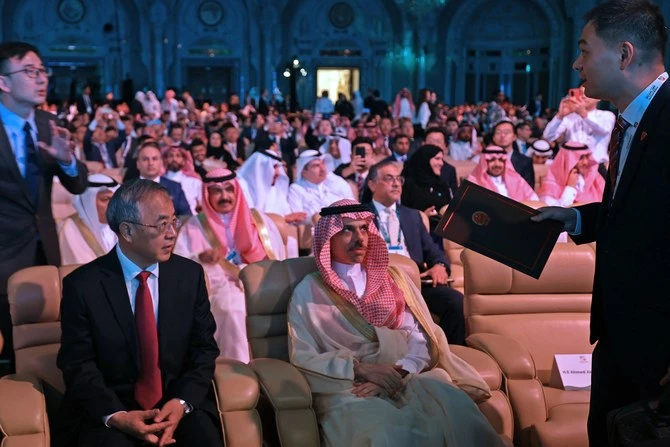
Saudi Foreign Minister Faisal bin Farhan and the vice chairman of the Chinese People’s Political Consultative Conference, Hu Chunhua, attend 10th Arab-China Business Conference in Riyadh, on Sunday. (Reuters)
First day of Arab-China conference witnesses signing of 30 deals worth $10 billion
Saudi energy minister highlights Saudi-China synergies in Vision 2030 and Belt and Road Initiative
The kingdom also announced the revival of the Silk Route on the sidelines of the two-day event
Updated 11 June 2023
Arab News
RIYADH: The first day of the 10th Arab-China Business Conference saw the signing of 30 investment agreements worth $10 billion across various sectors including technology, renewables, agriculture, real estate, minerals, supply chains, tourism, and healthcare.
According to the Investment Ministry, the Saudi government signed deals with several Chinese entities for projects including a joint venture for automotive research, development, manufacturing and sales, development of tourism and other apps, and production of rail wagons and wheels in the Kingdom.
Several business-to-business deals were also signed at the key business event that began in Riyadh on Sunday.
Speaking at the event, Saudi Energy Minister Prince Abdulaziz bin Salman said: “I would not be surprised if you will hear more announcements soon on Saudi-Chinese investment.”
He said the Kingdom seeks collaboration with the world’s second-largest economy instead of competition.
Prince Abdulaziz said there are synergies between the two countries, as the Kingdom is progressing steadily with its Vision 2030 plan, while China is pursuing its Belt and Road Initiative.
The two-day event has been organized by Saudi Arabia’s investment and foreign ministries in collaboration with the General Secretariat of the Arab League, the Chinese Council for the Promotion of International Trade, and the Union of Arab Chambers.
Saudi Foreign Minister Prince Faisal bin Farhan, who inaugurated the conference on behalf of Crown Prince Mohammed bin Salman, said: “The crown prince has continually amplified efforts to enhance the long-standing and advanced partnership between the Arab world and China in all sectors.”
He said the conference outlines methods for achieving mutual compatibility, exchanging experience, and launching new opportunities that enable growth and investment, resulting in prosperity and progress for all.
The program of plenaries, workshops, special meetings, and side events dedicated to topics such as environmental, social and governance, and supply chain resilience attracted more than 3,500 business leaders, innovators, and policymakers from 26 countries.
In a bid to further boost trade ties with China, Saudi Arabia announced the revival of the Silk Route on the sidelines of the event.
Saudi Investment Minister Khalid Al-Falih said the Kingdom can serve as China’s gateway to the Arab world as the world’s second-largest economy seeks to elevate trade ties with the region.
The Kingdom represents 25 percent of the $432 billion trade between China and Arab countries in 2022.
Commenting on the revival of the Silk Route, the minister said the initiative aligns with Saudi Arabia’s future vision that seeks to diversify its economy and use modern technology to elevate the skills of its youth.
The volume of trade between Saudi Arabia and China hit $106 billion in 2022, registering a 30 percent increase over 2021.
The second day of the program will include a closing keynote from Dilma Rousseff, former president of Brazil and current president of New Development Bank, a multilateral development bank established by Brazil, Russia, India, China, and South Africa to mobilize resources for infrastructure and sustainable development projects in emerging markets and developing economies.
Kingdom’s mineral wealth valued at $2.5tn, positioning mining as a third pillar of the national economy
Updated 07 March 2026
Ghadi Joudah
RIYADH: Saudi Arabia is accelerating its push into mining as part of its economic transformation under Vision 2030, amid the growing importance of critical minerals and rare earths.
The Kingdom’s mineral wealth is valued at $2.5 trillion, positioning mining as a third pillar of the national economy alongside hydrocarbons.
The mining industry could give Saudi Arabia an edge in transition minerals and supply chains by expanding extraction, processing and the logistics needed to move materials to market, according to economists and industry specialists.
Saudi Arabia is home to more than 45 identified minerals, including gold, copper and uranium, according to the Vision 2030 strategy.
Momentum has been supported by measures aimed at making mining easier to invest in and faster to scale, including updated regulations, digital licensing platforms, specialized mining services, and new transport and rail links to mining areas.
Vision 2030 aims to raise mining’s contribution to gross domestic product to SR240 billion ($63 billion) by 2030, create 200,000 direct and indirect jobs, and attract $27 billion in new investment, according to published government targets.
Signs of progress are starting to show in the mining sector in terms of exploration activity, licensing and new discoveries.
“The mining strategy shows it’s working very well, evidenced by the rapid rise in exploration and industrial licenses, and major new mineral discoveries,” Talat Hafiz, an economist and financial analyst, told Arab News.
Saudi Arabia is undertaking the world’s largest geological survey, covering about 700,000 sq. km of the Arabian Shield for $1.5 billion, he said.
The number of mining licenses issued exceeds 2,000, according to official data, and the Kingdom’s mineral wealth is valued at 90 percent higher than it was in 2016 when Vision 2030 was rolled out.
A key milestone highlighted in Vision 2030’s mining strategy was the introduction of a new mining investment law, which reduced the tax rate to 20 percent from 45 percent to spur investment and align the sector with global standards.
The Kingdom’s mining resources position it well to be a critical supplier of raw materials that are integral to energy transition as clean-energy technologies require large volumes of mined materials.
Copper is central to electrification and power networks, while battery supply chains rely on minerals such as nickel and lithium. Phosphate is a key industrial input with wider economic value.
Reliable supplies of metals and minerals used in power grids, batteries and electric vehicles can attract investment and support downstream industry in the Kingdom.
Saudi Arabia’s Jabal Sayid site, northeast of Jeddah, ranks among the world’s top four resources for rare earth elements, Khalid Al-Mudaifer, vice minister of industry and mineral resources for mining affairs, recently told Al Eqtisadiah.
It will help meet Saudi Arabia’s needs for minerals used in magnet manufacturing, EVs and wind energy, while also supporting global supply, including the US market, he said.
Mining can also catalyze investment in the Kingdom, widen supply-chain employment, and boost non-oil exports and private-sector growth, according to economists and policymakers.
Mines, processing plants and the infrastructure around them require large upfront capital spending, creating a pipeline of work across construction, equipment, utilities and logistics.
The mining industry could give Saudi Arabia an edge in transition minerals and supply chains by expanding extraction, processing and the logistics needed to move materials to market. (Shutterstock)
“When a mining sector scales, the economic footprint extends well beyond extraction,” said Turki Al-Nahari, vice president of global mining at Ecolab, told Arab News. “Growth typically occurs across engineering services, industrial water management, logistics, laboratory testing, equipment reliability, environmental services and digital performance systems.
“That shift creates demand for skilled engineers, technicians, data analysts and operational specialists,” he added.
In 2025, Saudi Arabia’s mining exploration budget increased 600 percent to $146 million from $21 million in 2022.
“This growth is driven by ongoing geological surveys, technological advancements and higher exploitation budgets, all of which signal stability and opportunity, attracting foreign investment,” Manraj Lamba, a mining economics analyst at S&P Global, said in a recent report.
Mining projects are easier to finance when the size and quality of the deposit are clear, costs are competitive, and rules and taxes are stable, Abdullah Al-Harbi, an economist familiar with the industry, told Arab News.
Investors want solid feasibility work, credible timelines and evidence a project can stay profitable through swings in commodity prices, Al-Harbi said.
Saudi Arabia’s pipeline includes 24 exploration-stage projects and 17 more advanced developments, according to S&P Global.
“Its proactive approach to geological surveys and resource assessment has uncovered significant potential across gold, copper, phosphate and bauxite,” Lamba said.
Large projects also tend to generate employment across a wider industrial supply chain, including contractors, maintenance, laboratories, transport and a range of operational services.
To boost employment and support hiring and training, Saudi Arabia has moved to standardize job roles and skills for the mining industry.
HIGHLIGHT
Vision 2030 aims to raise mining’s contribution to gross domestic product to SR240 billion ($63 billion) by 2030, create 200,000 direct and indirect jobs, and attract $27 billion in new investment.
The Kingdom rolled out a framework related to employment and skills in the mining industry in January at the Global Labor Market Conference.
The framework is “a tool which ensures clear definitions of occupations and their required skills,” the Kingdom’s Minister of Industry and Mineral Resources Bandar Al-Khorayef said. It will cover more than 500 job roles, detail the necessary skills, responsibilities and titles, he added.
Exports from the sector are already rising in tandem with investments to develop the industry and create jobs.
Saudi Arabia exported 5.7 million tonnes of phosphate fertilizer in 2024, up about 6 percent from 2023, according to a GASTAT report.
As the energy transition accelerates, Saudi Arabia’s advantage may be strongest beyond extraction alone.
“Saudi Arabia’s most realistic advantage in the accelerating energy transition lies in combining selective mining with strong processing and refining capabilities, supported by its emerging role as a logistics and supply-chain hub,” Hafiz said.
The Kingdom’s position between Africa, Europe, and Asia favors downstream processing and value-added industries, he added.
“Saudi Arabia is prioritizing minerals that are both financeable and strategically aligned with emerging industries such as electric vehicles and clean energy technologies, where markets are clear, and demand is scalable,” Hafiz said.
Aluminum, phosphate, and similar commodities remain a key focus to support local manufacturing, infrastructure development and downstream industries while strengthening export capacity, he said.
“Once construction concludes, the priority shifts to operational stability and performance optimization,” Al-Nahari said.
“Small efficiency gains, applied consistently across large-scale operations, compound materially over time,” influencing cost as well as uptime and competitiveness over the life of a mine, he added.
As the global race toward electrification and decarbonization accelerates, the Kingdom is effectively positioning itself beyond its oil legacy with its strategic commitment to the minerals sector, which will play a critical role in powering the future.
Its investment in exploration, infrastructure, and downstream processing anchor it as a pivotal supplier in the critical minerals and rare earths value chain in the era of energy transition.