

Pakistani women playing key roles in Hajj mission

1 / 4
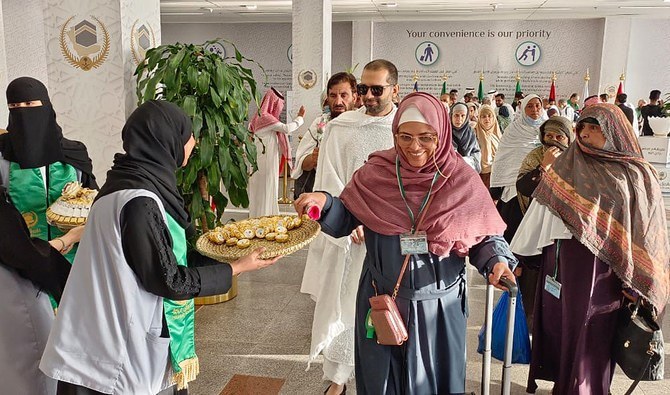
Pakistani Hajj facilitators welcome pilgrims from Pakistan at the King Abdulaziz International Airport in Jeddah. (Supplied)
2 / 4
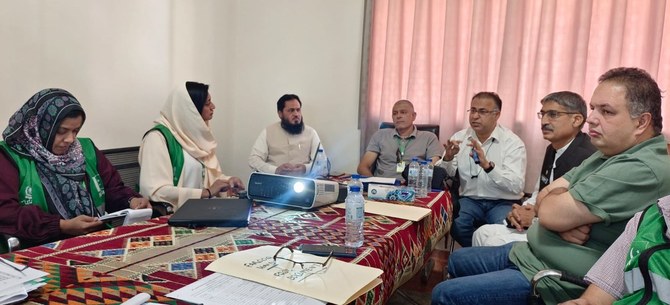
Pakistani women facilitators attend a Hajj mission meeting in Makkah. (Supplied)
3 / 4
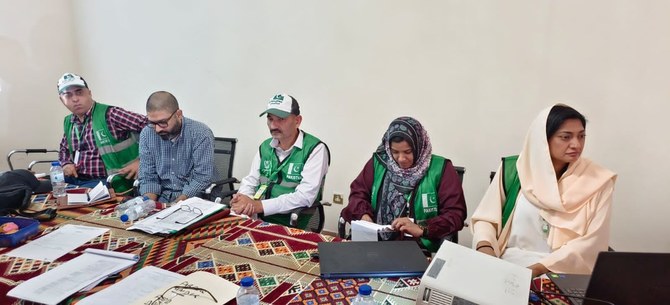
Pakistani women facilitators attend a Hajj mission meeting in Makkah. (Supplied)
4 / 4
A Pakistani woman officer, Beenish Ashraf, heads a call center of the Pakistani Hajj mission in Makkah. (Supplied)
Short Url
Updated 11 June 2023
Follow

Pakistani women playing key roles in Hajj mission

  • 40 females among teams of experts helping pilgrims from South Asian country

ISLAMABAD: Pakistan has sent more than 40 women to work as part of its Hajj mission in Saudi Arabia, many of them in leadership roles, a Religious Affairs Ministry official said on Saturday.

Saudi authorities have reinstated Pakistan’s pre-pandemic Hajj quota, allowing 179,210 people to participate in this year’s pilgrimage, and removed the upper age limit of 65. About 80,000 of the pilgrims will perform Hajj under a government scheme, with the rest using private tours.

Pakistan’s Religious Affairs Ministry said that more than 50,000 Pakistanis had arrived in the Kingdom since the government launched special flights on May 21.

“Currently, over 40 women are working shoulder to shoulder with men in the Hajj mission in Makkah and Madinah, and approximately 15 more are expected to arrive in the coming days,” Mohammed Umer Butt, a ministry spokesperson, told Arab News.

“These women are serving in various sections and some of them are even leading different departments,” he said, adding that some female doctors and paramedics were contributing to Pakistan’s Hajj medical mission.

Nadia Razzaq, the head of information technology in Makkah, said women were playing crucial roles within the Hajj mission.

“More than 40 women have already arrived in Saudi Arabia to fulfill various responsibilities across different sectors, such as food, accommodation and transportation,” she told Arab News.

“Women are making valuable contributions to every sector of the Hajj operations.”

Ayesha Ijaz, who is responsible for monitoring the Hajj mission in Makkah, said her role involved overseeing the arrangements made by private tour operators for pilgrims arriving in Saudi Arabia.

“This includes addressing their issues and ensuring the provision of the facilities promised to them in Makkah, Madinah and other locations during the Hajj,” she said.

“Women staff also hold crucial positions in the Hajj mission, which greatly contributes to our smooth operations.”

Beenish Ashraf, who heads up the call center at Makkah’s main control office, said her department helped to resolve pilgrims’ complaints.

“We have employed call agents who handle pilgrims’ calls round the clock,” she said.

“As soon as we receive these calls, we enter the details into our system, notify the respective sector commander and contact the relevant department to expedite the resolution.”


US NATO envoy says allies must ‘pull weight’ after Czech defense cut

Updated 6 sec ago
Follow

US NATO envoy says allies must ‘pull weight’ after Czech defense cut

PRAGUE, March 12 : The United States’ ambassador to ‌NATO said on Thursday that all allies must “pull their weight,” after Czech lawmakers approved a 2026 budget that cuts defense outlays.
Czech Prime Minister ​Andrej Babis’ government, in power since December, pushed a revamped budget through the lower house on Wednesday evening which cut the defense ministry’s allocation versus a previous proposal to 154.8 billion crowns ($7.31 billion), or 1.73 percent of gross domestic product.
That is below a NATO target of 2 percent of GDP already expected before alliance members pledged last year in the Hague ‌to raise defense spending ‌to 3.5 percent of GDP plus ​1.5 percent ‌on ⁠other defense-relevant investments ​over ⁠the next decade.
The Czech Finance Ministry says total defense spending in the budget will reach 2.07 percent of GDP, but the country’s budget watchdog has warned that includes money earmarked elsewhere, like for the transport ministry for road projects, that may not be recognized by NATO.
“All Allies must pull their weight and ⁠honor The Hague Defense Commitment,” US Ambassador to ‌NATO Matthew Whitaker said on X ‌on Thursday with a picture of ​a news headline on the Czech ‌budget approval.
“These numbers are not arbitrary. They are about ‌meeting the moment — and the moment requires 5 percent as the standard. No excuses, no opt-outs.”
European NATO countries are under pressure to raise defense spending amid the Ukraine-Russia war ‌and at US President Donald Trump’s urging.
Babis, whose populist ANO party won elections last year, said ⁠in February ⁠the country was “certainly not” on the path to raising core defense spending to the 3.5 percent target, saying there was a different focus, like on health care.
The budget watchdog on Thursday reiterated “strong doubts” that some spending deemed defense in this year’s budget would meet NATO’s definition.
President Petr Pavel, a former NATO official, has also said defense cuts risked a loss of trust from allies — but has signalled he would not veto the budget.
US Ambassador to Prague Nicholas Merrick said last ​week the Czech Republic may ​slip to the bottom of NATO’s defense-spending ranks.