





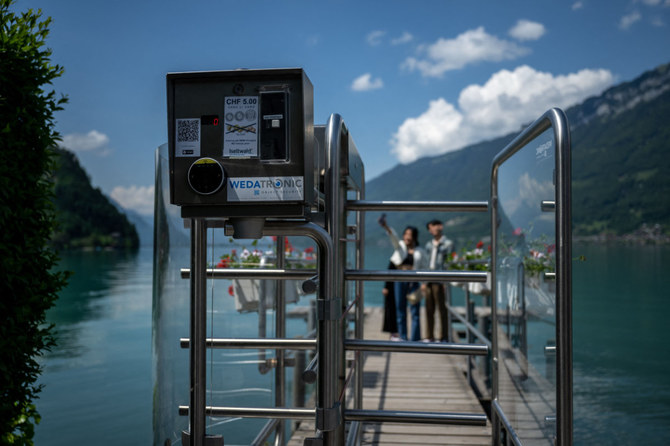

ISELTWALD, Switzerland: “It’s a dream come true,” said Filipino tourist Isabel Palijon, staring in wonder at a wooden pier framed by the turquoise waters of a Swiss lake and the towering Alps behind.
And she is not alone. Ever since the hugely popular South Korean series “Crash Landing on You” aired a romantic scene shot on this very spot, the picturesque village of Iseltwald has been overrun by Asian tourists.
The Netflix hit tells the unlikely story of a South Korean billionaire heiress who accidentally paraglides into the peninsula’s demilitarised zone, crashing landing onto a chivalrous army officer serving North Korean leader Kim Jong Un.
Several flashbacks in the show take place in Switzerland, including a riveting romantic scene on Iseltwald’s wooden pier, where the male lead plays a beautiful piano melody that echoes across the water as the girl he will later fall in love with arrives by ferry from Interlaken.
“I wish someday someone would do that for me,” said Jiah Hni Gwee, a 35-year-old from Malaysia, looking longingly at the spot on the pier where the piano stood.
“It would be amazing and romantic.”
She was among dozens of tourists milling around the lakeside on a sunny day last week, as a large steamboat bearing a giant Swiss flag pulled up to the nearby dock, teeming with visitors.
The breathtaking scenery and the romantic setting have made the pier a must-see for so-called “CLOY” fans who make it to Europe.
The 16-part series started airing just as Covid-19 began and it became a must-watch in much of Asia during pandemic lockdowns.
A South Korean culture ministry survey found that CLOY was the second-most popular K-drama show among foreign viewers in 2021 after “Squid Game.”
But its success has caused an unexpected headache for Iseltwald, especially since last year when travel restrictions were lifted across much of Asia.
“The numbers have exploded,” local tourism office manager Titia Weiland told AFP.
She said it was difficult to calculate how many CLOY tourists had come but estimated that “for every local person living here, it’s been 1,000 visitors.”
She stressed that “almost everybody in Iseltwald — population 400 — is happy to have many tourists,” but acknowledged “it has been quite overwhelming.”
Last summer, up to 20 coaches began arriving each day, clogging traffic and sometimes blocking access to the village.
And locals complain that CLOY fans typically rush to the pier for a picture before moving on, often leaving a mess but little money.
In a bid to deal with the influx, the municipality last month announced only pre-booked coaches that pay for reserved parking spots will be let in.
And it installed a turnstile at the pier, which tourists can pass for a “selfie fee” of five Swiss francs ($5.50).
Sonja Hornung, the manager of the Strand Hotel that overlooks the pier, said the measures had made a difference and her restaurant gives customers a turnstile token.
“Last year, it was terrible, (but) it has gotten much better,” she said, hailing the slot system that has dramatically reduced the number of coaches.
Some tourists, however, were a bit dismayed by the turnstile — and the price.
“Oh, five francs!” Florita Lichtensteiger, a 64-year-old Filipino living in Switzerland, exclaimed as she showed up with several visiting relatives.
She grudgingly paid for them to go through, but did not follow, saying she had been here at least 10 times before. “All my guests want to see this place.”
“It’s not worth it,” said Nayeon Park, a 21-year-old from South Korea.
Weiland insisted that the payment was needed for the upkeep of the pier, which had seen the number of people walking on it skyrocket.
“It has to be safe.”
Iseltwald “is like paradise on Earth,” she said. “We want to really try to keep it that way.”



