PARIS: Iga Swiatek suddenly seemed lost in the French Open final. Her strokes were awry. Her confidence was gone. Her big early lead vanished, too.
She kept looking up into the stands, seeking guidance from her coach and her sports psychologist.
So much was amiss right up until she was two games from defeat against unseeded Karolina Muchova on Saturday. And then, when she needed to most, Swiatek transformed back into, well, Swiatek. The No. 1 player in women’s tennis for more than a year. The defending champion at Roland Garros. Aggressive. Decisive. Full of clarity.
Swiatek overcame a second-set crisis and a third-set deficit to beat Muchova 6-2, 5-7, 6-4 and collect her third career championship at the French Open and fourth Grand Slam title.
“I really love being here,” Swiatek said. “Basically, it’s my favorite place on tour.”
Looking comfortable as can be at the outset, she raced to a 3-0 lead after just 10 minutes in Court Philippe Chatrier — taking 12 of the initial 15 points — and then was ahead 3-0 in the second set, too, before Muchova made things more intriguing.
Swiatek seemed out of sorts, unable to find the right strokes and unable to figure out why. Players are allowed to communicate with their coaches, but whatever Tomasz Wiktorowski — or sports psychologist Daria Abramowicz — might have been trying to tell Swiatek, either the message wasn’t getting through or it wasn’t working right away.
“I know much how much teams are important in our sport. Even though it’s an individual sport, I wouldn’t be here without my team,” Swiatek said afterward. “So, really, thank you, guys. Sorry for being such a pain in the” — and she let the sentence end there.
Muchova grabbed five of six games on the way to pulling even at a set apiece. She carried that momentum into the deciding set, going ahead by a break twice.
That’s when Swiatek returned to her usual brand of crisp, clean tennis, scurrying around the red clay with sublime defense and finding just the occasions to try for a winner. She claimed the last three games of the match.
When it ended on a double-fault by Muchova, Swiatek dropped her racket, hunched forward and covered her face as she cried.
The 22-year-old from Poland has won the French Open twice in a row now, along with her 2020 title there and her triumph at the US Open last September. That makes Swiatek the youngest woman with four Grand Slam trophies since Serena Williams was 20 when she got to that number at the 2002 US Open.
Swiatek is also only the third woman in the professional era to start 4-0 in major finals, joining Monica Seles and Naomi Osaka.
“This was so close, but yet so far,” said Muchova, who is ranked 43rd and was participating in a championship match at a Slam for the first time.
“That happens when you play one of the best: Iga,” Muchova said. “So, I want to congratulate you out loud once again and your team.”
The contest was filled with sections where Swiatek — the dominant player in women’s tennis for more than a year now — was better, and sections where Muchova was.
Every time one woman or the other seemed to be wresting control, every time one or the other raised her level enough that the end appeared in sight, the road curved in a different direction.
Swiatek’s brilliant beginning meant little.
As did Muchova’s edges of 2-0 and 4-3 in the third set.
One point in particular captured the essence of Muchova’s unwillingness to count herself out.
Serving for the second set at deuce while ahead 6-5, Muchova pushed to the net and ranged well to her right for a forehand volley. Swiatek then sent her scrambling to the left, and Muchova somehow slid and stretched for a backhand volley while losing her balance. Her racket fell, and so did she, placing her hands on the clay to brace herself.
The ball, somehow, landed in to take the point, and a moment later, when Swiatek’s backhand return sailed long, Muchova raised her right fist and let out a yell.
Suddenly, it was a set apiece. Suddenly, the outcome was entirely in doubt.
So then the question became: Might Muchova be able to fashion another dramatic comeback, the way she did in the semifinals on Thursday? In that match, against No. 2 Aryna Sabalenka, the reigning Australian Open champion, Muchova faced a match point while trailing 5-2 in the third set and then completely reversed things, taking 20 of the last 24 points and each of the last five games to win.
That result made Muchova 5-0 for her career against foes in the Top 3.
Any hope she had of making that 6-0 dissipated down the stretch.
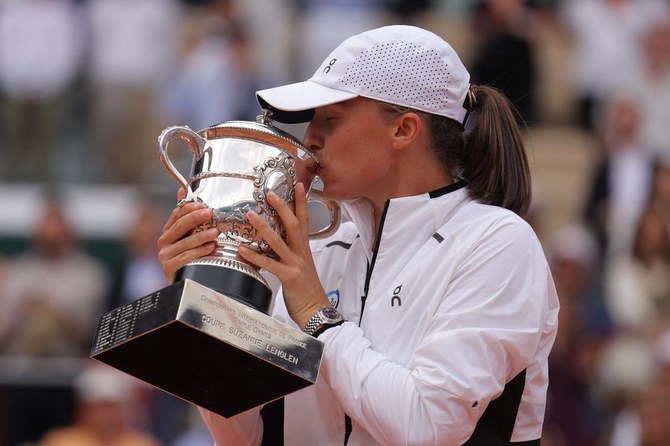
Once again, Swiatek produced what it takes to win. Once again, she was holding a trophy — although she bobbled it during the postmatch ceremony, causing its top to fall.


![]()

Iga Swiatek beats Karolina Muchova in the French Open final for her 3rd trophy in Paris, 4th Slam
Short Url
https://arab.news/23jap
Iga Swiatek beats Karolina Muchova in the French Open final for her 3rd trophy in Paris, 4th Slam
- So much was amiss right up until she was two games from defeat against unseeded Karolina Muchova on Saturday
- “I really love being here,” Swiatek said


Latest updates



© 2026 SAUDI RESEARCH & PUBLISHING COMPANY, All Rights Reserved And subject to Terms of Use Agreement.