

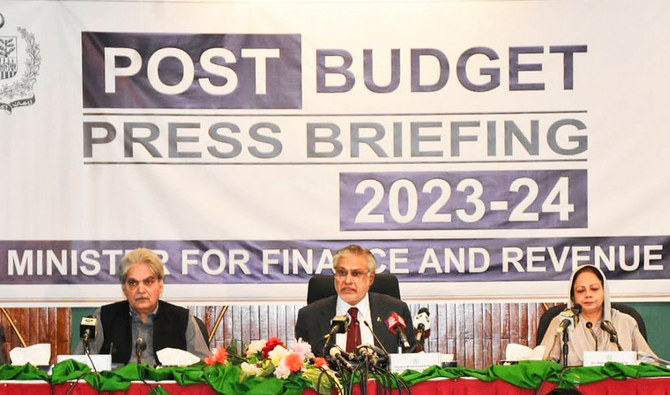

ISLAMABAD: Pakistan’s finance minister Senator Ishaq Dar said on Saturday his government was looking for a ‘Plan B’ in case the International Monetary Fund (IMF) did not release a $1.1 billion tranche of the stalled $6.5 billion bailout program Islamabad secured in 2019.
The statement came a day after the minister presented a Rs14.46 trillion ($50.4 billion) budget for the next fiscal year, setting a tax collection target of Rs9.2 trillion ($32 billion) that is 23 percent higher than the last year’s and envisioning a 3.5 percent GDP growth.
The government’s fiscal plan was unveiled amid record inflation, a depreciating currency, and fast-depleting foreign exchange reserves. While it stated its intention to provide relief to financially vulnerable segments, the budget numbers were aimed at securing the tough IMF loan amount to stave off a balance of payments crisis.
“A Plan B is always there and that is self-reliance,” the finance minister said, addressing a post-budget press conference in Islamabad. “Pakistan will not default.”
“If we don’t get it, we have a plan ready …. we hope to receive $1.1 billion [tranche], but there is no chance for the tenth review now,” the finance minister said. “We will only be fair to get the money after the ninth review.”
Pakistan’s IMF bailout program has been stalled since November and is set to expire on June 30, with its 9th and 10th reviews still pending the IMF board’s approval.
The finance minister said Saudi Arabia and the United Arab Emirates (UAE) had given a commitment of $2 billion and $1 billion respectively to the IMF as external financing support to Pakistan.
“We expect if this amount was not transferred to Pakistan by June 30, it will come next year then,” he said, clarifying that debt rescheduling from the multilaterals was not on the cards.
“We can always negotiate with the bilateral for an ease-out.”
The finance minister clarified that there was no need to reschedule domestic loans because it would be a “serious issue” if a sovereign country could not fulfil “requirement of own currency.”
He said the nation would have to “learn to live” as the country could not print dollars to repay external debts.
“We are trying to mobilize exports and remittances for the external debt [repayments],” Dar said.
About the 3.5 percent growth target, he termed it modest, realistic and in line with the IMF projection, admitting that servicing was one of the biggest items in the budget that the government was “trying to reverse.”
The government has paid special attention to agriculture and information technology (IT) sectors in the budget and given them tax exemptions on seeds and the import of machinery, according to Dar.
The economy is out of the woods now as hectic efforts by the government halted further decline of the economy.
He defended the government’s tax and non-tax revenues as “realistic and achievable” that were set after thorough consultations with stakeholders.
The budget levied new taxes of just Rs200 billion ($697 million) as the tax revenue had increased from Rs7,200 billion in the previous fiscal year to Rs9,200 billion.
“These 200 billion rupees taxes are mostly to promote documentation or fix an anomaly. This is not inflationary,” he said, adding that Rs900 billion out of Rs1,074 billion subsidies allocated in the budget were only meant for the power sector.
“This was a major stumbling block between us and the IMF, we have to focus on it,” he said. “No new major subsidy is being given.”


