

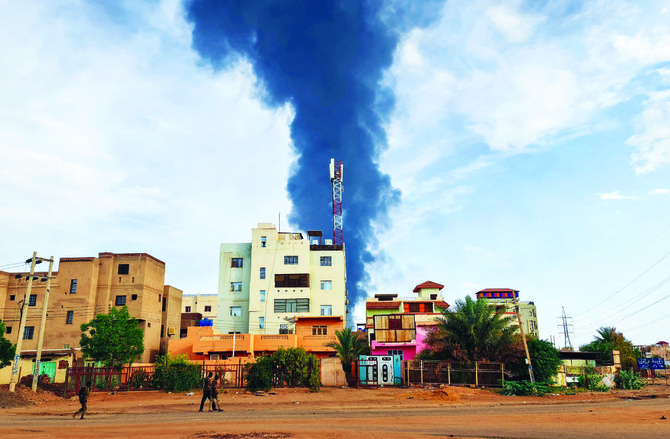
Khartoum quiet as truce takes hold

1 / 2
The fighting which began on April 15, has turned the metropolitan area including Khartoum and its sister cities Bahri and Omdurman into a war zone. (AFP)
2 / 2
Nearly two million people have been displaced by the Sudan conflict, including 476,000 who have sought refuge in neighboring countries, the United Nations says. (AFP)
Short Url
Updated 10 June 2023
Follow

Khartoum quiet as truce takes hold

  • Sudanese families turned back from Egyptian border
  • The fighting has displaced more than 1.9 million people, 200,000 or more of whom have crossed the border into Egypt

KHARTOUM: The Sudanese capital Khartoum was relatively calm on Saturday morning as a US and Saudi-brokered 24-hour ceasefire took effect, providing a window for humanitarian assistance and giving the public a break from the intense fighting.

The short ceasefire follows a string of violated truces between Sudan’s army and the paramilitary Rapid Support Forces, whose power struggle erupted into violence eight weeks ago, sparking a humanitarian crisis.
The US and Saudi Arabia said they shared “frustration” over the violations in a statement announcing the latest truce, and they threatened to adjourn the talks, which have continued indirectly, if fighting continues.
The fighting which began on April 15, has turned the metropolitan area including Khartoum and its sister cities Bahri and Omdurman into a war zone, and led to conflict in Sudan’s Darfur and Kordofan regions to the west.
Before the start of the truce at 6 a.m. (0400 GMT), residents reported anti-aircraft missiles firing in southern Khartoum and the Sharg El-Nil district across the Nile, which also saw airstrikes.
The fighting has displaced more than 1.9 million people, 200,000 or more of whom have crossed the border into Egypt.
Those who have taken the long journey have complained of poor conditions and long wait times.
On Saturday two people attempting to cross the Ashkeit border crossing said a new rule had come into effect requiring all Sudanese to obtain a visa before entering Egypt.
The Egyptian Foreign Ministry did not respond to a request for comment on the decision, which is a reversal of a previous agreement between the two countries that had guaranteed children, women and elderly men free movement.
“We spent two nights in the neutral territory and now they are turning us back,” said Sundus Abbas, a doctor speaking to by phone from between the countries’ checkpoints. “Some people are refusing to leave,” she said.
In the week since the last ceasefire lapsed on June 3 there has been intense fighting, including around crucial army bases, with the RSF claiming to have taken control of an arms manufacturing complex in southern Khartoum.
The US State Department said late on Friday it was supporting a platform called the Sudan Conflict Observatory which would release results of satellite monitoring of the fighting and ceasefires.
An initial report by the observatory documented “widespread and targeted” destruction of water, power and telecom facilities.
It also documented eight “systematic” arson attacks that razed villages in Darfur and several attacks on schools, mosques and other public buildings in El Geneina, country’s westernmost city, which has seen fierce militia attacks amid a telecom blackout.
A doctors’ union in the city called it a “ghost town” and alleged several human rights abuses, including blockading the city, depriving civilians of water, and killing the elderly.
Citizens have said that some of the men who have attacked the city wore RSF uniforms.
More than half of Sudan’s population will require aid this year due to the fighting, the UN has said, as most hospitals in conflict areas have stopped functioning and food supplies in many areas are dwindling.
Previous ceasefires had allowed some humanitarian access, but aid agencies reported still being impeded by the fighting, bureaucratic control and looting.
Medical aid agency MSF said on Saturday its staff had been stopped by RSF soldiers and “obliged” to make a statement that was later circulated by the forces.
The fighting derailed the launch of a transition toward civilian rule four years after a popular uprising ousted strongman President Omar Bashir.
Sudan’s army and the RSF, a parallel force that has operated legally since 2017, fell out over plans to integrate their troops and reorganize their chain of command as part of the transition.


Palestinians attempt to use Gaza’s Rafah Border crossing amidst delays

Updated 08 February 2026
Follow

Palestinians attempt to use Gaza’s Rafah Border crossing amidst delays

  • The Rafah Crossing opened to a few Palestinians in each direction last week, after Israel retrieved the body of the last hostage held in Gaza and several American officials visited Israel to press for the opening

CAIRO: Palestinians on both sides of the crossing between Gaza and Egypt, which opened last week for the first time since 2024, were making their way to the border on Sunday in hopes of crossing, one of the main requirements for the US-backed ceasefire. The opening comes as Prime Minister Benjamin Netanyahu is expected to travel to Washington this week, though the major subject of discussion will be Iran, his office said.
The Rafah Crossing opened to a few Palestinians in each direction last week, after Israel retrieved the body of the last hostage held in Gaza and several American officials visited Israel to press for the opening. Over the first four days of the crossing’s opening, just 36 Palestinians requiring medical care were allowed to leave for Egypt, plus 62 companions, according to United Nations data.
Palestinian officials say nearly 20,000 people in Gaza are seeking to leave for medical care that they say is not available in the war-shattered territory. The few who have succeeded in crossing described delays and allegations of mistreatment by Israeli forces and other groups involved in the crossing, including and an Israeli-backed Palestinian armed group, Abu Shabab.
A group of Palestinian patients and wounded gathered Sunday morning in the courtyard of a Red Crescent hospital in Gaza’s southern city of Khan Younis, before making their way to the Rafah crossing with Egypt for treatment abroad, family members told The Associated Press.
Amjad Abu Jedian, who was injured in the war, was scheduled to leave Gaza for medical treatment on the first day of the crossing’s reopening, but only five patients were allowed to travel that day, his mother, Raja Abu Jedian, said. Abu Jedian was shot by an Israeli sniper while he was building traditional bathrooms in the central Bureij refugee camp in July 2024, she said.
On Saturday, his family received a call from the World Health Organization notifying them that he is included in the group that will travel on Sunday, she said.
“We want them to take care of the patients (during their evacuation),” she said. “We want the Israeli military not to burden them.”
The Israeli defense branch that oversees the operation of the crossing did not immediately confirm the opening.
A group of Palestinians also arrived Sunday morning at the Egyptian side of the Rafah crossing border to return to the Gaza Strip, Egypt’s state-run Al-Qahera News satellite television reported.
Palestinians who returned to Gaza in the first few days of the crossing’s operation described hours of delays and invasive searches by Israeli authorities and an Israeli-backed Palestinian armed group, Abu Shabab. A European Union mission and Palestinian officials run the border crossing, and Israel has its screening facility some distance away.
The crossing was reopened on Feb. 2 as part of a fragile ceasefire deal that stopped the war between Israel and Hamas. Amid confusion around the reopening, the Rafah crossing was closed Friday and Saturday.
The Rafah crossing, an essential lifeline for Palestinians in Gaza, was the only crossing not controlled by Israel prior to the war. Israel seized the Palestinian side of Rafah in May 2024, though traffic through the crossing was heavily restricted even before that.
Restrictions negotiated by Israeli, Egyptian, Palestinian and international officials meant that only 50 people would be allowed to return to Gaza each day and 50 medical patients — along with two companions for each — would be allowed to leave, but far fewer people than expected have crossed in both directions.