

Russia has received hundreds of Iranian drones to attack Ukraine — White House

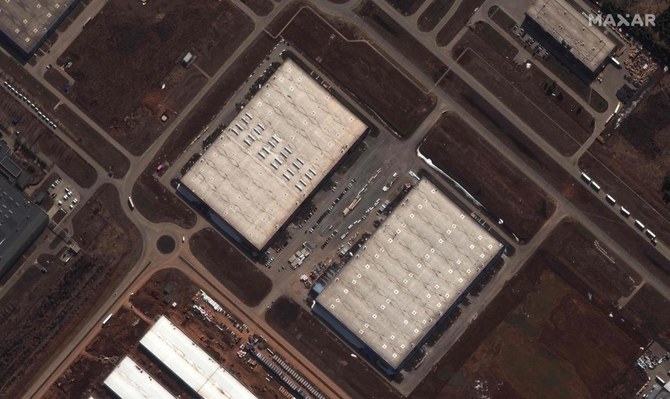
This April 4, 2023, satellite image courtesy of MAXAR Technologies shows the Alabuga special economic zone in Russia. Russia is receiving materials from Iran to build a drone factory on its territory that “could be fully operational early next year,” White House national security spokesman John Kirby said on June 9, 2023. (AFP Photo / Satellite image © 2023 Maxar Technologies)
Short Url
Updated 10 June 2023
Follow

Russia has received hundreds of Iranian drones to attack Ukraine — White House

  • White House said the drones built in Iran were shipped across the Caspian Sea, used by Russian forces against Ukraine
  • Iran has acknowledged sending drones to Russia but said in the past they were sent before the Russian invasion in Feb

WASHINGTON D.C.: The White House said on Friday that Russia appeared to be deepening its defense cooperation with Iran and had received hundreds of one-way attack drones that it is using to strike Ukraine.

Citing newly declassified information, the White House said the drones, or Uncrewed Aerial Vehicles (UAVs), were built in Iran, shipped across the Caspian Sea and then used by Russian forces against Ukraine.

“Russia has been using Iranian UAVs in recent weeks to strike Kyiv and terrorize the Ukrainian population, and the Russia-Iran military partnership appears to be deepening,” White House spokesman John Kirby said in a statement.
“We are also concerned that Russia is working with Iran to produce Iranian UAVs from inside Russia.”

Kirby said the US had information that Russia was receiving materials from Iran required to build a drone manufacturing plant that could be fully operational early next year.

“We are releasing satellite imagery of the planned location of this UAV manufacturing plant in Russia’s Alabuga Special Economic Zone,” he said.

The US has previously sanctioned Iranian executives at a defense manufacturer over drone supplies to Russia. Iran has acknowledged sending drones to Russia but said in they past they were sent before Russia’s February invasion. Moscow has denied its forces used Iranian drones in Ukraine.

Support between Iran and Russia was flowing both ways, Kirby said, with Iran seeking billions of dollars worth of military equipment from Russia including helicopters and radars.

“Russia has been offering Iran unprecedented defense cooperation, including on missiles, electronics, and air defense,” he said.

“This is a full-scale defense partnership that is harmful to Ukraine, to Iran’s neighbors, and to the international community. We are continuing to use all the tools at our disposal to expose and disrupt these activities including by sharing this with the public – and we are prepared to do more.”

Kirby said the transfers of drones constituted a violation of United Nations rules and the United States would seek to hold the two countries accountable.

Britain, France, Germany, the US and Ukraine say the supply of Iranian-made drones to Russia violates a 2015 UN Security Council resolution enshrining the Iran nuclear deal.

Under the 2015 UN resolution, a conventional arms embargo on Iran was in place until October 2020.

Ukraine and Western powers argue that the resolution includes restrictions on missiles and related technologies until October 2023 and can encompass the export and purchase of advanced military systems such as drones.

The Iranian and Russian missions to the United Nations did not immediately respond to a request for comment on the US accusations.

“We will continue to impose sanctions on the actors involved in the transfer of Iranian military equipment to Russia for use in Ukraine,” Kirby said.

He said a new US advisory issued on Friday aimed “to help businesses and other governments better understand the risks posed by Iran’s UAV program and the illicit practices Iran uses to procure components for it.”

The advisory highlighted key items sought by Iran for its development of drones, including electronics such as processors and controllers.


Second doctor in Matthew Perry overdose case sentenced to home confinement

Updated 17 December 2025
Follow

Second doctor in Matthew Perry overdose case sentenced to home confinement

  • Dr. Mark Chavez, 55, a onetime San Diego-based physician, pleaded guilty in federal court in October
  • Judge Sherilyn Peace Garnett also sentenced Chavez to 300 hours of community service

LOS ANGELES: A second California doctor was sentenced on Tuesday to eight months of home confinement for illegally supplying “Friends” star Matthew Perry with ketamine, the powerful sedative that caused the actor’s fatal drug overdose in a hot tub in 2023.
Dr. Mark Chavez, 55, a onetime San Diego-based physician, pleaded guilty in federal court in October to a single felony count of conspiracy to distribute the prescription anesthetic and surrendered his medical license in November.
Judge Sherilyn Peace Garnett also sentenced Chavez to 300 hours of community service. As part of his plea agreement, Chavez admitted to selling ketamine to another physician Dr. Salvador Plasencia, 44, who in turn supplied the drug to Perry, though not the dose that ultimately killed the performer. Plasencia, who pleaded guilty to four counts of unlawful drug distribution, was sentenced earlier this month to 2 1/2 years behind bars.
He and Chavez were the first two of five people convicted in connection with Perry’s ketamine-induced death to be sent off to prison.
The three others scheduled to be sentenced in the coming weeks — Jasveen Sangha, 42, a drug dealer known as the “Ketamine Queen;” a go-between dealer Erik Fleming, 56; and Perry’s former personal assistant, Iwamasa, 60.
Sangha admitted to supplying the ketamine dose that killed Perry, and Iwamasa acknowledged injecting Perry with it. It was Iwamasa who later found Perry, aged 54, face down and lifeless, in the jacuzzi of his Los Angeles home on October 28, 2023.
An autopsy report concluded the actor died from the acute effects of ketamine,” which combined with other factors in causing him to lose consciousness and drown.
Perry had publicly acknowledged decades of substance abuse, including the years he starred as Chandler Bing on the hit 1990s NBC television series “Friends.”
According to federal law enforcement officials, Perry had been receiving ketamine infusions for treatment of depression and anxiety at a clinic where he became addicted to the drug.
When doctors there refused to increase his dosage, he turned to unscrupulous providers elsewhere willing to exploit Perry’s drug dependency as a way to make quick money, authorities said. Ketamine is a short-acting anesthetic with hallucinogenic properties that is sometimes prescribed to treat depression and other psychiatric disorders. It also has seen widespread abuse as an illicit party drug.