

Pakistan speaking to bilateral lenders to restructure debt –finance minister 

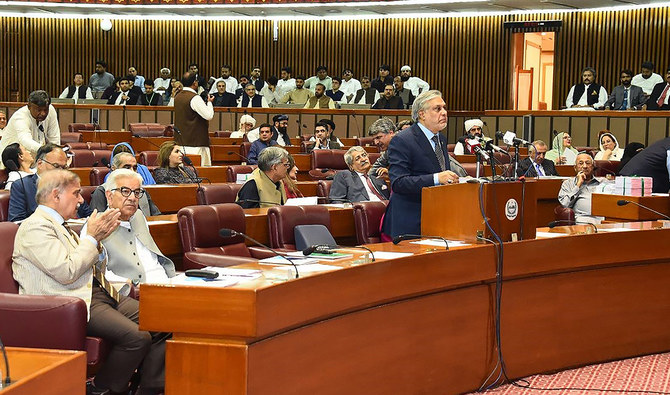
This handout photograph taken and released on June 9,2023 by the Pakistan National Assembly, shows Pakistan's Finance Minister Ishaq Dar presenting the budget 2023-2024 in the national assembly in Islamabad. (AFP/File)
Short Url
Updated 10 June 2023
Follow

Pakistan speaking to bilateral lenders to restructure debt –finance minister 

  • Pakistan’s IMF program runs out this month with about $2.5 billion in funds yet to be released 
  • Islamabad struggles for an agreement amid record inflation, fiscal imbalances, low forex reserves 

KARACHI: Pakistan is speaking to its bilateral creditors to restructure its debt, the cash strapped country’s finance minister said on Friday. 

Pakistan’s IMF program runs out this month with about $2.5 billion in funds yet to be released as it struggles to strike an agreement with the lender, as it grapples with record inflation, fiscal imbalances and critical levels of reserves that cover barely a month worth of imports. 

Bilateral creditors made up $37 billion of Pakistan’s debt in the fiscal year 2021, out of which $23 billion is owed to China, according to an IMF country report released last year. 

Minister Ishaq Dar said, “We are in the process of engaging bilateral lenders to restructure debt,” speaking on Geo TV hours after presenting the country’s national budget. 

“No haircuts will be made... Interest will be serviced, and principal payments will be staggered,” said Dar. 

In order to unlock funding under its long-delayed 9th review, Pakistan is required to secure firm and credible financing commitments to close the $6 billion gap. The government has only been able to get commitments of $4 billion, mainly from Saudi Arabia and the United Arab Emirates. 

The country has also rolled over debt from China as its reserves reach critical levels. 


Three Afghan migrants die crossing into Iran as UN warns of new displacement toward Pakistan

Updated 9 sec ago
Follow

Three Afghan migrants die crossing into Iran as UN warns of new displacement toward Pakistan

  • UNHCR says 1.8 million Afghans were forced to return from Iran this year, straining Afghanistan’s resources
  • Rights groups warn forced refugee returns risk harm as Afghanistan faces food shortages and climate shocks

KABUL: Three Afghans died from exposure in freezing temperatures in the western province of Herat while trying to illegally enter Iran, a local army official said on Saturday.

“Three people who wanted to illegally cross the Iran-Afghanistan border have died because of the cold weather,” the Afghan army official told AFP on condition of anonymity.

He added that a shepherd was also found dead in the mountainous area of Kohsan from the cold.

The migrants were part of a group that attempted to cross into Iran on Wednesday and was stopped by Afghan border forces.

“Searches took place on Wednesday night, but the bodies were only found on Thursday,” the army official said.

More than 1.8 million Afghans were forced to return to Afghanistan by the Iranian authorities between January and the end of November 2025, according to the latest figures from the United Nations refugee agency (UNHCR), which said that the majority were “forced and coerced returns.”

“These mass returns in adverse circumstances have strained Afghanistan’s already overstretched resources and services” which leads to “risks of onward and new displacement, including return movements back into Pakistan and Iran and onward,” UNHCR posted on its site dedicated to Afghanistan’s situation.

This week, Amnesty International called on countries to stop forcibly returning people to Afghanistan, citing a “real risk of serious harm for returnees.”

Hit by two major earthquakes in recent months and highly vulnerable to climate change, Afghanistan faces multiple challenges.

It is subject to international sanctions particularly due to the exclusion of women from many jobs and public places, described by the UN as “gender apartheid.”

More than 17 million people in the country are facing acute food insecurity, the UN World Food Program said Tuesday.